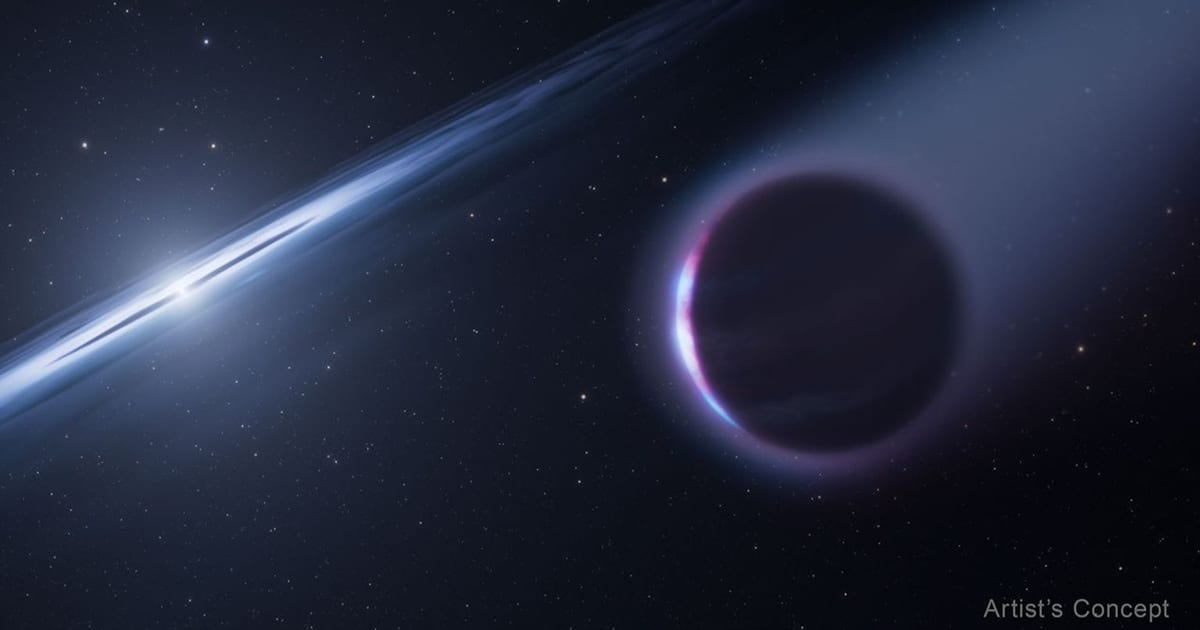
What are relativistic particles and why are astronomers so obsessed with them?
In the early 20th century, scientists realized that the universe was not a finite bubble, but an ever-expanding void where galaxies were moving away from one another. Observed through a phenomenon known as cosmological redshift—where expanding space stretches the light emitted by faraway objects towards the red end of the spectrum—this observed movement of galaxies led to a realization: if objects in the universe seem to be drifting apart from each other now, there must have been a time when they were closer together. This conceptual reconstruction of the universe's past eventually paved the way for the conception of the now-famous Big Bang theory, which informs our current understanding of the cosmos.

Around the same time, as astronomers were gleaning fresh insights from the heavens, physicists were grappling with a mystery of their own—an ever-present ionizing radiation that had been detected in Earth's atmosphere. Initially believed to be coming from radioactive elements within our planet, this was later disproven when Austrian physicist Victor Hess carried out a series of balloon flights between 1911 and 1912. Since it was assumed that this radiation was coming from Earth and emanating upwards into the atmosphere, radiation levels should have decreased with altitude. However, what Hess found was the exact opposite: radiation levels increased the higher he went. But if it wasn't radioactivity from Earth, what was causing this? Scientists suspected that the culprit was the Sun, given that it is the biggest and most energetic object in the sky. This too was disproven by Hess, who deliberately carried out a balloon flight on April 17, 1912, the date of a near-total solar eclipse over Europe. During this flight, when the Sun was almost completely blocked out by the Moon, radiation levels in the upper atmosphere remained unchanged, suggesting that there was some other actor at play.
Every second, every square meter of Earth’s atmosphere is pelted by 1000s of high-energy particles traveling at nearly the speed of light. Discover how & why we use @NASAFermi Space Telescope to study these zippy little assailants called cosmic rays: https://t.co/u3vKlwtIpe pic.twitter.com/tAUQDkUVRP
— NASA (@NASA) May 1, 2018
We now know that this ionizing radiation is caused by streams of subatomic particles from deep space, primarily protons, that collide with Earth's atmosphere at breakneck speeds. Aptly named cosmic rays, these particles travel so close to the speed of light—the cosmic speed limit—that they display behaviors that cannot be explained by classical physics. Enter relativity.
What are relativistic particles?
Albert Einstein's theory of relativity, which unified space and time into a single continuum, also posited that the faster an object moves through space, the slower it moves through time, a phenomenon known as time dilation. This applies to elementary particles as well, and any particle that's moving close to the speed of light and experiencing time dilation is referred to as a relativistic particle in physics.
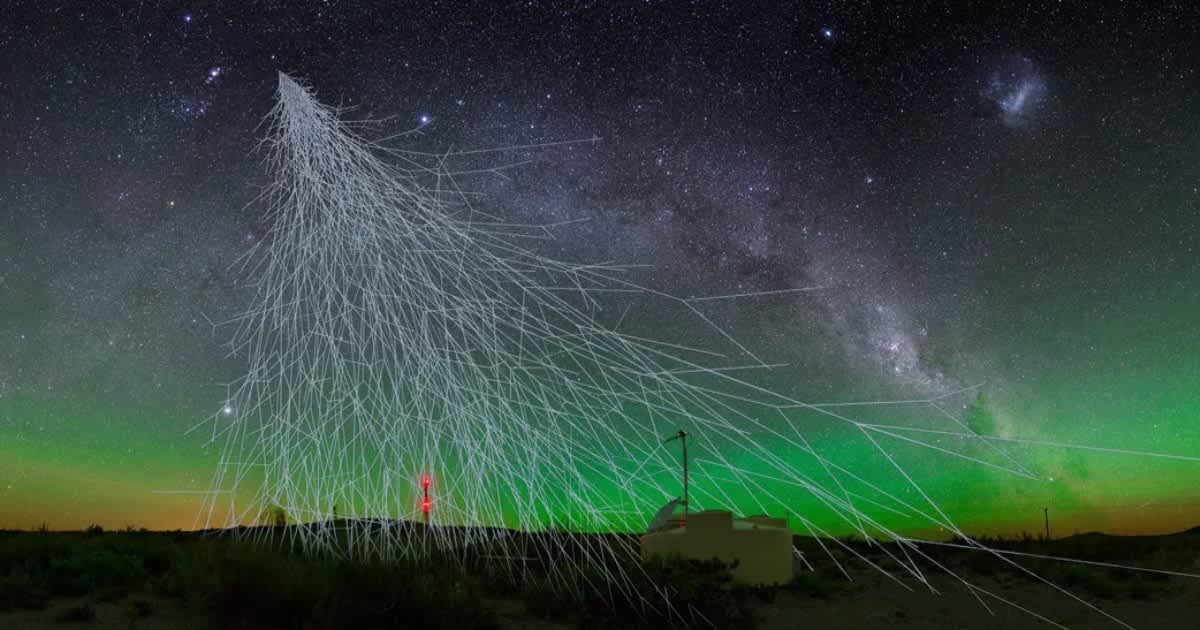
This time dilation, for instance, can be observed in the collision of cosmic rays with Earth's atmosphere. When a primary cosmic ray from deep space strikes an air molecule in the atmosphere, it shatters and creates a cascade of secondary cosmic rays. These secondary rays contain muons, which are unstable subatomic particles that last just a few microseconds, not long enough for them to reach the surface, at least under classical physics. Yet, detectors on Earth routinely detect these muons. This discrepancy is explained by relativity. Because these muons travel at near-light speeds, time dilation kicks in—from our perspective on the surface, a muon's internal clock slows down to a crawl as it travels at extreme speeds, allowing it to reach the surface before decaying.
How do relativistic particles help us understand the universe?
Since muons are born from high-energy collisions between cosmic rays and air molecules, it raises the question: what charges these cosmic rays to velocities near the speed of light in the first place? Thanks to instruments like NASA's Fermi Gamma-ray Space Telescope, we know that cosmic rays come from the remnants of supernovae. As predicted by the telescope's namesake, physicist Enrico Fermi, when massive stars die in these violent explosions, they send out magnetic shockwaves that trap charged particles and accelerate them to near-light speed before sending them across the universe.
While earlier, physicists were limited to observing these relativistic particles coming in from space, today, science has provided us with the capability to manufacture such collisions using particle accelerators like the Large Hadron Collider (LHC) at CERN. Facilities like the LHC have enabled physicists to accelerate protons to near-light speed before smashing them together, essentially creating cosmic ray collisions in a controlled environment that allows for the study of particles born from these collisions. Notably, these lab-made collisions give us glimpses into exotic and unstable matter that do not naturally exist in the relatively cold present state of the universe, but which existed billions of years back, right after the Big Bang, before the birth of stars and planets. By replicating the conditions of the early universe in this manner, particle accelerators like the LHC allow scientists to study the building blocks of the cosmos.
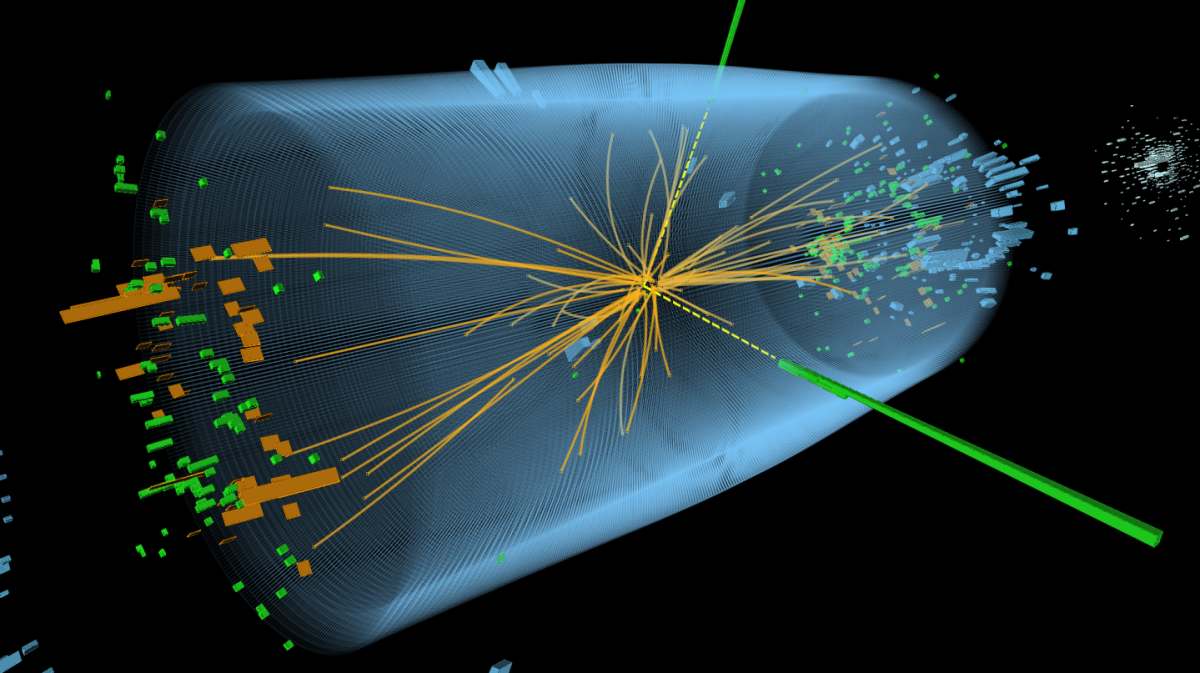
This is how, in 2012, researchers discovered the elusive Higgs boson. Often referred to as the 'God particle' in the media and popular culture, the Higgs boson is the manifestation of the Higgs field—an invisible field that grants elementary particles such as quarks and electrons their mass when these particles interact with it. As mass-bearing particles, elementary or otherwise, gain more and more speed and approach the speed of light, Einstein's theory of relativity posits that they would require more and more energy to accelerate further. In simple words, under relativity, accelerating a mass-bearing particle to the actual speed of light would require infinite energy, and the discovery of the Higgs boson proves where this very mass comes from. Well, what about light itself? Photons, interestingly, do not interact with the Higgs field, and hence have zero mass, allowing them to travel through vacuum at the cosmic speed limit.
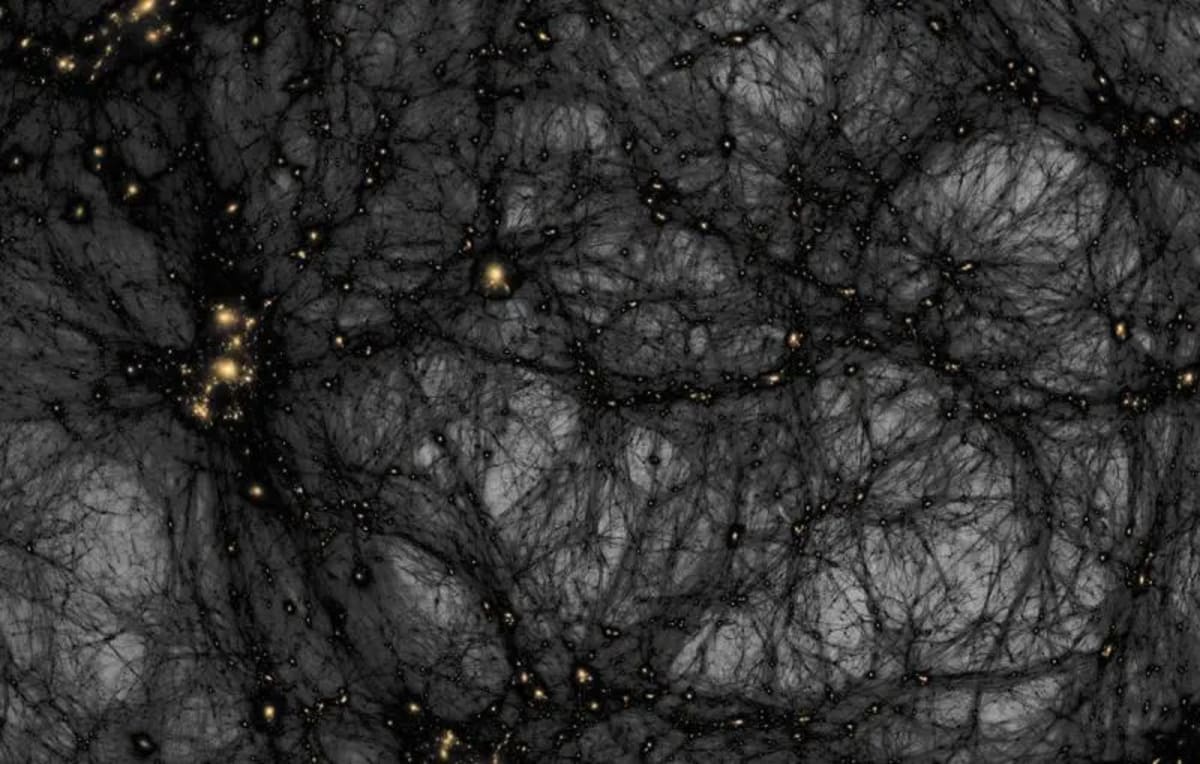
Indeed, discoveries in particle physics, like that of the Higgs boson, have advanced our understanding of the universe by leaps and bounds, but cosmic mysteries still remain. For instance, back in the early 20th century, astronomers had expected the universe's expansion to slow down due to the collective gravity of all the matter in it, but in 1998 they found out that the expansion of the universe was speeding up, something that's as yet unexplained. However, because acceleration requires some sort of force, scientists have, for now, coined the placeholder term "dark energy" to describe this hidden player. Similarly, "dark matter", the existence of which has been inferred from astronomical observations and which makes up a staggering 85% of all matter in the universe, remains invisible to us, rendering us incapable of understanding its properties. Unraveling these mysteries has now become a major focus, and experiments at the LHC and other particle accelerators are already underway to try and understand these unseen forces.
More on Starlust
Massive water tank located 600 meters below ground can help deepen understanding of ghost particles