Earth-like waves a key driver of Mars' atmospheric loss, finds new study
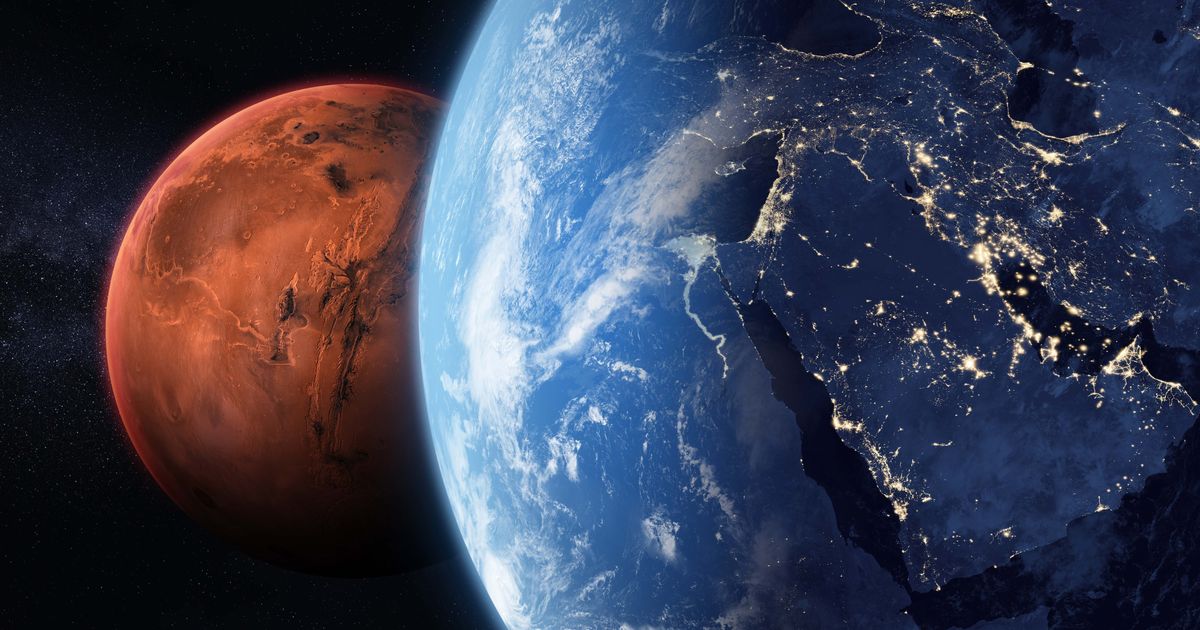
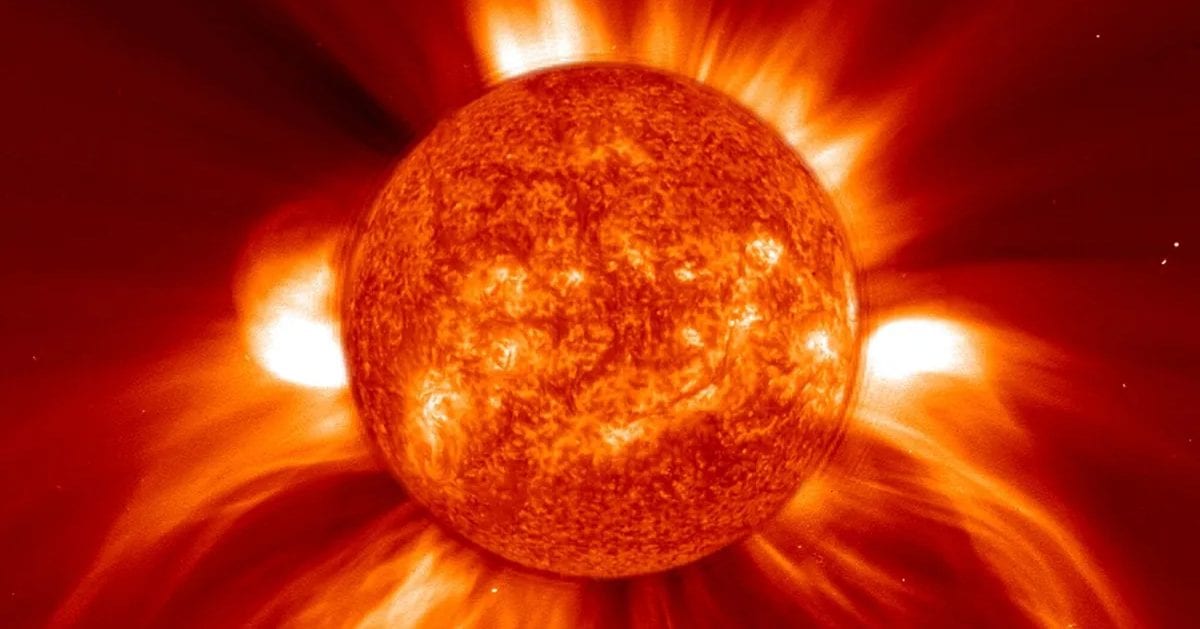
A new study, led by a team at Boston University, is offering new insights into how the Sun’s relentless solar wind—a stream of high-speed charged particles—removes Mars’ atmosphere. Since Mars is thought to have been wet and habitable once, the findings, published in Science Advances, are helping understand how it changed to the bone-dry world that we see today.
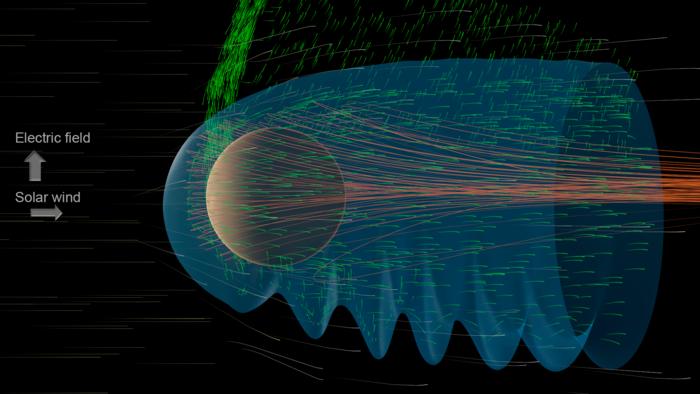
Unlike Earth, Mars lacks a strong global magnetic field, making it easier for solar wind to directly interact with Mars' upper atmosphere and strip away its particles. The researchers found that the stream of energetic particles generates large boundary waves known as Kelvin–Helmholtz waves that are akin to waves formed by wind on the water surface on Earth. The researchers made the breakthrough by analyzing the observations made by the MAVEN and Tiwanwen-1 missions. Tiwanwen-1 tracked solar wind, while MAVEN monitored loss of atmospheric ions into space near Mars. By doing this, they were able to link real-time upstream solar wind conditions to atmospheric ion escape at Mars.
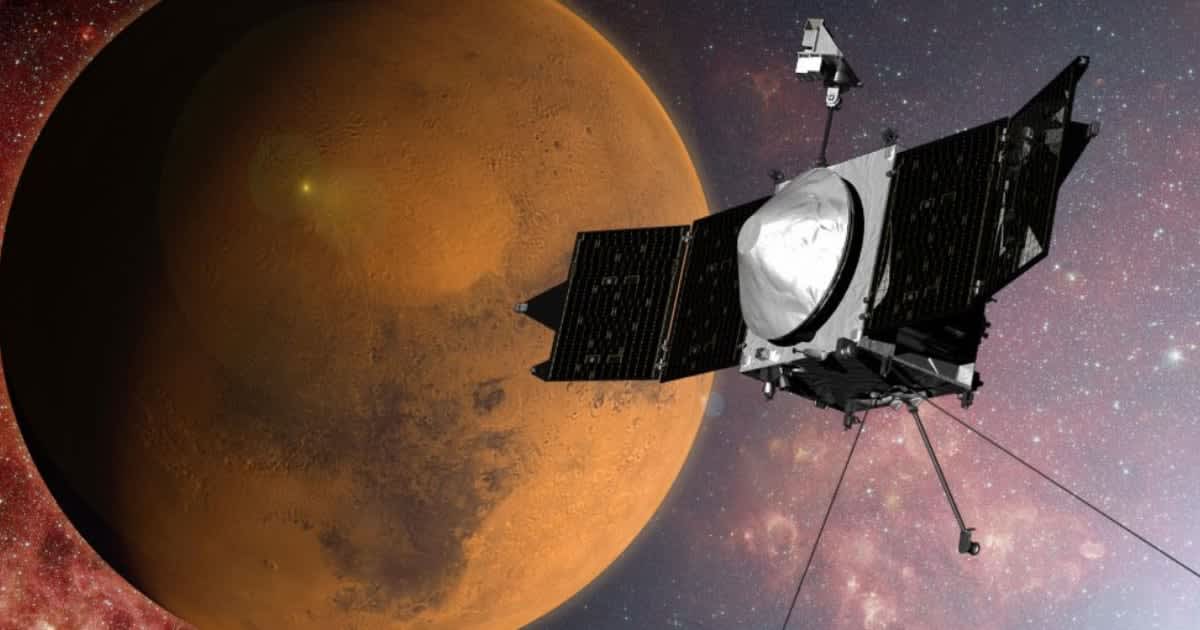
Studies have shown that large clouds of plasma in Mars’ upper atmosphere contribute significantly to ion escape. And while there are a few theories about how these clouds came to be, a lack of actual observational evidence prevented scientists from pinning down their origins. That's because connecting solar wind to atmospheric escape at the Red Planet involved making simultaneous observations of the undisturbed solar wind upstream and the escaping atmospheric ions. First author Chi Zhang and his colleagues had demonstrated in a previous study that simultaneous observations from MAVEN and Tianwen-1 could directly link the two. The new study saw the team identify Kelvin–Helmholtz waves as a key driver of the atmospheric ion escape.
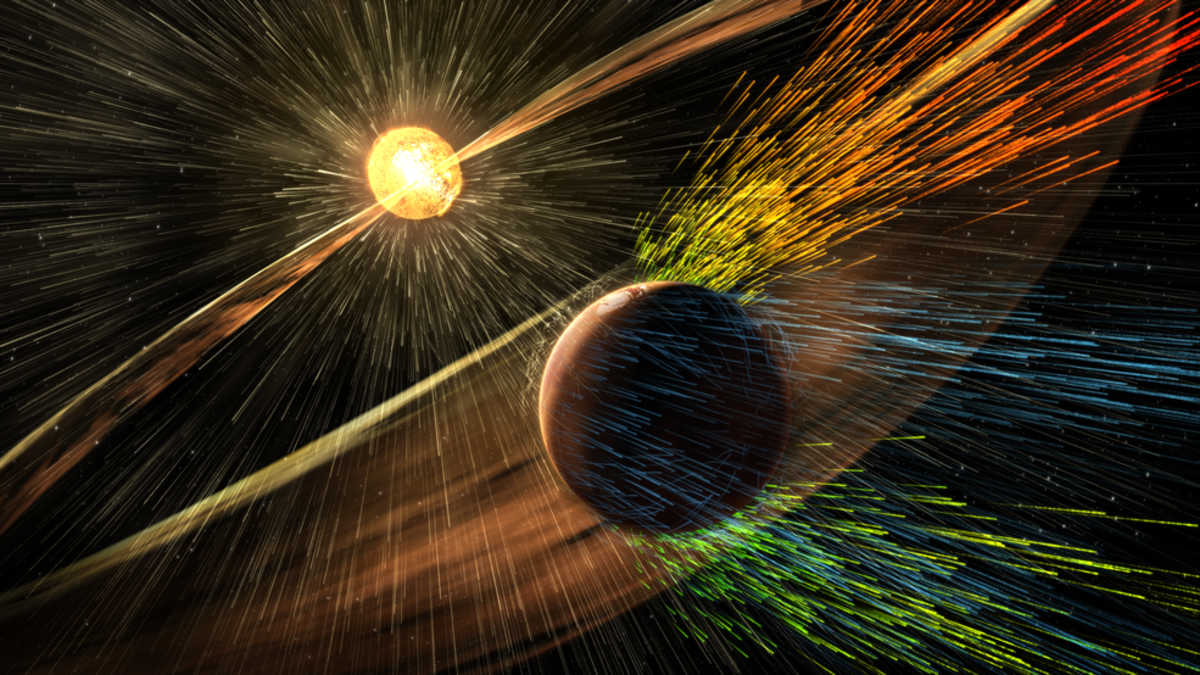
Besides proving that the Kelvin–Helmholtz waves generate plasma clouds, they found evidence that the process does not happen uniformly across the planet. “Instead, it is mainly observed on one side of the planet, depending on the direction of the solar wind electric field,” said Zhang, who is a research scientist at BU’s Center for Space Physics, a collaboration between BU's College of Arts & Sciences and College of Engineering, in a statement.
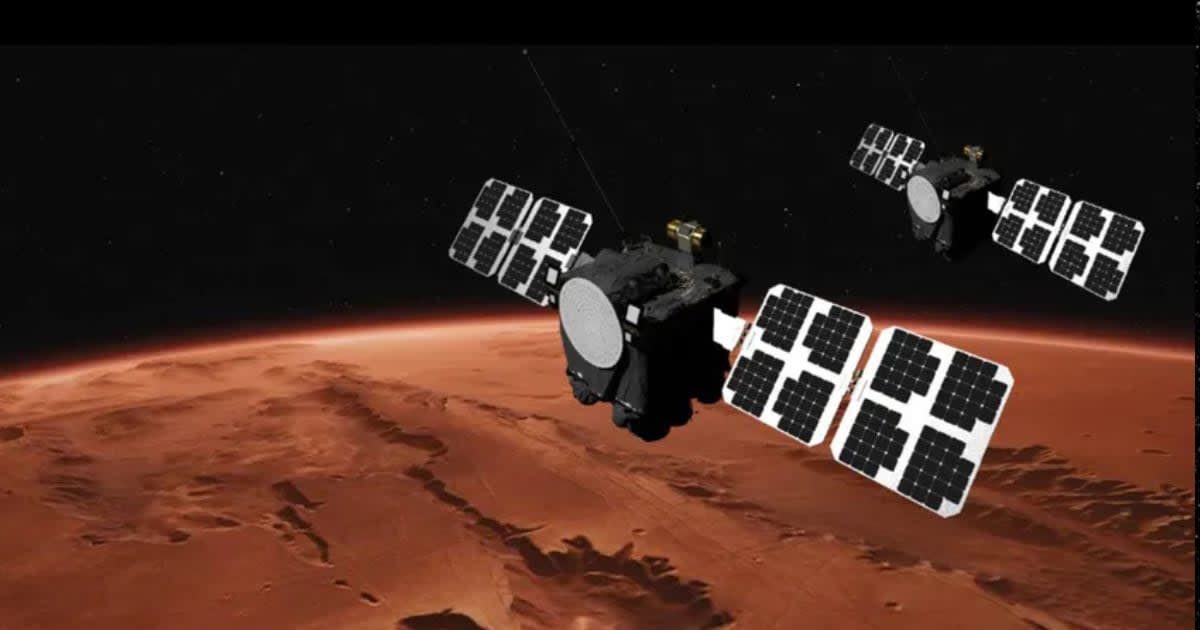
However, the researchers think that advanced numerical simulations, supported by more spacecraft observations, can help astronomers pin down the conditions conducive to the formation and growth of Kelvin-Helmholtz waves and find out their exact contribution to atmospheric escape at Mars. The MAVEN spacecraft has been declared dead, but Zhang thinks that “its rich scientific legacy will be complemented by NASA's ESCAPADE mission, which has already launched and will provide an important new opportunity to investigate solar-wind-driven atmospheric loss at Mars.” The implications of the research extend beyond Mars. “We want to know when these waves are most likely to form, how they evolve, and how strongly they can drive atmospheric escape,” said Chuanfei Dong, a BU Center for Space Physics faculty member and a College of Arts & Sciences assistant professor of astronomy. “This process could also occur on other planets that lack a strong magnetic field, including some exoplanets.”
More on Starlust
Do solar storms influence Martian weather? New study finds evidence that dust storms get affected
‘Took our breath away’: Scientists amazed as NASA's Curiosity images honeycomb-like features on Mars