Japan’s H3 rocket spotted in space after launching MMX mission to Martian Moon Phobos; watch video
Japan’s Martian Moons eXploration (MMX) mission is finally off to the Martian neighborhood in order to find the origins of the red planet’s natural satellites. The spacecraft lifted off atop an H3-24L rocket at 3:41 pm EDT on October 19 (4:41 am local time on Tuesday) at the Yoshinobu Launch Complex of the Tanegashima Space Center, kickstarting its 10-month journey to Mars. MMX aims to collect samples from Mars’ moon Phobos and complete a round-trip to Earth—something which has never been done before.
What a moment! #MMX has launched from Tanegashima🚀 A proud milestone for 🇺🇸🇯🇵 cooperation in planetary exploration 💫 Humanity’s next leap in discovery begins now. 🌍🚀 #NASA #JAXA #MarsExploration @usembassytokyo https://t.co/wgkiJMJJrF
— 在福岡米国領事館 (@USConsFukuoka) October 19, 2026
"The launch was spectacular, and JAXA's H3 launcher performed fantastically to send MMX onward to Mars,” Elliot Sefton-Nash, ESA Project Scientist for MMX, said in a statement. “The team are celebrating, and now even more motivated to prepare for arrival at Mars next summer to start investigating its moons Phobos and Deimos up close.” The European Space Agency (ESA) is one of the key collaborators in this mission, along with the German, American, and French space agencies.
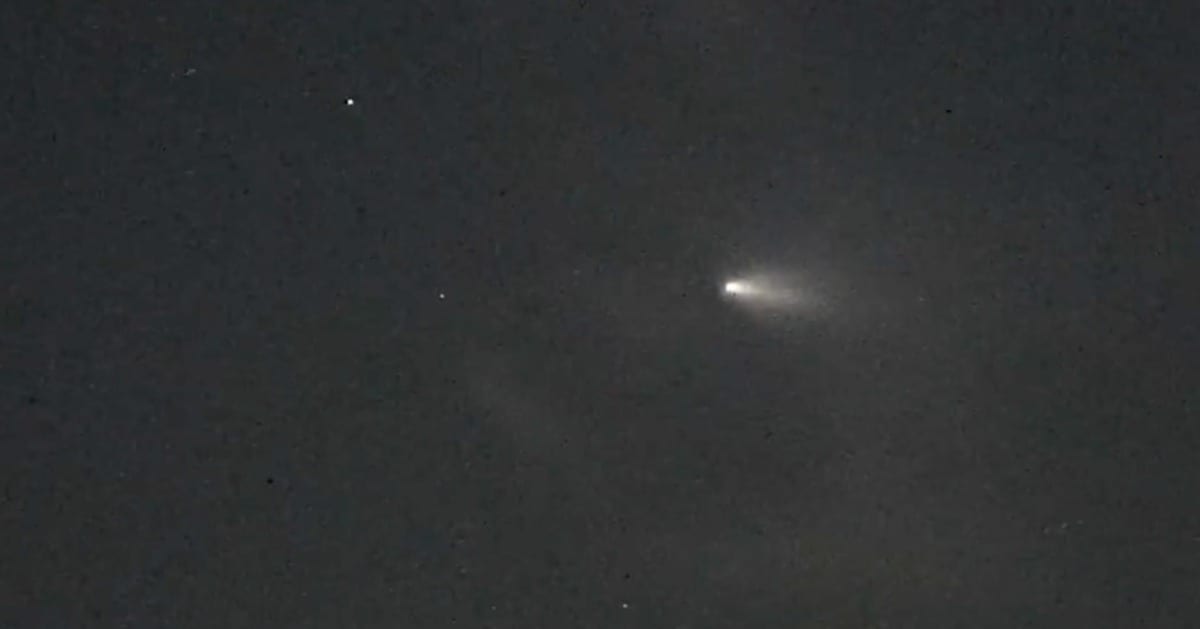
火星衛星探査機「MMX」打ち上げ成功、おめでとうございます。 平塚の自宅から撮影した打ち上げの様子を8倍速にした動画です。 左側の離れていく点が1段目、右側のクラゲのような光が2段目です。 噴煙が少しずつ形を変えていく様子がよく分かります。 https://t.co/6JXiJ4WbC2
— 藤井大地 (@dfuji1) October 19, 2026
Shortly after the launch, the H3 rocket was captured by Japanese astronomer Daichi Fujii via a telescope. Taking to X, Fujii shared a video of the spacecraft and the second stage post-separation in low Earth orbit. “Congratulations on the successful launch of the Mars moon exploration probe 'MMX'. This is an 8x speed video of the launch, filmed from my home in Hiratsuka,” Fujii posted on X. “The point moving away on the left is the [payload], and the jellyfish-like light on the right is the second stage. You can clearly see how the exhaust plume gradually changes shape.” In a statement, the Japan Aerospace Exploration Agency (JAXA) said that the rocket flew exactly as planned, and the MMX spacecraft separated from the second stage approximately 71 minutes and 13 seconds after liftoff. It was then injected into its predetermined orbit.
The MMX spacecraft—which is 17.4 feet tall and 29.5 feet wide with its solar panels deployed—is expected to reach Mars in August 2027. It features a lander that will touch down on Phobos and a 25-kg rover, ‘Idefix’, that will be deployed on the moon’s surface before the lander’s touchdown. According to JAXA, the rover deployment is slated for early 2029, followed by the landing later that year. Once the lander is on Phobos, it will collect at least 10 grams of samples using two sampling tools and seal them in a canister that will be sent to Earth in a return capsule. The capsule will be retrieved from Australia, where it will land in 2031.
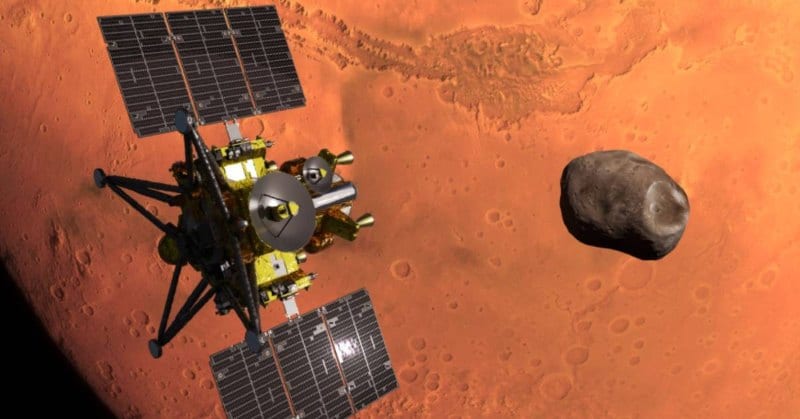
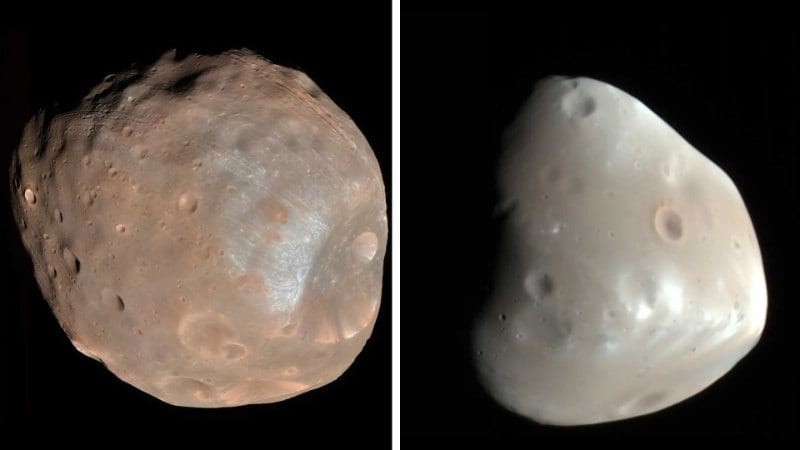
The mission objective is to bring the samples back and analyze them in laboratories to find the origins of Phobos as well as the second Martian moon, Deimos. Current theories suggest that the two moons might be asteroids caught by Mars or a result of a massive collision between the red planet and another object. MMX will help confirm which theory is true, or whether there’s another explanation. Using a suite of 11 instruments, the rover and lander will together gather data on topography, mineral composition, chemical composition, and radiation, and take high-resolution pictures of Phobos. On the final leg of its mission, the spacecraft will also study Mars and Deimos when it flies past them on the way to Earth.
More on Starlust
European Space Agency to build OASIS, a service station to support future missions on the Moon
NASA completes booster stacking of SLS rocket for Artemis III—here’s what’s next for the mission