Uranus and Neptune may be more rocky than icy, new study reveals
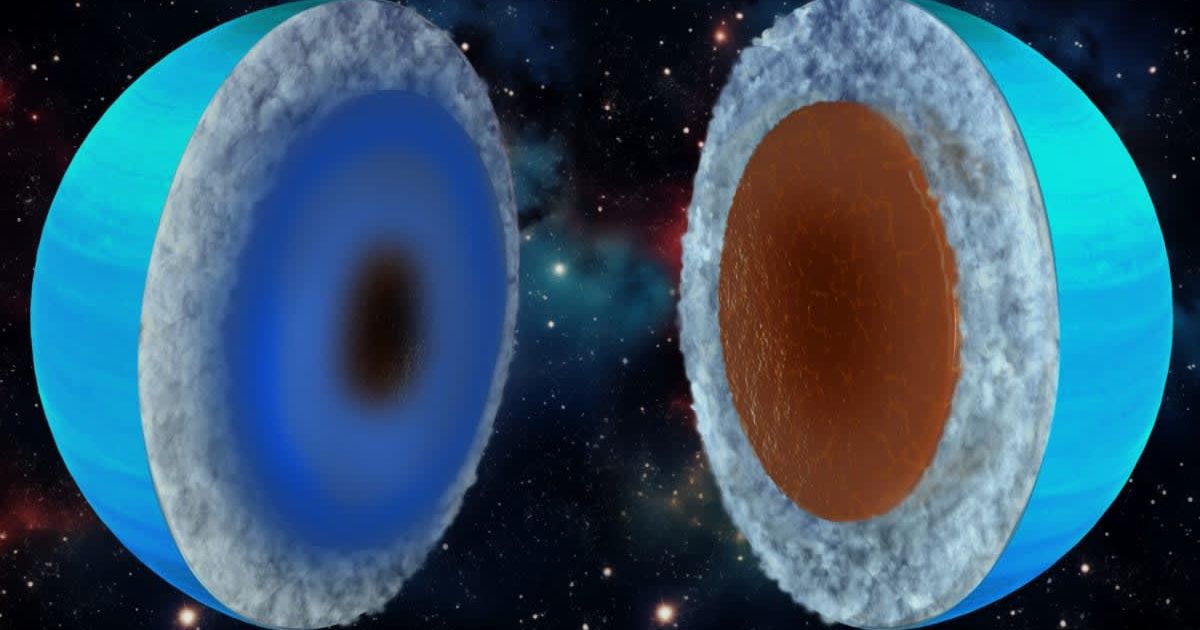
'The ice giant classification is oversimplified as Uranus and Neptune are still poorly understood,' said experts.
Uranus could be an ice giant (left) or a rock giant (right), depending on the model assumptions, researchers say. (Cover Image Source: Keck Institute for Space Studies/JPL/California Institute of Technology/National Aeronautics and Space Administration)

Researchers from the University of Zurich and the NCCR PlanetS are challenging what we know about the planets of our solar system by suggesting that Uranus and Neptune may be more rocky than icy. While their study, published in the journal Astronomy & Astrophysics (A&A), does not confirm that the planets are one or the other, it challenges the idea that they are ice-rich alone. This aligns with the discovery that Pluto, the dwarf planet, is predominantly rocky.

Diagram showing the theoretical interior of the ice giant planet Uranus. (Representative Image Source: Getty Images | Photo by MARK GARLICK / SCIENCE PHOTO LIBRARY)

“The ice giant classification is oversimplified as Uranus and Neptune are still poorly understood,” said Luca Morf, PhD student at the University of Zurich and the lead author of the study, per UZH News. “Models based on physics were too assumption-heavy, while empirical models are too simplistic.” So the team combined both methods to develop unbiased, yet physically consistent models.

Diagram showing the theoretical interior of the ice giant planet Neptune. (Representative Image Source: Getty Images | Photo by MARK GARLICK / SCIENCE PHOTO LIBRARY)

To this end, they randomly assigned a density profile for the planetary interior, after which they calculated the planetary gravitational field, which aligned with the observational data. Once a possible composition was inferred, the process was then repeated to acquire the best match between the observational data and models. Their model revealed that the potential interior composition of the planets is not limited to ice. “It is something that we first suggested nearly 15 years ago, and now we have the numerical framework to demonstrate it,” stated Ravit Helled, a professor at the University of Zurich.

Illustration of the magnetic fields of Solar System planets such as Uranus and Neptune.  (Representative Image Source: Getty Images | Photo by SiberianArt)
Illustration of the magnetic fields of Solar System planets such as Uranus and Neptune. (Representative Image Source: Getty Images | Photo by SiberianArt)

The model’s new range of internal composition reveals that both planets are capable of being either water-rich or rock-rich. The results can also be an addition to the perspectives on the magnetic fields of Uranus and Neptune. They are unique, as compared to the North and South magnetic poles of Earth. These planets have more complex fields with more than two poles. “Our models have so-called 'ionic water' layers which generate magnetic dynamos in locations that explain the observed non-dipolar magnetic fields,” explained Helled. The study also observed Uranus’ magnetic field to originate much deeper compared to Neptune. 

This zoomed-in image of Uranus, captured by Webb’s NIRCam on Feb. 6, 2023, reveals stunning views of the planet’s rings. (Image Source: NASA | Photo by NASA, ESA, CSA)
This zoomed-in image of Uranus, captured by Webb’s NIRCam on Feb. 6, 2023, reveals stunning views of the planet’s rings. (Representative Image Source: NASA | Photo by NASA, ESA, CSA)

Much like a lot of studies, the results, though promising, are prone to certain uncertainties. The primary reason is that the physicists are not entirely clear on how materials behave under the pressure and temperature found at the planet’s core. Despite the limitations, the results also open the doors to considering the possibility of a new potential interior composition. This challenges the age-old theories on the giants, thereby aiding future research on planetary conditions.

3D rendering of the planet Neptune in space with the sunlight casting light on its blue surface as it appears from behind the planet. (Representative Photo by suman bhaumik / Getty Images)
3D rendering of the planet Neptune in space with the sunlight casting light on its blue surface as it appears from behind the planet. (Representative Image Source: Getty Images | Photo by Suman Bhaumik)

Morf expressed his plans to expand the models in the future to address the uncertainties that exist. Helled also expressed how, depending on the assumptions made by the model, both Uranus and Neptune can be rock giants or ice giants. “Current data are currently insufficient to distinguish the two, and we therefore need dedicated missions to Uranus and Neptune that can reveal their true nature,” Helled explained. 

More on Starlust

39-year-old mystery about Uranus may have been solved by revisiting Voyager 2 data

NASA’s James Webb captures Neptune’s extraordinary auroras for the first time
MORE STORIES

The study used molecular physics to map unseen interactions, narrowing the search for dark matter.
13 hours ago
3I/ATLAS is now exiting our solar system at more than 137,000 miles per hour.
18 hours ago
The files raise intrigue but stop short of confirming the existence of extraterrestrial life.
19 hours ago
A new study, published in the journal Physical Review Letters, suggests that some of the highest-energy cosmic rays could contain atomic nuclei heavier than iron.
1 day ago
Knowledge of oxygen abundance may shed light on the evolutionary history of the Sun and other stars.
1 day ago
Growing levels of light pollution due to satellites is obscuring our view of the universe.
4 days ago
The Moon can fill a critical frequency gap that remains out of reach for both ground and space-based observatories.
4 days ago
"This observation is expected to be key for planning sustainable space operations in the future."
5 days ago
Ice is key for long-term survival on the Moon and this pushes us closer to realizing a lunar base.
6 days ago
JSWT's direct observation of LHS 3844 b's surface is a massive stepping stone for exoplanet geology.
6 days ago