NASA’s James Webb captures Neptune’s extraordinary auroras for the first time

Neptune’s auroras are no longer a speculation, as the beautiful sight on the planet was officially captured by James Webb.
Neptune in space. The large dark oval near the western limb is at a latitude of 22 degrees south, and the bright clouds change their appearances in short four hours. (Photo by NASA/JPL/Michael Benson via Getty Images)

The auroras on Earth are an incredible sight, and people often go to places in the Arctic in search of the experience of this wonder. Space enthusiasts often wonder what this dynamic display of natural light may look like on other planets, if it happens there. And now, they have an answer. NASA's James Webb Space Telescope observed the first-ever image of auroras on Neptune. The bright auroral activity was seen on the upper atmosphere of the planet, and experts were in awe of its details. Earlier flyby missions hinted at the possibility of auroras on Neptune, but this is conclusive evidence that the event is a reality.

The bright array of lights called Aurora borealis or Northern lights shines in the Iceland sky as the photo is captured from beneath it. (Representative Photo by Arctic-Images / Getty Images)

Auroras result when the energetic particles originating from the Sun get trapped in a planet’s magnetic field and start striking the upper atmosphere. These collisions release energy that creates the signature array of lights. Despite NASA’s Voyager 2 flyby in 1989 and confirmed detections on Jupiter, Saturn, and Uranus, imaging and confirming the auroras on Neptune never occurred. “Turns out, actually imaging the auroral activity on Neptune was only possible with Webb’s near-infrared sensitivity,” said Henrik Melin of Northumbria University, who conducted the study about the auroras on Neptune.  

Engineers and technicians assemble the James Webb Space Telescope November 2, 2016 at NASA's Goddard Space Flight Center in Greenbelt, Maryland. (Photo by Alex Wong/Getty Images)
Engineers and technicians assemble the James Webb Space Telescope November 2, 2016, at NASA's Goddard Space Flight Center in Greenbelt, Maryland. (Photo by Alex Wong/Getty Images)

“It was so stunning to not just see the auroras, but the detail and clarity of the signature really shocked me,” Melin added. Neptune was the last piece of the puzzle that evaded the detection of auroras on the giant planets of our solar system. The data was collected in June 2023 from Webb’s Near-Infrared Spectrograph. Along with the image of the planet, astronomers found a spectrum to lay out the composition and measure the temperature of the planet’s upper atmosphere. They observed an important and vivid emission line indicating the chances of auroras.

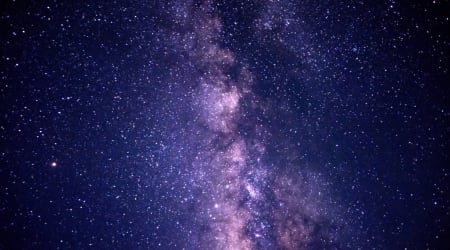
A Cloud with Nebula and Stars During the Dark Blue Night reveals colorful cosmos that resemble a Star field with Milky Way (Representative Photo by Annandistock / Getty Images)

The presence of H3+, a molecule formed during auroras, amplified the vivid emission line. The signature glow of H3+ revealed itself as cyan-colored splotches in the Neptune images captured, as per Earth.com. “H3+ has a been a clear signifier on all the gas giants: Jupiter, Saturn, and Uranus, of auroral activity, and we expected to see the same on Neptune as we investigated the planet over the years with the best ground-based facilities available,” stated Heidi Hammel, the Webb interdisciplinary scientist at the Association of Universities for Research in Astronomy.

Engineering teams at NASAs James Webb Space Telescope Mission Operations Center at the Space Telescope Science Institute in Baltimore monitor progress as the observatory's second primary mirror wing rotates into position, on January 8, 2022 in Baltimore, Maryland. (Photo by Bill Ingalls/NASA via Getty Images)
Engineering teams at NASAs James Webb Space Telescope Mission Operations Center monitor progress as the observatory's second primary mirror wing rotates into position on January 8, 2022, in Baltimore, Maryland. (Photo by Bill Ingalls/NASA via Getty Images)

Only with a machine like the James Webb could astronomers finally confirm the molecular presence. Neptune’s auroral activity is evidently different from what is typically seen on Earth or even the other planets where it has been observed earlier. The aurora is not confined to the north and south poles of the planet but is situated at its geographic mid-latitudes. This can be compared to where South America is located on Earth. This is caused by the unique magnetic field of Neptune, which is tilted by 47 degrees from the planet’s rotation axis, as observed by Voyager 2 in 1989.

Digital Illustration of Planet Neptune that captures the vivid details observed from NASA'S Voyager flyby image in space. (Representative Photo by 3quarks / Getty Images)

The data from Webb also showed that Neptune’s upper atmosphere had cooled down immensely since 1989. “I was astonished! Neptune’s upper atmosphere has cooled by several hundreds of degrees. In fact, the temperature in 2023 was just over half of that in 1989,” Melin commented. This explains why Neptune’s bright aurora lights escaped detection for decades as colder temperatures weakened the brightness of auroras. 
MORE STORIES

A new study led by a recent graduate of the University of Arkansas suggests that 3D printing tools might be possible on the Red Planet.
1 day ago
The technological payloads represent some of the latest advancements in the fields of space technology and biotechnology.
1 day ago
“The wheels mimic the animal’s characteristic interaction with the ground, generating both longitudinal and lateral forces."
2 days ago
The imaging was done using an instrument that also found changing composition of the comet.
4 days ago
The rover ventured farther west than it had ever been since landing at the Jezero Crater in 2021.
7 days ago
When used in future space missions, it could process huge amounts of data directly in space instead of taking most of the help from Earth.
May 13, 2026
Called Solar Neutrino Astro-Particle PhYsics CubeSat (SNAPPY), the project launched on May 3, 2026, atop a SpaceX Falcon 9 rocket.
May 8, 2026
The STORIE instrument will be installed on the exterior of the International Space Station, from where it will measure the speed and direction of energetic neutral atoms in the ring current.
May 8, 2026
The new technology, called LESTR, mimics cold temperatures without the use of cryogenic liquids.
May 7, 2026
Part of ESA’s Copernicus program, the constellation allows all-weather, day-night monitoring.
May 5, 2026