Scientists discover 'water ice' around a young star, hinting at how our solar system was formed

The search for water in the universe is something that is seemingly set to go on for several hundred years from now. Water is one of the most interesting assets when it comes to the cosmos, as not only does it support life, but it might have also helped give birth to planetary bodies. Now, scientists have discovered the presence of 'water ice' around a young star, HD 181327, which holds a close resemblance to our Sun, as reported in Daily Galaxy on June 3.

The reason why this is so intriguing is that it could give scientists an insight into how our own solar system came into existence. There have been theories positing that water was present in the early stages of our solar system’s formation, and this discovery could provide new avenues for investigation. The water was found as crystalline water ice around the star HD 181327, about 155 light years away. The discovery was made through the James Webb Space Telescope (JWST).
For the first time, @NASAWebb has identified frozen water in a planet-forming disk around a young star. This icy discovery could help explain how water makes its way to planets like ours.
— NASA 360 (@NASA360) May 17, 2025
Learn more: https://t.co/dSGcMwFqZg pic.twitter.com/DEiFPPpRfD
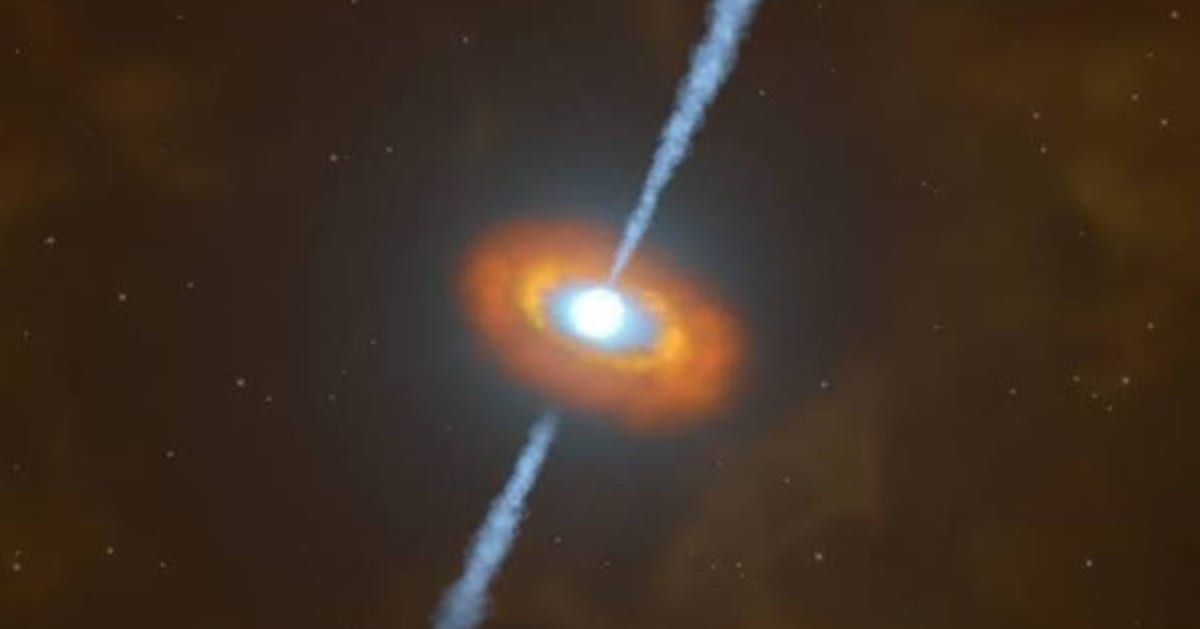
The star is 23 million years old, way younger than our sun, which has been in existence for 4.6 billion years. Before all the planets were formed, our sun was surrounded by what is called a protoplanetary debris disk. It is a ring of dust, rocks, and ice that has not yet banded together to form planets. HD 181327 currently has a disk around it, and that’s where all the water ice is.

This kind of water ice bears a resemblance to what scientists have found in the rings of Saturn and "icy bodies" located in the Kuiper Belt. Scientists used the James Webb Space Telescope’s near-infrared spectrograph (NIRSpec) to identify the presence of crystalline water ice in the rings of debris around the young star. “Icy materials may also ultimately be ‘delivered’ to terrestrial planets that may form over a couple of hundred million years in systems like this,” the study’s lead author, Chen Xie, noted.

However, this crystalline water ice is mainly concentrated in the outer reaches of the debris ring surrounding the star. That’s where it comprises 20% of all the debris floating around. If we move closer to the star, this percentage drops drastically. Towards the inner side of the ring, water ice comprises only 8% of the debris, and that drops to zero as we go further towards the center of the star.
UV radiation from the young star could be one of the reasons why this is the case, as that would instantly vaporize any ice in its vicinity. Another theory is that water in these areas might be trapped inside rocks or planetesimals. What’s more interesting about this debris belt is that it isn’t dormant in the slightest. Collisions between rocks and icy bodies are common, which is also similar to the Kuiper Belt.
While the star may be surrounded by giant rings of rocks, dust, and ice, its immediate surroundings are clear. There is a big gap between it and its ring. This discovery could go a long way in giving scientists information about how our sun looked when it was younger and how all the planets around it came to be.