Source of gravitational waves from a black hole merger weighing 230 suns may have been an illusion
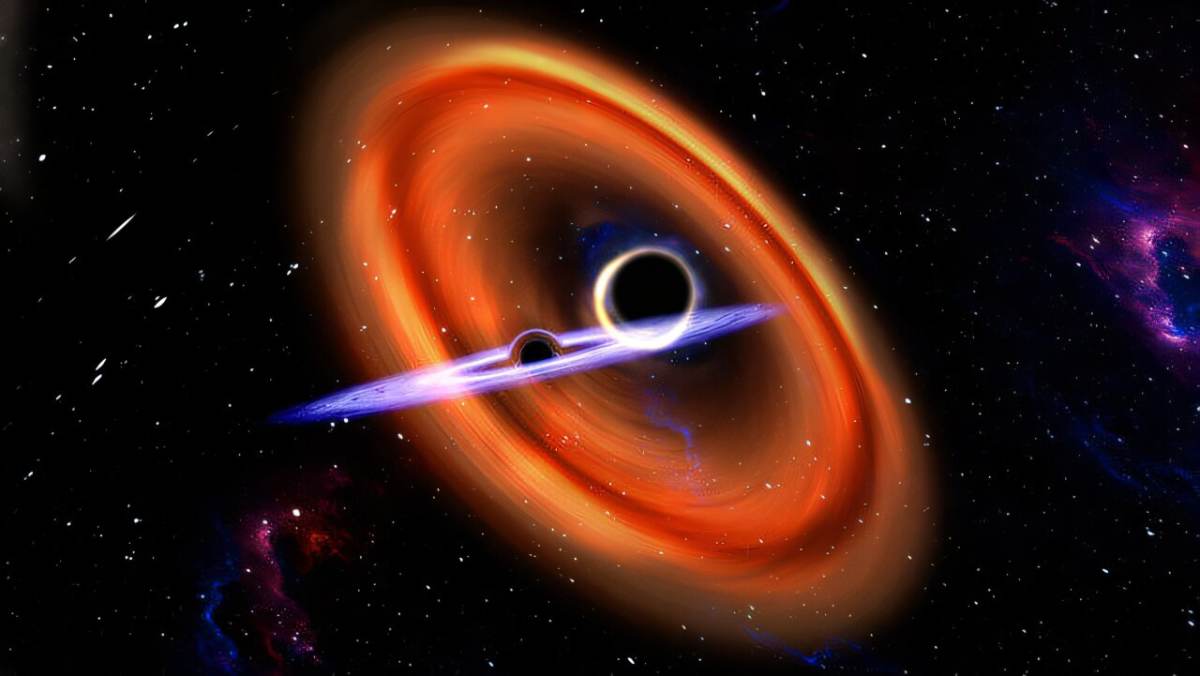
Scientists have come up with an explanation for why a particular source of gravitational waves was as atypical as it was—so much so that it could not be explained using existing models—and think that what we observed could have been a cosmic illusion. The gravitational waves, which had been detected by two installations that make up the Laser Interferometer Gravitational-Wave Observatory (LIGO) back in November 2023, are known to have originated from an extreme black hole merger. The gravitational wave signal picked up by observatories on Earth has been designated as GW231123, and pointed to a source with the largest combined mass of two black holes that were merging with one another.
What is a gravitational wave?
Ever since Einstein released his landmark set of papers about general relativity in 1915, scientists have come to understand the universe as an expansive fabric that is made up of time as much as space. All cosmic bodies are thought to be embedded in this fabric of space and time and move due to gravity, which is really objects following the curves of the fabric rather than being attracted by an invisible pulling force. These curvatures are created by anything with mass, with heavier bodies having a larger effect. When violent occurrences like supernovae or a heavy system like a binary black hole or a neutron star merger take place, ripples can be sent across this space-time continuum—much like how dropping an object in water can create waves on its surface. Since a merging pair of black holes follows a spiraling orbital motion as they fall into one another, gravitational waves of increasing frequency are emitted. By studying the nature of these waves detected by observatories like LIGO, scientists can tell what their source is and where it is located. That said, the latter is a very painstaking process that doesn't produce absolute figures.

What did signal GW231123 show?
Captured by the two LIGO detectors (and subsequently analyzed as part of the wider LIGO-Virgo-KAGRA collaboration), the signal GW231123 appeared to come from a source that had a combined mass of about 230 times that of the Sun. Individually, each of the two black holes in the binary system appeared to have 101 and 137 solar masses, respectively. What's more, the gravitational wave signal suggested that the spins of the black holes were uncharacteristically extreme—rotating at 80% and 90% of the theoretical limit for angular velocity.
On 14 July 2025, the LIGO-Virgo-KAGRA (LVK) collaboration announced to have detected GW231123, a gravitational wave signal generated by the merger of the two most massive black holes ever observed.
— Nereide (@Nereide) July 15, 2025
With masses of approximately 100 and 140 times that of the Sun, these cosmic… pic.twitter.com/ah9ONxYNTV
Why was this signal extraordinary?
At the time, the aforementioned metrics of the source made the black hole binary system the most massive ever detected, which attracted plenty of intrigue worldwide. On the other hand, a consensus between what are known as waveform models could not be reached due to the extreme characteristics of the black holes in the system. This forced researchers to employ a number of different explanations as to what could be causing the extreme spins of the black hole pair, as well as how they could be as massive as they were. Nelson Christensen, who is an astronomer at the Côte d’Azur Observatory, stated, "This is the event that just keeps giving." The reason for the tension between all of the existing research on the source of GW231123 was that the black hole masses being indicated should not even exist. This is because stars with certain masses leave nothing behind after they die. Instead of collapsing into a black hole, they obliterate themselves entirely in what is known as a pair-instability supernova. Because of this, black holes with masses between roughly 65 and 130 times that of the Sun should not exist—a forbidden "mass gap" into which the 101-solar-mass black hole fell squarely.
Why is the latest research important?
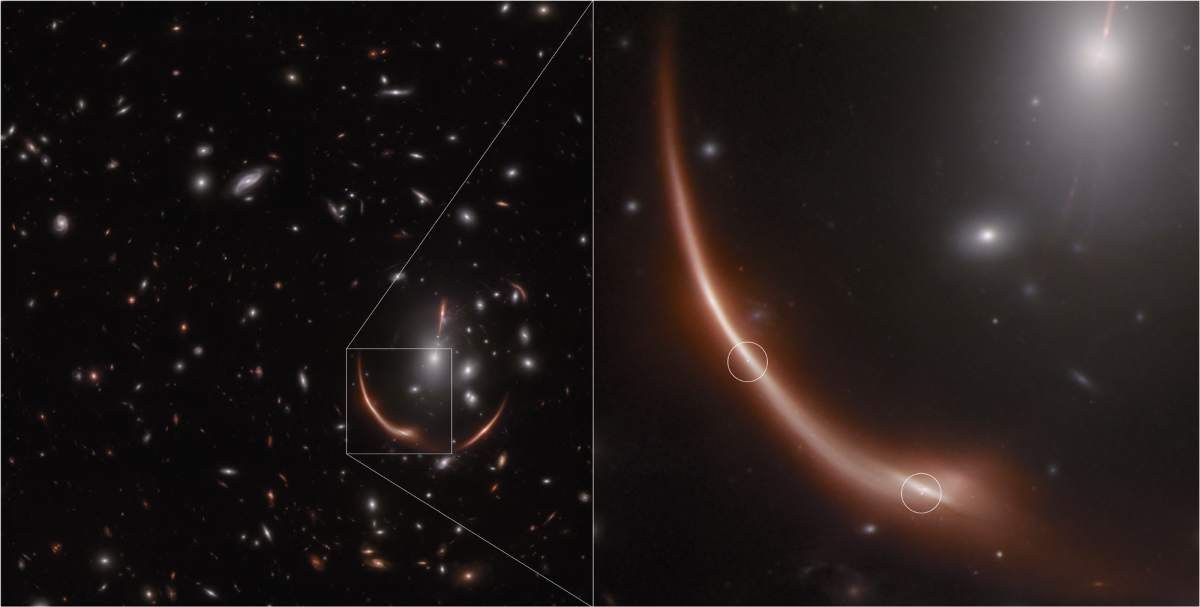
The research paper, which was published in late August in The Astrophysical Journal Letters, described a phenomenon similar to gravitational lensing, where light from distant sources can bend around objects directly between it and our perspective. While light is an electromagnetic wave, the study points to a similar effect that also happens with gravitational waves, which can distort the signals. Srashti Goyal, who led the research at the Max Planck Institute for Gravitational Physics, found that the combined mass of the binary black hole merger could actually be around 140 solar masses, rather than 230, and that the spins of each black hole could be much slower as well. The reason for the original mass calculation could be a phenomenon where a larger cosmic object, such as a galaxy with a black hole inside it, could work in combination as a larger lens with an embedded 'microlens' and produce the illusion, with Goyal attesting to the model's strong statistical fit, though acknowledging it is not yet absolute. "It turns out lensing is a better fit", said Goyal, which was seconded by Iuliu Cuceu of the Côte d’Azur Observatory, who stated, "This probably is the best explanation of the data we have". Talking about how difficult it is to be absolutely sure about the findings, Cuceu added, "This event is so exceptional that we do not know what is normal".
More on Starlust
Astronomers confirm first 'black hole star,' explaining Little Red Dots seen by James Webb Telescope