Scientists may have finally found where stars stop forming in the Milky Way's disc
The Milky Way’s star-forming disc has no sharp boundary. It just fades away at its outer edges. The bulk of our galaxy’s stars are born within 40,000 light-years of the galactic center, according to a new study by an international team of astronomers. They homed in on the edge of the Milky Way’s star-forming disc by analyzing the ages of bright, giant stars and simulating galaxy evolution. The findings are published in the journal Astronomy & Astrophysics. This helped them find a “U-shaped” pattern in the distribution of the ages of stars. “The extent of the Milky Way’s star-forming disc has long been an open question in Galactic archaeology; by mapping how stellar ages change across the disc, we now have a clear, quantitative answer”, said lead author Dr Karl Fiteni, now based at the University of Insubria, in a statement.
Stars don’t form uniformly across the discs of galaxies. Instead, they form closer to the galactic center and then move outward. Star formation began at the heart of galaxies and gradually they started to pop up in an outward direction over billions of years. This is a process called “inside-out” growth. Such growth patterns also hint at their age. On average, stars that are further away from the center are younger than those near the center. The outer disc is the place where star formation has only recently reached. The new study uncovered that in the Milky Way, the average age of stars decreases away from the center. In an inside-out growth pattern, this happens. At around 35,000 to 40,000 light-years away from the Galactic Centre, the trend changes; stars start getting older again with increasing distance. This leads to the formation of a “U-shaped” age profile.
The team then compared this pattern with galaxy simulations. They found that the age minimum marks a sharp drop in star formation efficiency. With it comes the solid evidence that it is the true boundary of the Milky Way's star-forming disc. “The data now available allow increasingly precise stellar ages to serve as powerful tools for decoding the story of the Milky Way, ushering in a new era of discovery about our home Galaxy", commented Prof. Joseph Caruana, co-author and supervisor of the project based at the University of Malta. The sharp drop in star formation at this boundary also raises a question. Why are there stars beyond this region if their birthrate drops? Astronomers found the answer in a process called "radial migration."
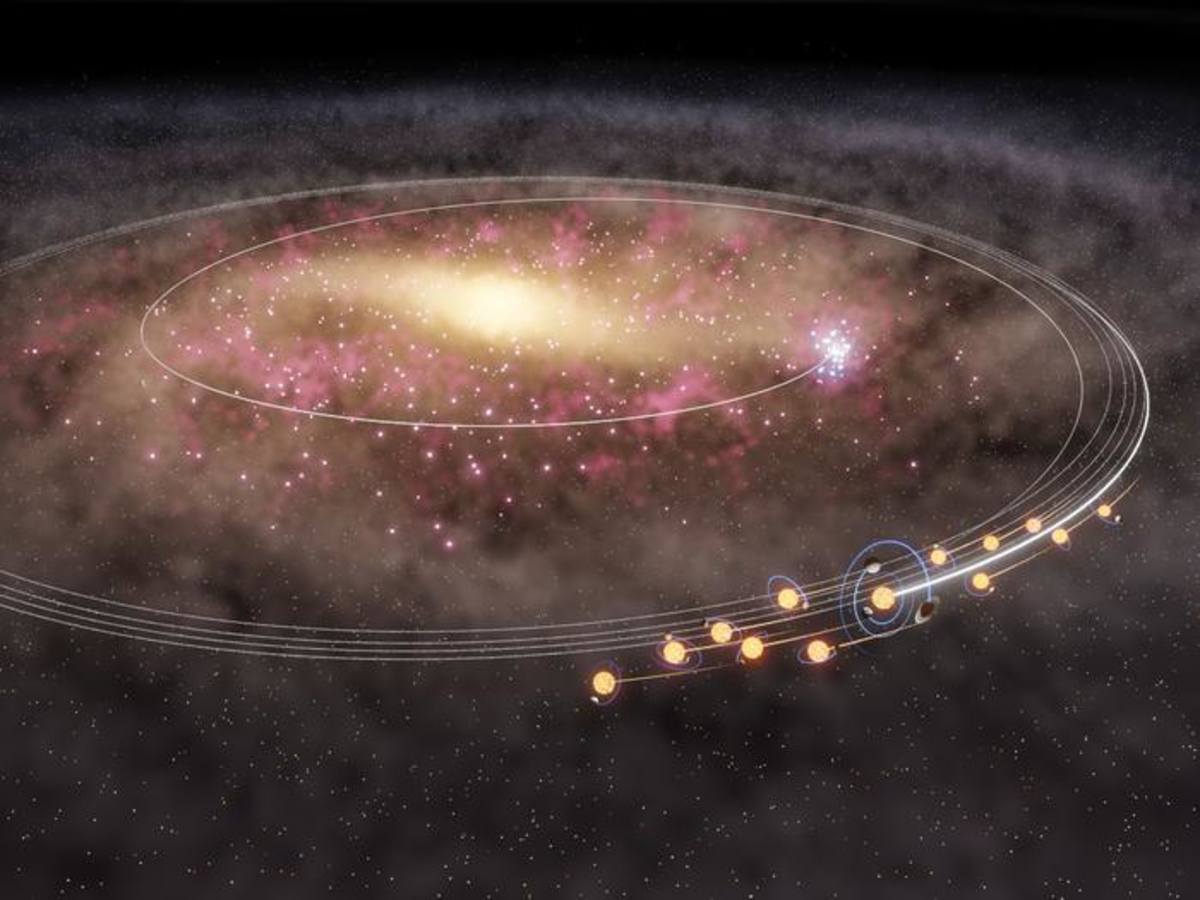
In such migration, stars gradually drift away from their birthplaces. A recent study that bolsters this theory also shows that the Sun and sun-like stars left their birthplaces at the core regions of our galaxy between 4 and 6 billion years ago. But, how do they migrate? Like ocean surfers who catch waves that carry them toward shore, stars ride on spiral waves that sweep through the galaxy, causing them to speed away from their birthplaces. However, such migration is a random process. Stars catch different spiral waves at different times, making them end up beyond the radius of star formation. This creates the observed pattern, displaying older stars beyond the younger ones.
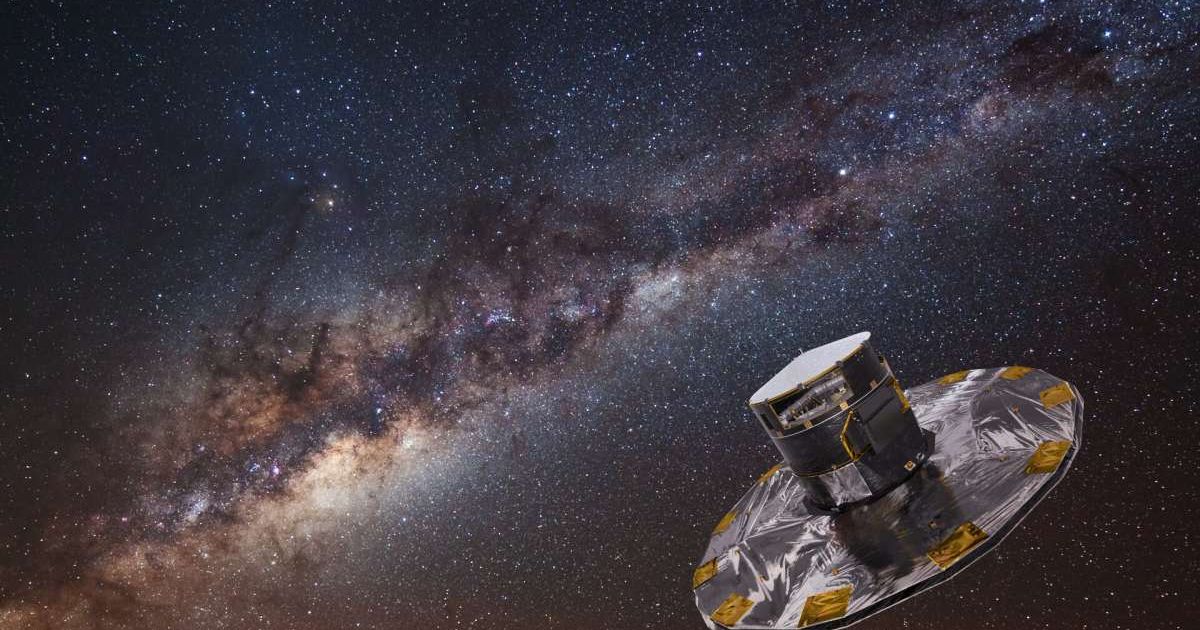
The astronomers rule out the possibility of stars being hurled by any collision with a satellite galaxy. "A key point about the stars in the outer disc is that they are on close to circular orbits, meaning that they had to have formed in the disc. These are not stars that have been scattered to large radii by an infalling satellite galaxy," explained Prof. Victor P. Debattista, co-author and co-supervisor of the study at the University of Lancashire. To support their hypothesis, the team analyzed more than 100,000 giant stars using data from the spectroscopic LAMOST and APOGEE surveys, and observations by the Gaia satellite, hovering in space to map the stars in the Milky Way. By narrowing their search to stars in the galaxy's main disc, they detected the signal of inside-out growth from other galactic processes.

Prof. Laurent Eyer, a co-author from the University of Geneva, remarked: “Gaia is delivering on its promise: by combining its data with ground-based spectroscopy and galaxy simulations, it allows us to decipher the formation history of our Galaxy.” The researchers further simulated galaxies’ evolution, which confirmed the U-shaped pattern, suggesting that the observed pattern requires older stars to migrate out, leaving younger ones inside. Some astronomers suspect the presence of the Milky Way’s central bar, whose gravitational pull may have caused gas to drift at a certain radius. However, the exact mechanism that contributes to the U-shaped age profile remains unknown. The new findings about the age profile pattern provide astronomers with a snapshot of how the Milky Way formed and evolved over billions of years.
More on Starlust
NASA's Hubble provides spectacular views of a barred spiral galaxy 380 million light-years away
Scientists have found the most 'pristine' star in the universe—and it's right here in the Milky Way