Scientists have found the most 'pristine' star in the universe—and it's right here in the Milky Way
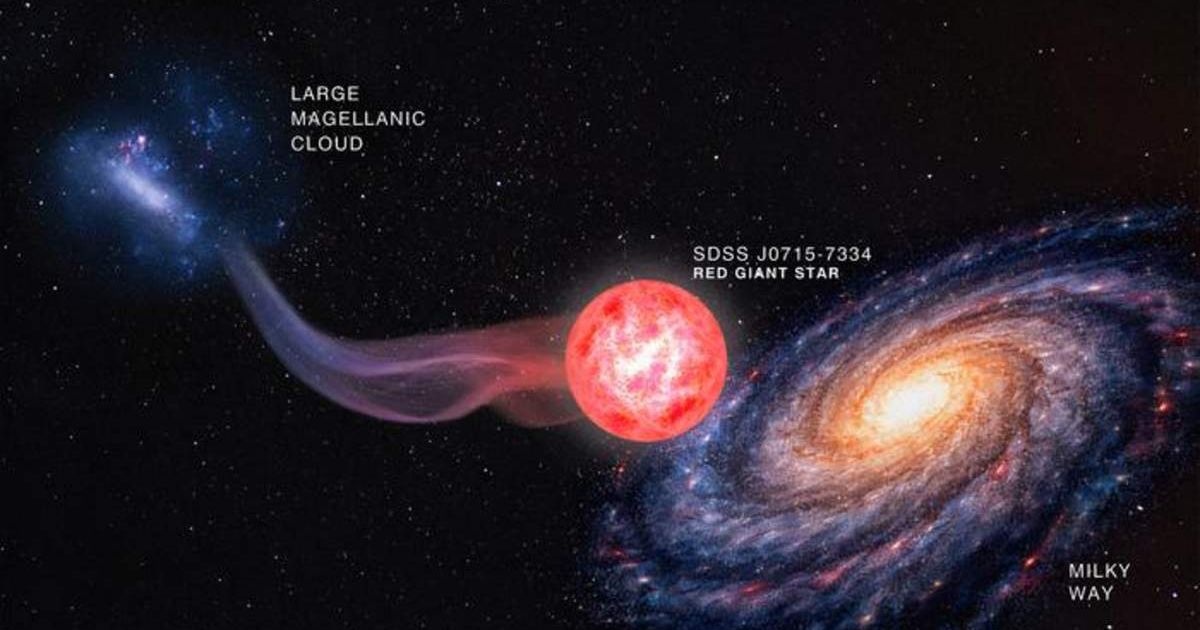
A team of astronomers, led by Alexander Ji from the University of Chicago, has discovered the most pristine star in the known universe, called SDSS J0715-7334. The star belongs to the second generation of celestial objects, which formed a few billion years after the birth of the universe. After being born near the Large Magellanic Cloud, it migrated toward the Milky Way and made our galaxy its home. Now, located 80,000 light-years from Earth, it has less than 0.005 percent of the Sun’s metal content and is forty times more metal-poor than the most iron-poor known star. Ji and his team detected the star using Sloan Digital Sky Survey-V (SDSS-V) data and observations on the Magellan telescopes at Carnegie Science’s Las Campanas Observatory (LCO) in Chile and the European Space Agency's Gaia mission. They have reported their findings in a paper published in Nature Astronomy.
Ji’s team, which mostly comprises undergraduate students, is supported by astrophysicist Juna Kollmeier at The Observatories of the Carnegie Institution for Science. They have been peering through the telescopes and poring over the SDSS-V data to hunt down ancient stars. “These pristine stars are windows into the dawn of stars and galaxies in the universe,” Ji said in a statement. The universe came into existence as a hot soup of energetic particles. After this moment of birth known as the Big Bang, the soupy particles expanded, cooled, and then coalesced to form neutral hydrogen gas. As the materials went on to expand, some patches became denser than the others. After a few hundred million years, those patches collapsed under gravity, defying the universe’s outward expansion. Such a collapse led to the formation of the first generation of stars, just made of pristine hydrogen and helium.
Those early stars exhausted their fuel and died young. But before dying, they produced new elements in their fiery cauldron and spewed the elements into space during end-of-life explosions. From these leftovers, new stars were born, containing a different array of elements than their precursors. “All of the heavier elements in the universe, which astronomers call metals, were produced by stellar processes—from fusion reactions occurring within stars to supernovae explosions to collisions between very dense stars,” said Ji. “So, finding a star with very little metal content in it told this group of students that they’d come across something very special.”
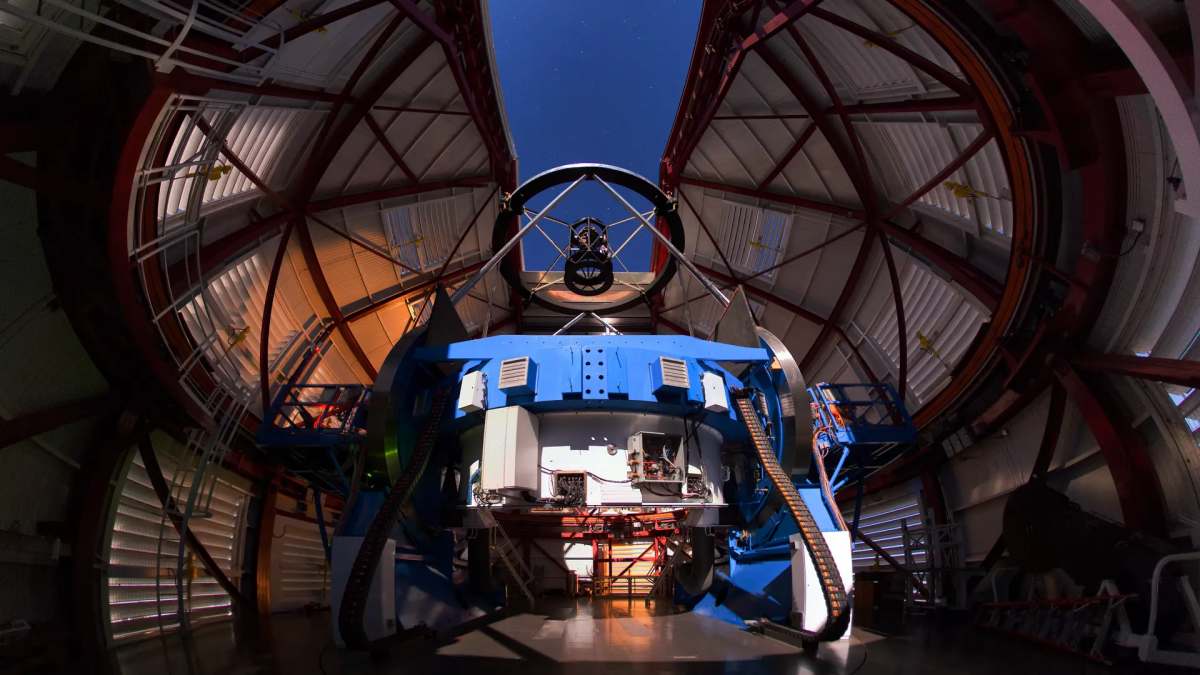
The discovery would probably not have been possible had it not been for the SDSS-V data that enabled Ji and his students to identify stars with very few heavy elements. They zeroed in on the new star in the wee hours of the morning on their first Magellan observing run. “We have to look in our cosmic backyard to find these objects, because we can’t yet observe individual stars at the dawn of star formation,” said Kollmeier. “Since these stars are rare, surveys like SDSS-V are designed to have the statistical power to find these needles in the stellar haystack and test our theories of star formation and explosion.”