Rare supernova lights up spiral galaxy 45 million light-years away; check out these pictures
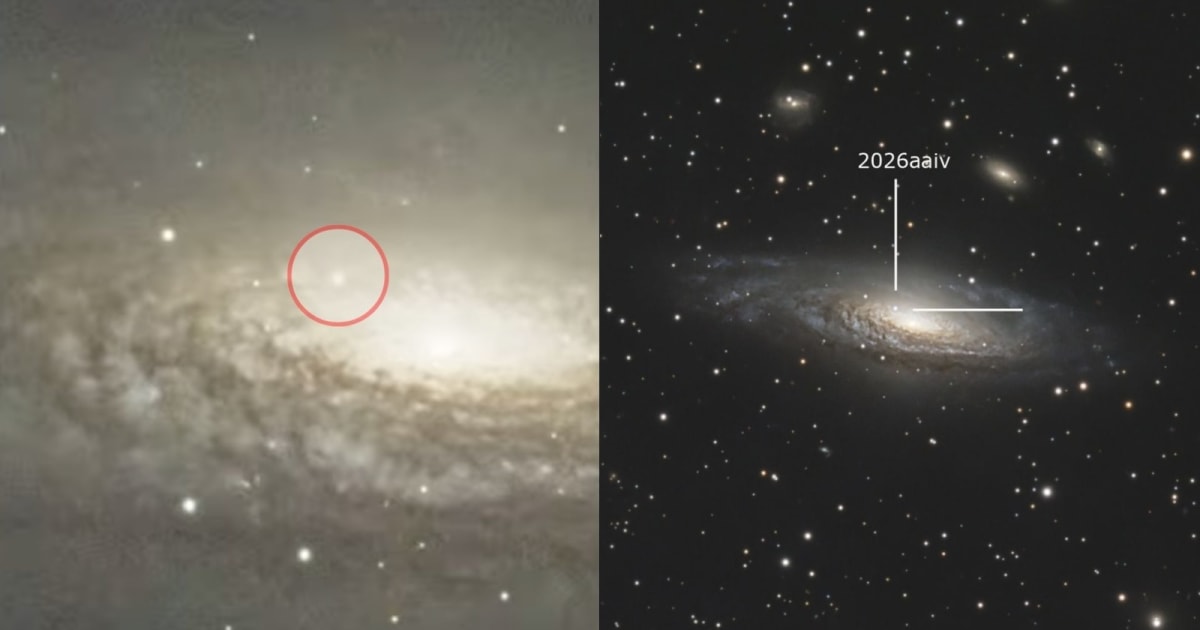
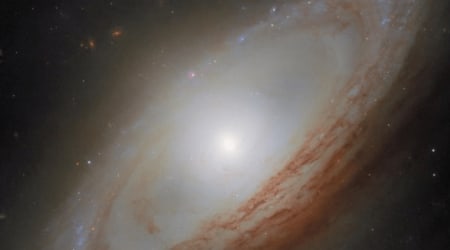
We have a new supernova with incredible views from Earth. This object has been spotted in a spiral galaxy located approximately 45 million light-years away and its visibility has excited astrophotographers. Several experts with telescopes have captured the supernova which is currently best visible in the Northern Hemisphere and at mid-latitudes in the Southern Hemisphere in the constellation Pegasus. A supernova is a powerful explosion that occurs when a star at least five times the mass of our sun reaches the end of its life.
A new supernova emerges
This supernova named SN 2026aaiv in the galaxy Caldwell 30 or NGC 7331 was discovered by the ATLAS survey on September 1 and it's reportedly a Type Ia supernova that occurs in a binary star system with at least one white dwarf—the small, hot core remnant of a Sun-like star. NASA says Type Ia supernova are rare as they happen roughly once every 500 years in the Milky Way.
Last week, astrophotographer Andrew McCarthy released a stunning photograph of the supernova as it appeared close to the center of the galaxy. “As luck would have it, I happened to be in the middle of a massive project with this galaxy, and caught the supernova,” he said. “This video is made from just 4 hours of exposure (two before and two after the supernova) but I’ve been shooting this area for nearly 100 hours already.”
This was the last time this happened btw. I was shooting narrowband to resolve nebulae in the pinwheel galaxy in 2023 and a supernova appeared in one of the arms.
— Andrew McCarthy (@AJamesMcCarthy) September 6, 2026
This also happened to me in 2020 with Messier 61 (but who knows what I did with that footage) https://t.co/YEuVcP64hj pic.twitter.com/0VXjXhEBLk
In another post on X, McCarthy said he plans to photograph the supernova for several nights to document the change in its brightness. He also shared a picture from 2023 featuring a supernova which appeared in the Pinwheel galaxy (Messier 101) located approximately 25 million light-years.
I captured 3 hours on Galaxy NGC 7331 this month, which shows a new supernova SN 2026aaiv. I then compared it to the same galaxy I captured a year ago in July, which shows supernova SN 2025rbs (which has since faded and can no longer be seen in the new data). pic.twitter.com/bKAGNYfEug
— Chuck's Astrophotography (@chucksastropho1) September 7, 2026
Another astrophotographer shared an image of the SN 2026aaiv and compared it to SN 2025rbs which appeared in the same galaxy in July 2025. He said the latter “has since faded and can no longer be seen in the new data.” According to Phil Michel, who also snapped the exploding star, “this is the 2nd Type Ia explosion in NGC 7331 in the past 12 months and the 4th SN to be discovered in this galaxy since 2013.”
SN 2026aaiv: New Type Ia supernova in the nearby (14 Mpc) galaxy NGC 7331 discovered this week. Interestingly this is the 2nd Type Ia explosion in NGC 7331 in the past 12 months and the 4th SN to be discovered in this galaxy since 2013 making this an excellent host for recent… pic.twitter.com/kx6GCzL5JI
— Phil Michel (@m1che2) September 3, 2026
The Caldwell 30 galaxy was discovered in 1784 by famed astronomer William Herschel, who also discovered the planet Uranus. NASA says it is only about half a degree away from Stephan’s Quintet—a group of five galaxies—and has a size, shape, and mass similar to the Milky Way. Interestingly, the galaxy's star formation rate also matches the Milky Way’s, and it hosts a similar number of stars along with a central supermassive black hole. What separates it from our galaxy though is the lack of a “bar” of stars, gas and dust cutting through its nucleus. Moreover, its central bulge has an unusual rotation pattern and it’s spinning in the opposite direction to the galactic disk.
More on Starlust
"Never encountered objects that act like this": NASA’s Chandra reveals a new class of cosmic objects