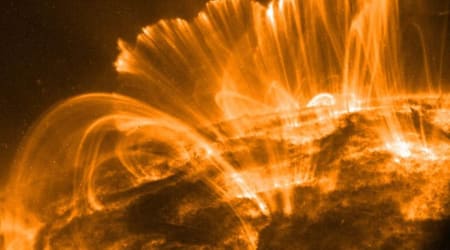
NASA and NOAA forecast CME impact on December 9, geomagnetic storm warning issued
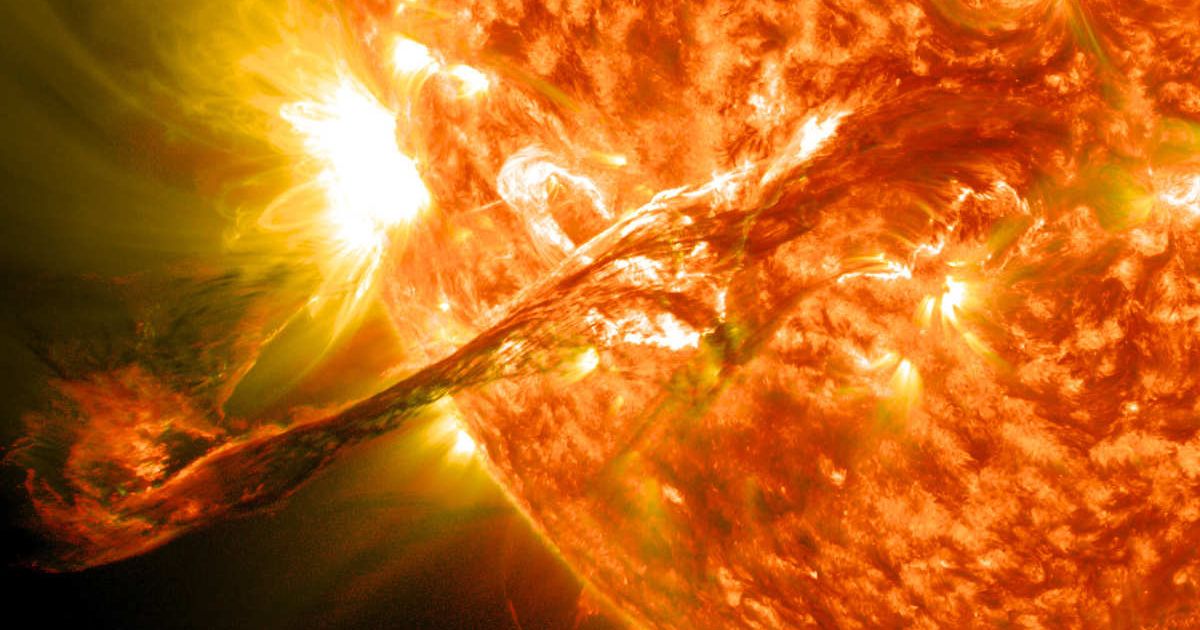
The space weather alert was triggered by an M8-class solar flare from sunspot 4299 on December 6, which immediately preceded the incoming CME.
PUBLISHED 1 HOUR AGO
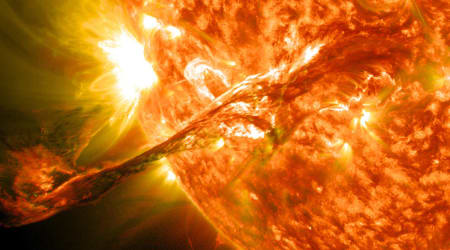
Magnificent CME Erupts on the Sun: The above picture features a filament eruption on the sun, accompanied by solar flares. (Cover Image Source: NASA Image and Video Library | Photo by NASA Goddard)

A Coronal Mass Ejection (CME), a powerful burst of solar material, is en route to Earth and expected to arrive on December 9, according to the Space Weather Prediction Center. This space weather event follows a strong solar flare produced on December 6. The flare came from sunspot 4299 and was an M8-class event, nearly the top rating, just shy of X-class.
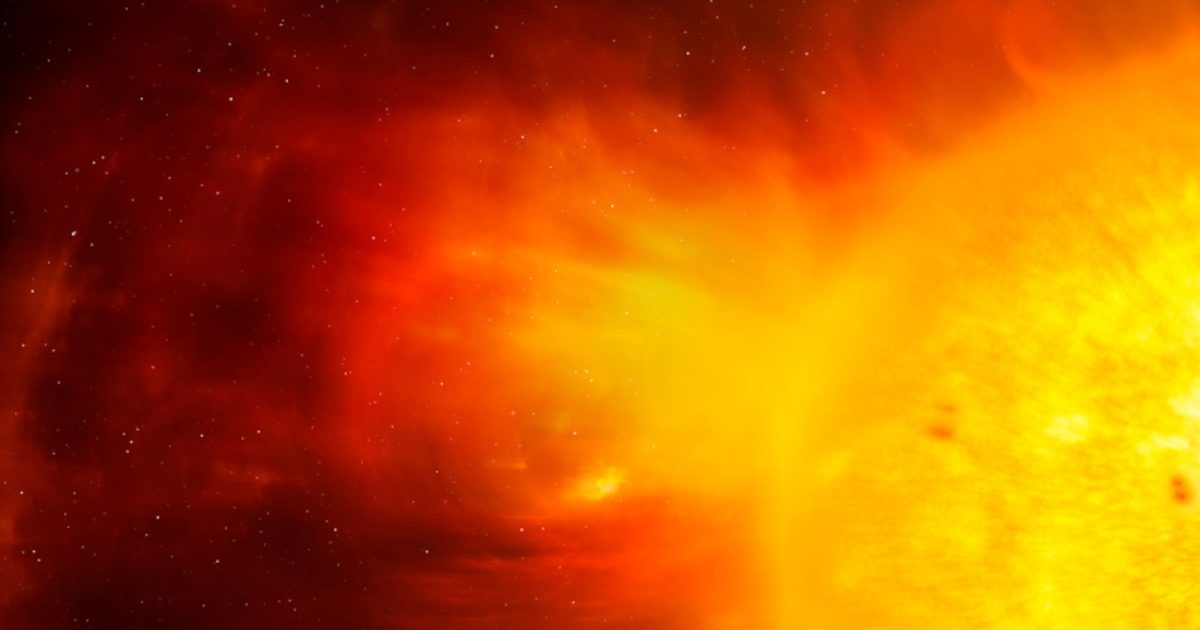
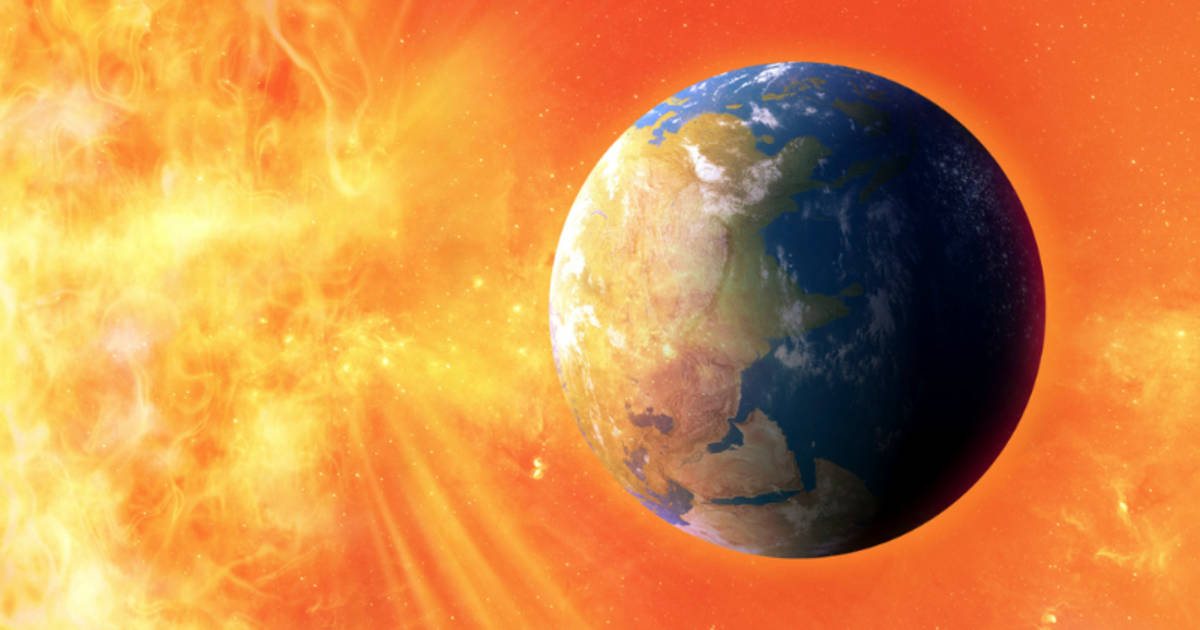
Illustration of a coronal mass ejection (CME) emanating from the Sun. 
(Representative Image Source: Getty Images | Mark Garlick | Science Photo Library.)
Illustration of a coronal mass ejection (CME) emanating from the Sun. (Representative Image Source: Getty Images | Mark Garlick | Science Photo Library.)

Its immediate effects were felt across the Pacific, where the atmospheric disturbance caused a shortwave radio blackout. Radio users, including ships and amateur operators, saw signals drop for about 15 to 20 minutes on all frequencies below 20 MHz, per Space Weather

A digital illustration of a solar flare hitting the Earth's surface.
(Representative Image Source: Getty Images | Victor Habbick Visions.)
A digital illustration of a solar flare hitting the Earth's surface. (Representative Image Source: Getty Images | Victor Habbick Visions.)

NASA and the National Oceanic and Atmospheric Administration (NOAA) have been utilizing sophisticated models to monitor the enormous cloud of plasma and magnetic fields, which is en route to Earth. Their forecasts agree: the CME should reach Earth early to midday on December 9. Experts from the Space Weather Prediction Center warned that the impact might generate a G3-Strong geomagnetic storm. While such high-level alerts are not an everyday occurrence, neither are they rare. 
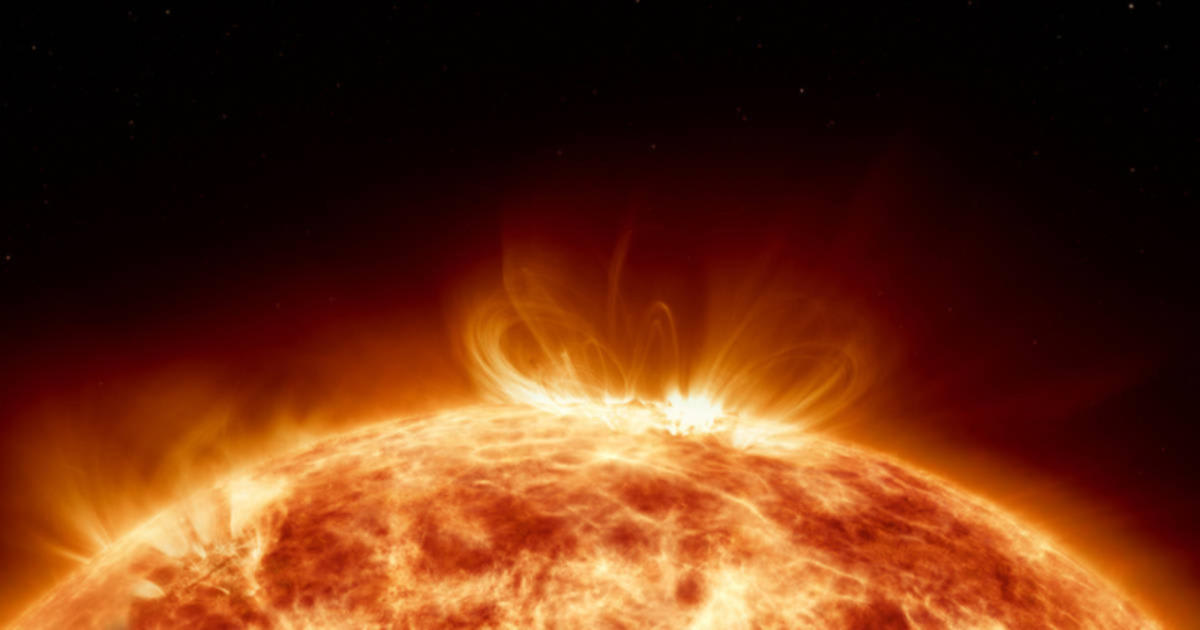
An artistic concept 3D illustration of the solar surface with powerful bursting flares (Representative Image Source: Getty Images | Remotevfx.)

There might be minor, limited disruptions to some technological systems; these are generally manageable and correctable. To the general public, the most striking effect will be an intensification of the dramatic Northern Lights. The auroras could light up parts of the northern U.S. states, even reaching into portions of the Midwest and Oregon. People should check NOAA's website for any latest information and updates on the progress of the storm. 

Image of Northern lights (aurora borealis) over icebergs near ilulissat (Cover Image Source: Getty | Andre Schoenherr)
Image of Northern lights (aurora borealis) over icebergs near Ilulissat (Image Source: Getty | Andre Schoenherr)

An expansive display of the Northern and Southern Lights (aurora borealis and aurora australis) is a direct result of the interactions between charged particles of the Sun and Earth's magnetic field. Due to their different chemical compositions, they usually come in different colors

The Sun continuously blows charged particles into space, the so-called solar wind. Whenever this wind reaches Earth’s magnetic shield, energy is deposited. As this energy gathers and finally is released, the charged particles rain down into our atmosphere, creating the auroras. The green glow of the auroras is produced by oxygen at altitudes of around 60 to 120 miles; red auroral displays are produced by oxygen at higher altitudes, above 120 miles.

Yellow tent illuminated under the aurora borealis display in Alaska's Arctic (Image Source: Getty | Patrick J. Endres)

This incoming space weather event began in the Sun's outer atmosphere, the corona, a region sculpted by strong magnetic fields. NASA notes that these can become unstable if certain conditions are met, especially above active sunspot regions, and violently release enormous bubbles of gas and magnetic fields. That is a Coronal Mass Ejection. A large CME is a great force; it can hurl up to a billion tons of matter into space that can be accelerated to millions of miles per hour in a colossal blast. Once launched, this solar material might travel through space to strike any planet or spacecraft in its path.

More on Starlust

In a breakthrough, scientists successfully predicted a solar storm just 15 hours before it struck Earth

New findings suggest solar storms are taking a toll on Starlink, and SpaceX is racing to keep up
MORE STORIES

Physicists found that clocks on Mars will tick 477 microseconds (millionths of a second) faster than on Earth per day, on average.
2 hours ago
The Hubble captured the image on November 30, while Juice caught a glimpse of the interstellar visitor shortly after perihelion.
3 days ago
The population of satellites could grow to a massive 560,000 by the end of the 2030s.
3 days ago
The object in question is a cosmic filament, a thread-like chain of gas that is about 5.5 million light-years in length and 117,000 light-years in width.
3 days ago
Avi Loeb's hypothesis follows the reasoning that this tail stretches tens of thousands of miles and is bright enough to show up in stacked telescopic images.
4 days ago
As many as 19 big clusters were discovered, but 16 of them crossed the threshold for large drainage basins.
5 days ago
The flare peaked at 9:49 p.m. ET on November 30 and triggered an R3-level radio blackout on the sunlit side of Earth.
6 days ago
The sunspot, initially classified as large, came fully into view on November 30, confirming its truly vast size.
7 days ago
The consequences of the Moon exploding will be felt in a variety of ways, and none of them will be good.
Nov 29, 2025
The SuperCam's microphone unexpectedly picked up the signals from two dust devils.
Nov 27, 2025