NASA’s Psyche teams up with ESA's Mars Express for a coordinated photoshoot at the Red Planet
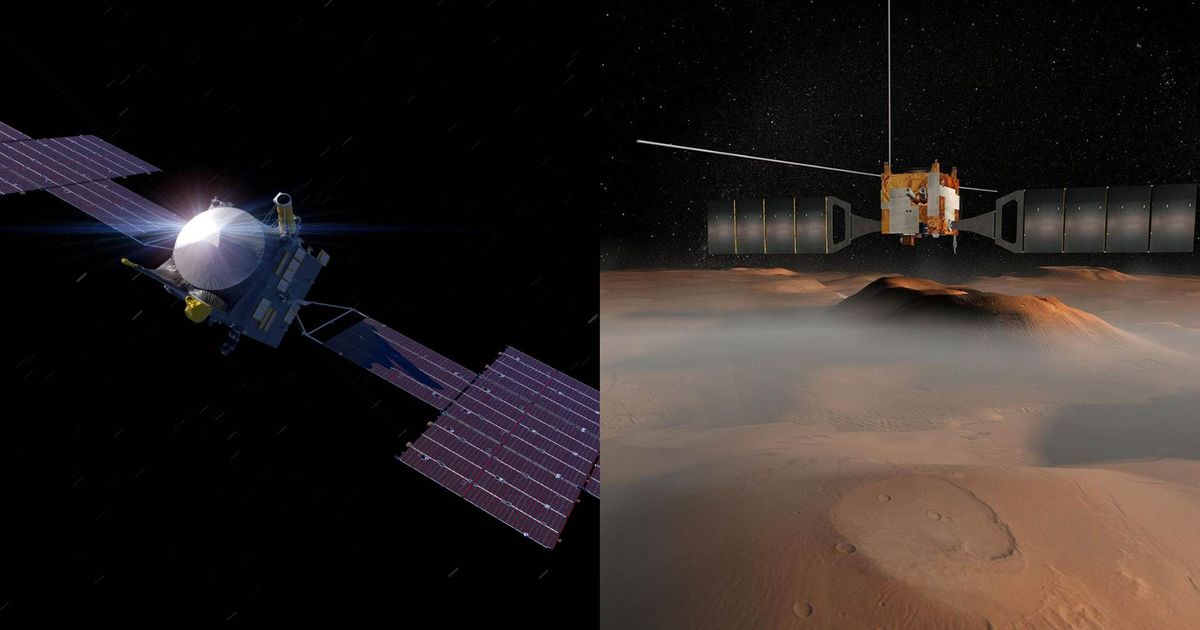
May 15 was a date to remember for both the European Space Agency (ESA) and NASA. On that day NASA’s Psyche spacecraft, headed toward a metal-rich asteroid of the same name, met ESA’s Mars Express during the former's stopover at the Red Planet. Both spacecraft turned on their imagers to make coordinated observations of the same patch of the planet. Mars Express, launched on 2 June 2003, arrived at the Red Planet in December 2003. And since beginning operation in 2004, the ESA spacecraft has mapped the chemical composition of Mars’ atmosphere and studied its inner moon Phobos. Psyche, launched on 13 October 2023, is likely to arrive at the metal-rich asteroid in the summer of 2029.
Psyche was flying by Mars to use the planet’s gravity to gain extra speed and adjust its trajectory on its way towards the metal-rich asteroid, which scientists believe could offer a one-of-kind look inside the interior of rocky planets like Earth. Such a flyby, known as a gravity-assist flyby, saves fuel, making interplanetary journeys more efficient. Looking to make the most of the opportunity presented by the flyby, teams working on both missions planned their observations weeks in advance so that the two spacecraft could image the same region of Mars as close in time as possible. In one of the two coordinated observations, the spacecraft imaged a part of Noachis Terra, one of the oldest known regions on the Martian terrain.
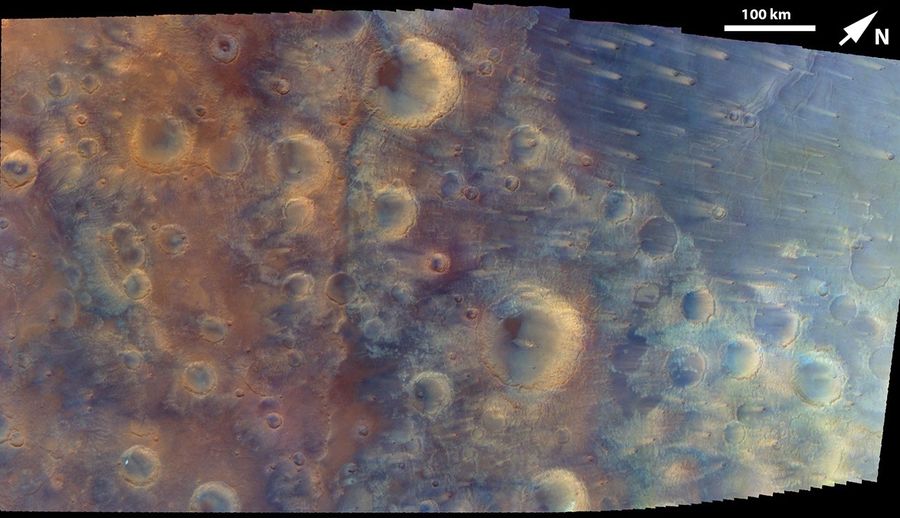
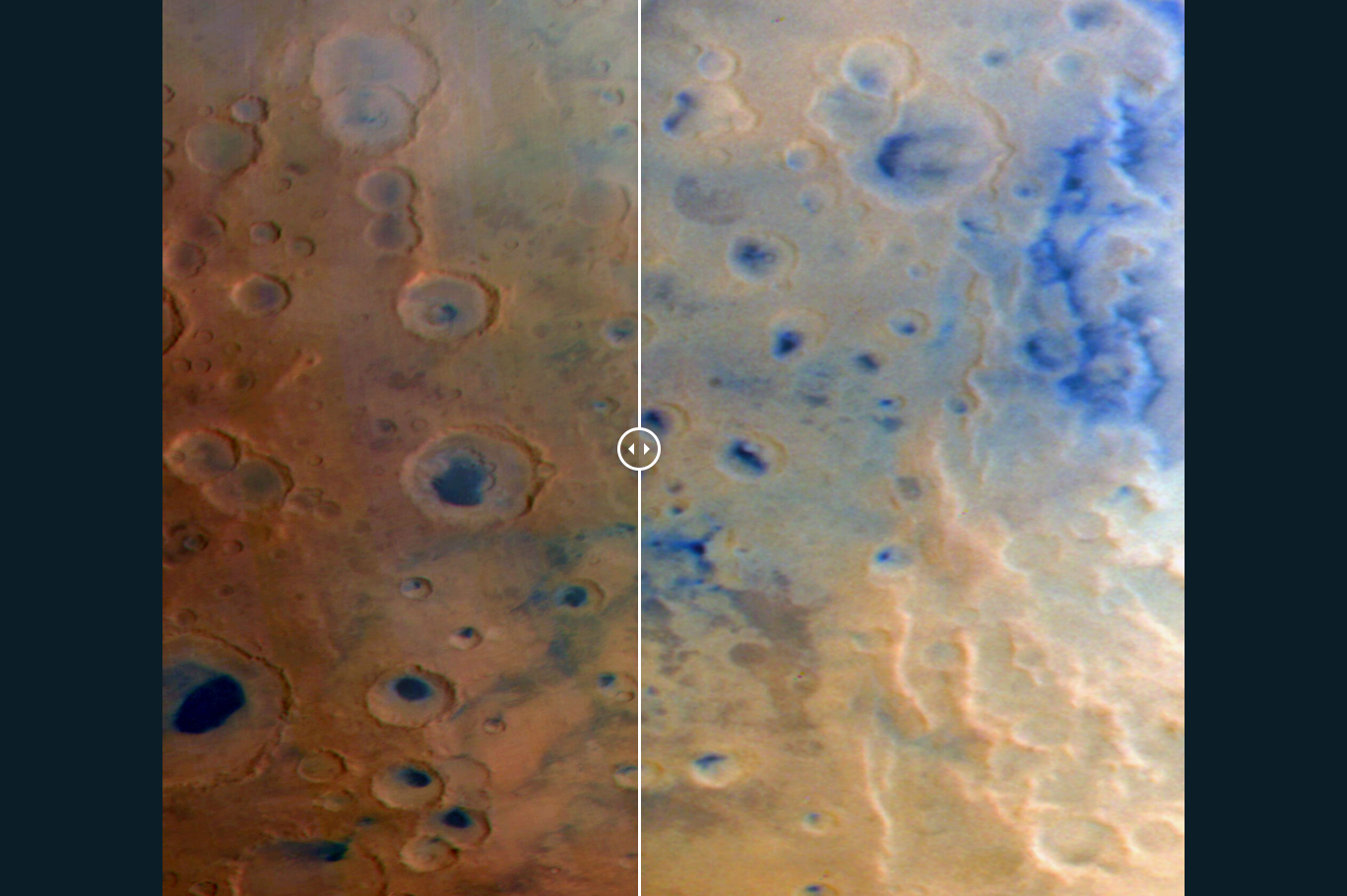
The spacecraft’s imagers captured the Martian surface from very different altitudes and viewing angles. Mars Express observed the region from only about 3,728 miles above the surface at an inclined angle, while Psyche photographed the surface from about 25,476 miles above Mars, looking almost straight down, just 1 hour and 50 minutes later. In the images displayed side-by-side below, Noachis Terra's craters can be seen filled with sand dunes that are shown in dark blue. Besides being excellent visual comparisons, the images could help with checking and adjusting Psyche's camera to ensure that it performs optimally when it reaches its target.
“The imager performed brilliantly, delivering some rarely seen views of the Red Planet,” said Jim Bell, the Psyche imager instrument lead at Arizona State University in Tempe, in a statement. Besides ESA’s Mars Express, NASA compared the Psyche images with those of NASA’s Mars Reconnaissance Orbiter, 2001 Mars Odyssey orbiter, Curiosity and Perseverance rovers, and the United Arab Emirates Mars Mission’s Hope Orbiter.
More on Starlust
Data from NASA's MAVEN orbiter shows Mars gets Earth-like auroras—here's how