Veiled in dust for billions of years, this ancient star cluster could be the oldest in the Milky Way
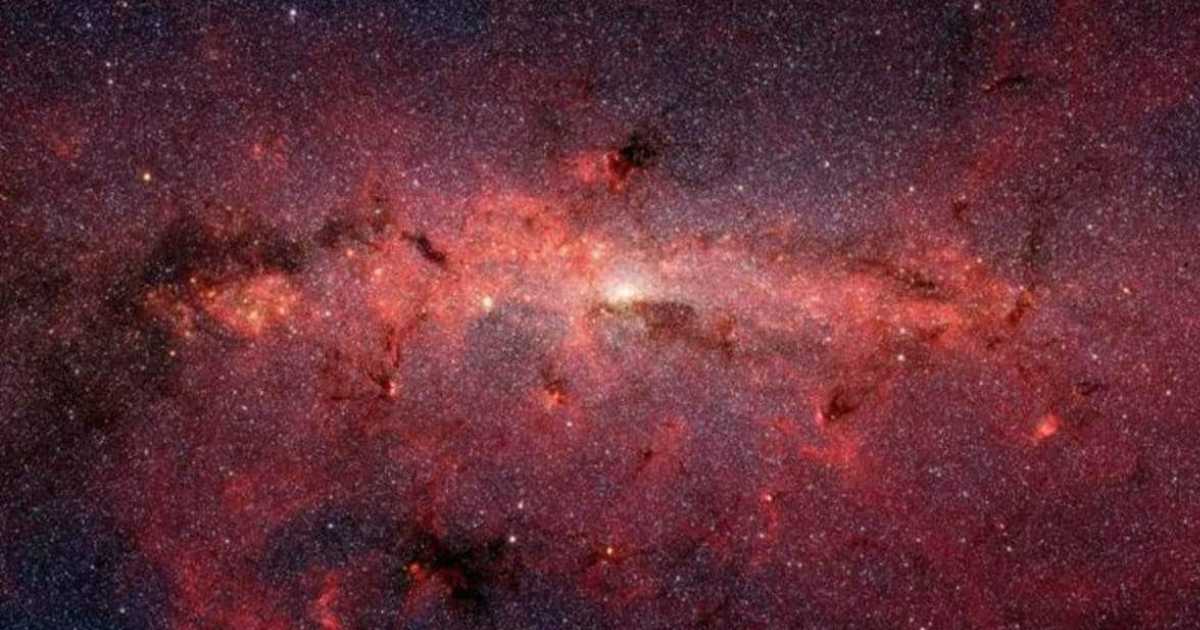
Astronomers have identified a star cluster that could be the oldest in our galaxy. A new study focused on a globular cluster designated as VVV CL001 estimates that it is approximately 13.4 billion years old, placing it remarkably close in age to the universe itself, which is estimated to be about 13.8 billion years old. If confirmed, VVV CL001 could provide an important glimpse into the conditions that existed when the Milky Way was taking shape. The research, led by J. Olivares Carvajal of the INAF Capodimonte Astronomical Observatory, was published as a preprint on the arXiv preprint server on October 20 and has been accepted for publication in the journal Astronomy & Astrophysics.
VVV CL001: A cluster shrouded by dust in the Milky Way
Globular clusters, densely packed groups of stars, contain some of the oldest stellar populations in a galaxy. The reason why astronomers study them is because a cluster's age and chemical composition can provide information on our galaxy's age. Particularly, researchers focus on metal-deficient globular clusters, as ancient clusters usually demonstrate a low metal content—VVV CL001, the cluster analyzed in the latest study, is one such metal-poor cluster.
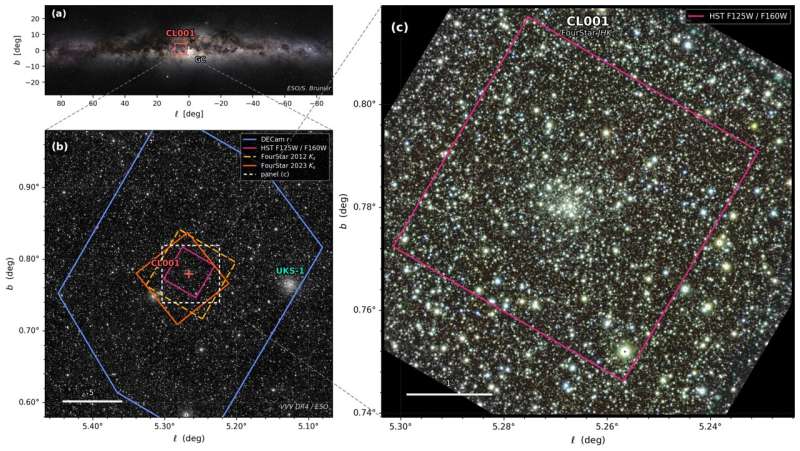
VVV CL001 was first identified in 2010 through the VISTA Variables in the Vía Láctea (VVV) Survey and was confirmed as a star cluster in 2019. It lies in the constellation Sagittarius in the inner bulge of the Milky Way, relatively close to the galaxy's center. But pinning down the cluster’s distance has been difficult. This is because it lies in a densely populated part of the sky where interstellar dust dims the light of its stars. Also, VVV CL001 is small and faint, and earlier images were too shallow to reveal enough of its stars. Astronomers also haven’t found any RR Lyrae stars in it, the pulsating variables they usually rely on as distance markers.
For the study in question, the team refined VVV CL001's distance by analyzing near-infrared images from the FourStar Infrared Camera on the 6.5-meter Magellan Baade Telescope, while studying images obtained from the Hubble Space Telescope to estimate the cluster's age. They also monitored the motion of the stars in the sky and applied a machine-learning algorithm to distinguish genuine cluster members from unrelated foreground and background stars. This analysis helped identify approximately 155 stars belonging to VVV CL001, including two important evolutionary groups: the main-sequence turnoff stars and horizontal-branch stars. Among these two, turnoff stars are among the most dependable age markers for a cluster. Stars in a cluster form at roughly the same time, but the massive ones burn through their fuel faster and leave the main sequence—the long phase of hydrogen burning in a star’s core. On the other hand, horizontal-branch stars, which shine with relatively steady brightness, serve as distance markers.

By comparing the stars with a theoretical stellar evolution model, the team placed VVV CL001 about 7.34 kiloparsecs (roughly 24,000 light-years) from Earth. Meanwhile, the Hubble Space Telescope images, which haven't been impacted by dust much, pointed to an age of about 13.4 billion years. They then checked the result using turnoff stars, those that are just beginning to leave the main phase of their lives, which gave a similar age. "Both methods estimate the cluster age at 13.4±0.4 Gyr, suggesting that VVV CL001 could be the oldest GC in the bulge and perhaps the galaxy," the researchers wrote.
The findings could help astronomers understand how the Milky Way's central regions developed and how its oldest stellar populations came together. However, researchers caution that the age estimate needs further investigation before VVV CL001 can be definitively declared the oldest star cluster in the galaxy. Since the universe is roughly 13.8 billion years old, any age estimate for the cluster has to come in below that figure, even with its uncertainty taken into account. Considering that the cluster's estimated age is close to the universe's 13.8-billion-year age, the team says that if the cluster formed in the bulge and is truly this old, scientists may have to reconsider the age of the galaxy, and possibly, even that of the universe.
More on Starlust
NASA's Hubble and Webb spot the first of a star cluster's 10,000 missing black holes
Astronomers find the earliest, hottest galaxy cluster that should not exist: 'Too strong to be real'