NASA's Hubble images Trifid Nebula again after 29 years, focuses on 'Cosmic Sea Lemon'
![New Image of the Trifid Nebula captured in April 2026. The Trifid Nebula is a star-forming region which was first captured in 1997. [Cover Image Source: NASA, ESA, STScI; Image Processing: Joseph DePasquale (STScI)]](https://d3hedi16gruj5j.cloudfront.net/800157/uploads/c26b5630-3d48-11f1-b426-39ae744d49e5_1200_630.jpeg)
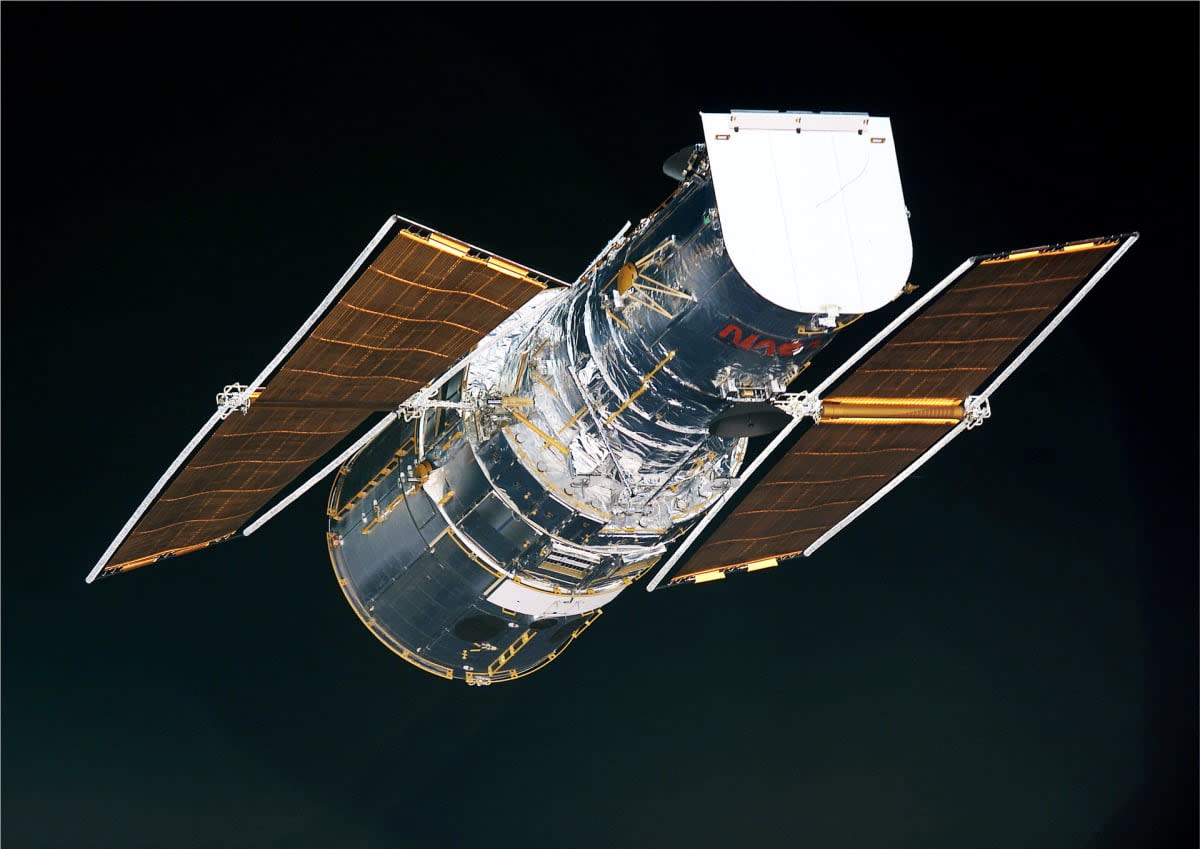
NASA marked the 36th anniversary of the Hubble Space Telescope by releasing a new image of the Trifid Nebula. The telescope had observed the nebula once before in 1997. But this time, it looked at the nebula to image the changes it has gone through in the last 29 years. The telescope also had a new camera this time, which was installed during Servicing Mission 4 and offers a wider field of view with greater sensitivity.
The latest view captured by Hubble reveals a turbulent environment around the Trifid as glowing gas and dark dust lanes hint towards an active stellar nursery. The Trifid Nebula, also known as Messier 20, is shaped by massive stars outside Hubble's field of view. The winds of these stars have impacted the region for at least 300,000 years. They have created a large bubble, which pushes and compresses the cloud's gas and dust, setting off star formation.
5,000 light-years from Earth, stars are forming in the Trifid Nebula. Our orbiting @NASAHubble telescope is taking a close look: https://t.co/gkoaV8e64M pic.twitter.com/iq7orzmKub
— NASA (@NASA) April 20, 2026
Visible in the Hubble image is what NASA has called the “Cosmic Sea Lemon." It features the “head” and undulating “body” of a rusty-colored cloud of gas and dust. It has the appearance of a sea slug, and its left horn features a part of the Herbig-Haro 399—a jet of plasma ejected by a young protostar embedded in the head of the sea lemon. These outflows change over time, allowing scientists to measure their speeds and estimate the energy released into the surrounding medium. And the recent observations would help in understanding how young stars interact with their birth environments.
A counter jet can also be observed, which is visible as jagged orange and red lines. The darker, more triangular ‘horn’ reveals another young star that the head of the cosmic lemon is hosting. The green arc may be indicative of strong ultraviolet light from nearby stars eroding a circumstellar disc. Other sharp lines indicate the activity of other young stars.

The bluer top-left of Hubble's visible light observations appears clearer than the other parts of the image. This is the result of massive neighboring stars, outside the field of view, stripping away electrons from the surrounding gas, ultimately creating a bubble. Meanwhile, the yellow gas rising upward from the head of the sea lemon of the nebula reveals the impact of the ultraviolet light making its way into the dark brown dust and decimating the gas and dust. The extreme right end of the view appears pitch black as the dust is extremely dense in that zone. Protostars reside in the densest areas, which cannot be perceived in visible light.
A storm of stars is brewing in the Trifid nebula as seen in this @WISE_Mission image! http://t.co/ifDfDWUbAP pic.twitter.com/aE5aN6KRjt
— NASA (@NASA) January 31, 2014
The Hubble Space Telescope has made more than 1.7 million observations. For more than three decades, the instrument has been aiding scientists in framing our understanding of the functioning of the universe. Furthermore, scientists have combined Hubble’s observations with the ones captured by NASA's James Webb Space Telescope, and soon they might delve into comparative studies with the Nancy Grace Roman Space Telescope, which is yet to launch.
More on Starlust
NASA's James Webb Space Telescope pictures Helix Nebula in extraordinary detail
NASA’s Hubble Space Telescope captures sharpest-ever picture of interstellar comet 3I/ATLAS