Mysterious weather patterns of Jupiter and Saturn's poles reveal secrets about their interiors
MIT scientists may have finally found the answer to the difference in polar weather of the almost similar planets.
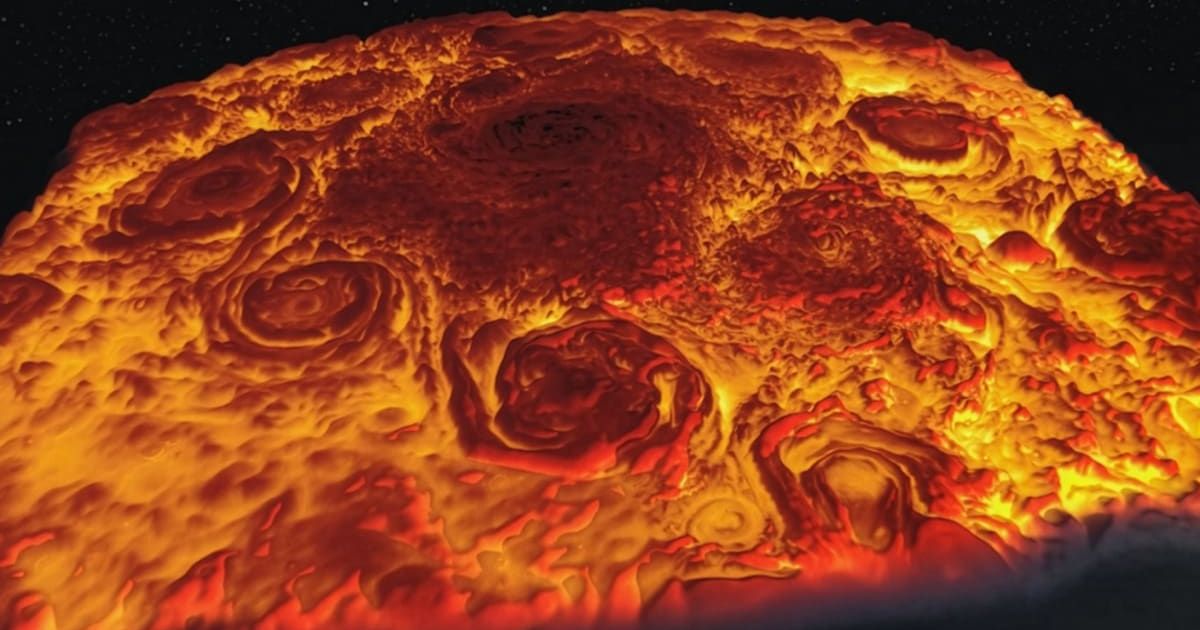
This infrared 3D image of Jupiter's north pole depicts cyclones and anticyclones. (Cover Image Source: MIT | Photo by NASA/JPL-Caltech/SwRI/ASI/INAF/JIRAM)

Spacecraft exploring the vast extent of the cosmos have made significant observations about the gas giants Jupiter and Saturn. Despite being similar in many ways, observations have revealed mystifying weather patterns at the poles of Jupiter and Saturn. A study to be published in the journal Proceedings of the National Academy of Sciences and a seminar at AGU25 revealed new insights. Scientists at MIT have found how the two different systems might have evolved, likely revealing data not only about the polar weather patterns but also about the planets’ interiors.

These observations of Jupiter’s auroras were captured with Webb’s Near-Infrared Camera on Dec. 25, 2023. (Image Source: NASA | James Webb Telescope)
These observations of Jupiter’s auroras were captured with Webb’s Near-Infrared Camera on Dec. 25, 2023. (Representative Image Source: NASA | James Webb Telescope)

The polar vertices of Jupiter and Saturn, the massive atmospheric whirlpools rotating over the planet’s polar regions, are very different. A single massive polar vortex covers the north pole in a hexagonal pattern on Saturn, and a central polar vortex surrounded by eight smaller vortices is seen on Jupiter, according to MIT News. The stark differences in their polar weather patterns have been a mystery, given the almost same size of the planets and the same gaseous elements they harbor. The team simulated various conditions of the vortex formation to study how they have evolved.
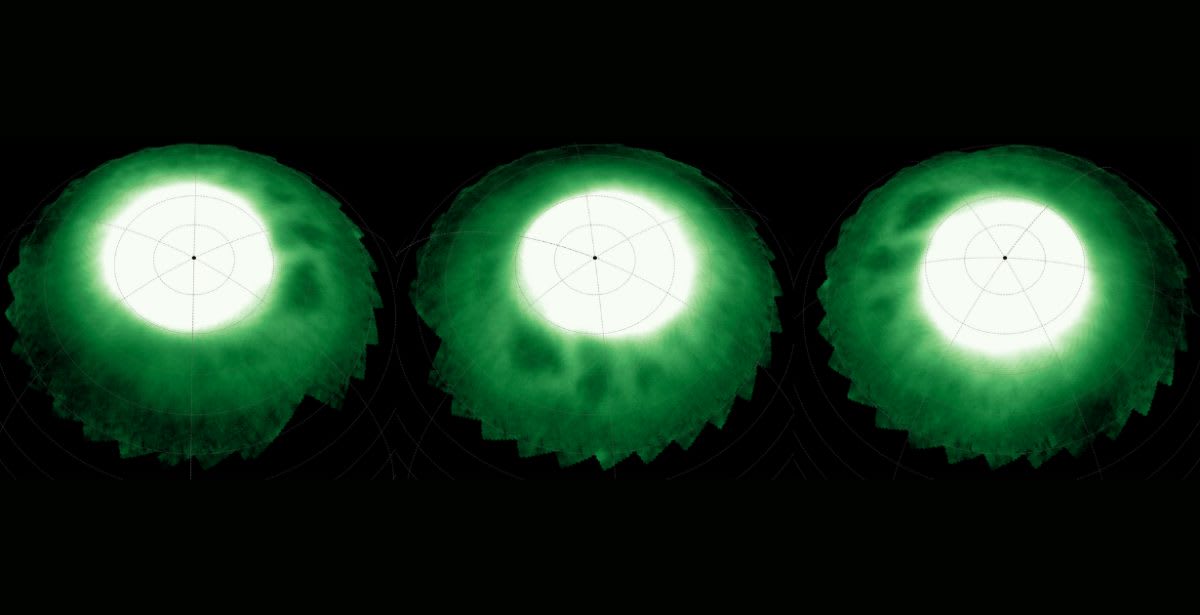
Montage of stills from animation showing the dark, bead-like features embedded in bright auroral halos as Saturn rotates beneath JWST’s view. (Image Source: Northumberland University | Photo by NASA/ESA/CSA/Stallard et al 2025)
The dark, bead-like features embedded in bright auroral halos as Saturn rotates beneath JWST’s view. (Representative Image Source: Northumberland University | Photo by NASA/ESA/CSA/Stallard et al 2025)

To identify a physical mechanism of the vortex and vortices, Kang and MIT graduate student Jiaru Shi worked with a two-dimensional model of surface fluid dynamics. As the fast rotation of Jupiter and Saturn creates uniform motion along the rotation axis, despite the three-dimensional nature of a polar vortex, it is accurate to represent vortex evolution in two dimensions. An existing equation describing swirling fluid evolution was used to develop a two-dimensional model of vortex evolution on a gas giant.
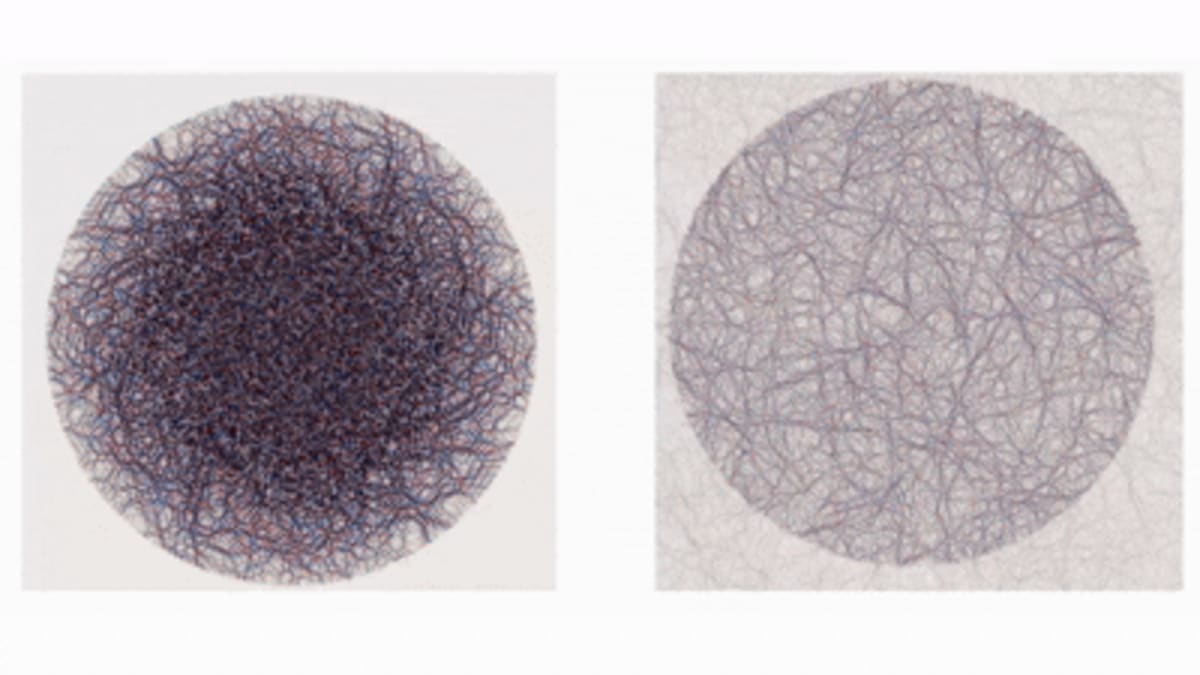
MIT researchers ran simulations and found that vortex patterns. Whether a planet develops one or multiple polar vortices, is determined by the “softness” of the vortex’s base. (Image Source: MIT | Photo by Shi, Kang et al.)
MIT researchers ran simulations and found that vortex patterns. Whether a planet develops one or multiple polar vortices is determined by the “softness” of the vortex’s base. (Image Source: MIT | Photo by Shi, Kang et al.)

They studied how well-organized vortex patterns may form from random stimulations on a gas giant. Among many plausible planetary configurations, the currents coalesced into a single large vortex in some cases. This is similar to Saturn’s pattern, while for Jupiter’s vortices, some of the other simulations produced multiple large circulations. Upon comparing the simulations, it was found that vortex patterns and the formation of a single or multiple polar vortices depend on the “softness” of a vortex’s base, which is connected to the interior composition.
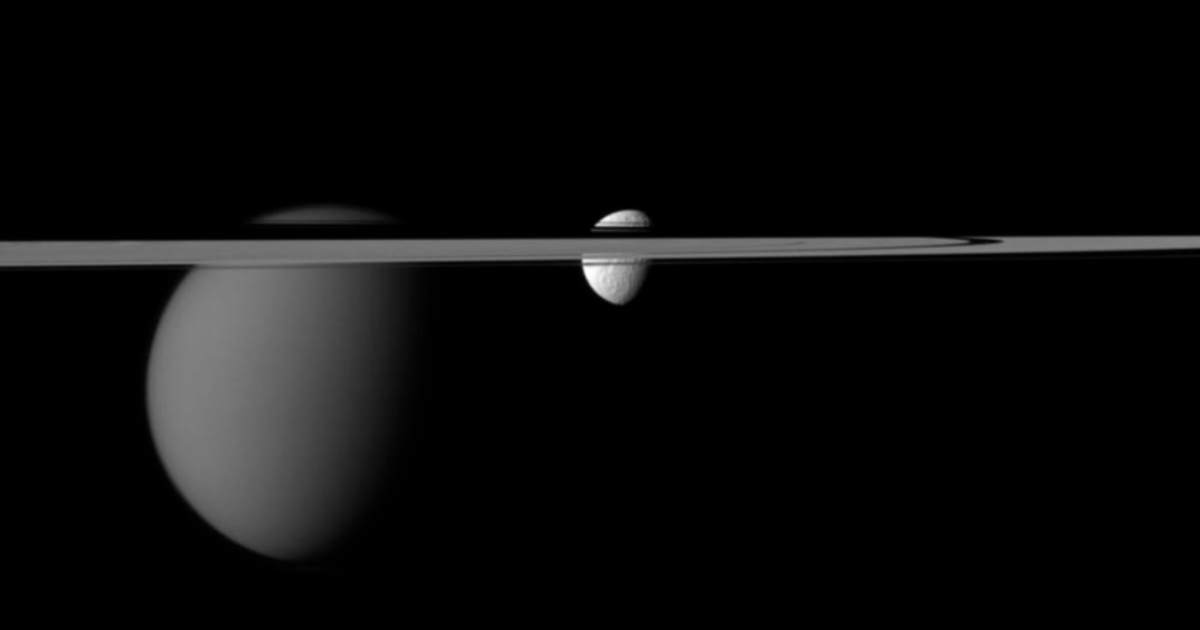
The line of Saturn rings disrupts NASA's Cassini spacecraft's view of the moons Tethys and Titan (Representative Image Source: NASA Image and Video Library | NASA)

“Our study shows that, depending on the interior properties and the softness of the bottom of the vortex, this will influence the kind of fluid pattern you observe at the surface,” says Wanying Kang, assistant professor in MIT’s Department of Earth, Atmospheric and Planetary Sciences (EAPS). “I don’t think anyone’s made this connection between the surface fluid pattern and the interior properties of these planets,” Kang added. If this mechanism holds, it means that Jupiter is made of softer, lighter material, while Saturn contains heavier interior matter.
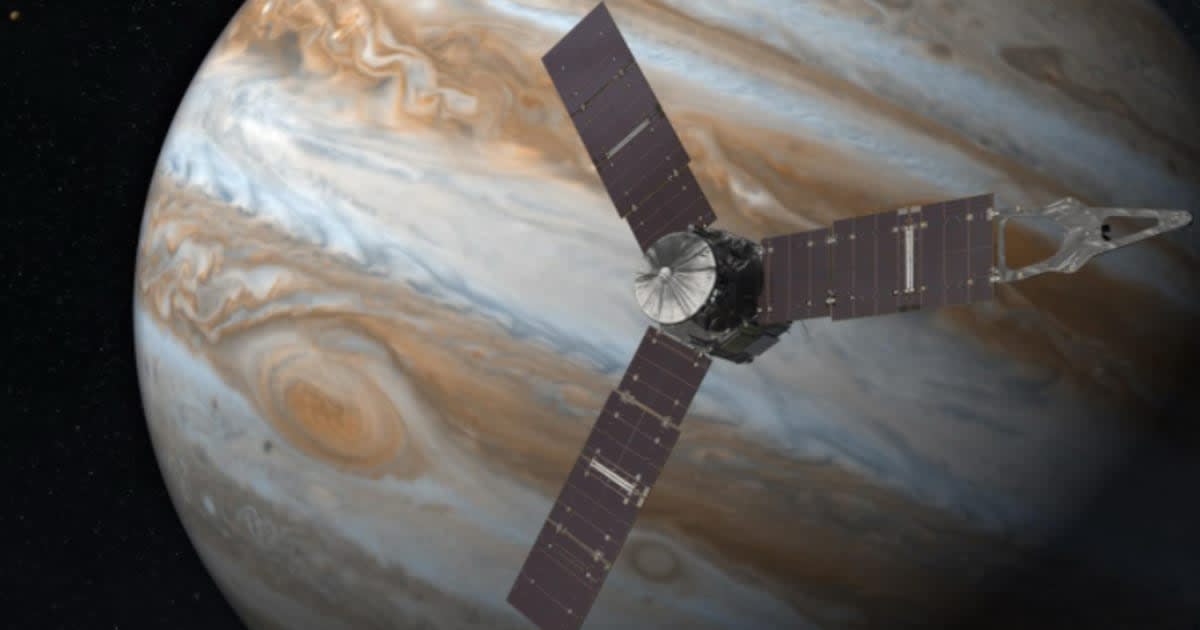
Computer rendered image of Juno in orbit around Jupiter with the Great Red Spot in the background. (Respresentative image source: NASA | The Guardian)
Computer-rendered image of Juno in orbit around Jupiter with the Great Red Spot in the background. (Representative Image source: NASA | The Guardian)

An individual vortex is like a whirling cylinder spinning through a planet’s various atmospheric layers. When softer and lighter materials make up the base of the swirling cylinder, any vortex involved can only grow so big. As seen in Jupiter, the final pattern then accommodates multiple smaller vortices. If the vortex’s base is made of harder, denser material, it can grow large and eventually eat up other vortices, forming a single, massive vortex, like that of Saturn. The study is inspired by images of Jupiter and Saturn taken by the Juno and Cassini missions over the years.

More on Starlust

NASA's 'Accident' helps understand hidden chemistry of giant planets like Jupiter and Saturn
NASA’s James Webb captures auroras on Jupiter that glow hundreds of times brighter than those on Earth

MORE STORIES

The study of these fast-moving particles provides significant clues about the early universe.
1 day ago
By looking at the Sun's interior, the scientists found that our star's behavior is changing.
4 days ago
A team of scientists looked into impact glass returned by China's Chang'e-5 to understand lunar surface processes at the micro- and nanoscale.
4 days ago
Astronauts could face psychological issues during a long Moon stay. Here's what simulations show.
5 days ago
A new study suggests that water ice on Mercury may have been deposited in one Mercurian day by an impactor larger and slower than previously thought.
6 days ago
The technology used by NASA's PUEO could also be used to detect traces of cosmic rays on the Moon.
6 days ago
The conditions at Salar de Pajonales, the high-altitude salt flat in northern Chile, are harsh and mimic those that early life on Mars might have experienced.
7 days ago
The findings could help scientists better understand dangerous solar events from the past.
7 days ago
A dense metallic core, a silicate mantle, and a thin atmosphere on top—this familiar internal structure of rocky planets may be a rarity in the universe.
7 days ago
The latest release contains files on strange phenomenon experienced by Apollo astronauts.
7 days ago