Musical symbol in space? NASA's Chandra Observatory helps reveal origins of 'Treble Clef' radio structure
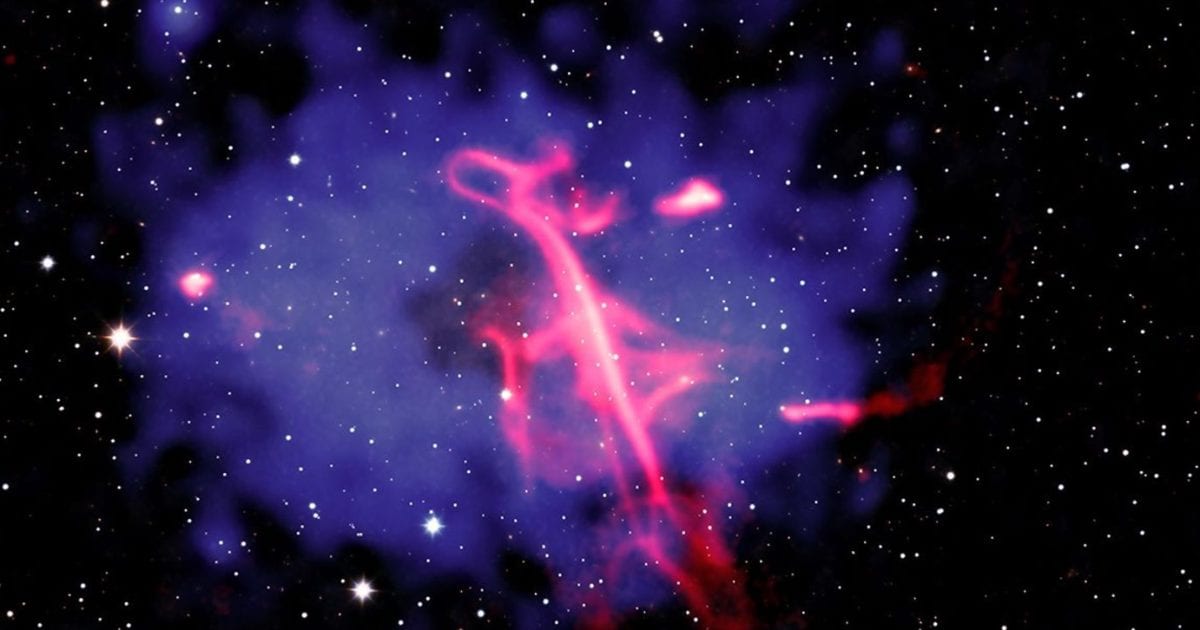
A colossal radio structure shaped like the musical symbol known as a treble clef was forged by a supermassive black hole's outburst and later reshaped by a collision between two galaxy clusters, a new study has found. Published in Astronomy & Astrophysics on October 14, 2026, by a team led by Andrea Botteon of Italy's National Institute for Astrophysics (INAF), the study used observations from NASA's Chandra X-ray Observatory and other telescopes to piece together how the collision reshaped streams of energetic particles released by the black hole into this massive structure.

Looking through the Milky Way
The structure, nicknamed Treble Clef for its appearance, was difficult for astronomers to study because it is located directly behind the plane of the Milky Way. The stars, gas, and dust in our galaxy make it difficult to observe this region from Earth, hiding details that could help astronomers identify its source. To trace its origins, researchers thus turned to X-ray and radio observations of the region.

Inside the Treble Clef's formation
NASA's Chandra X-ray Observatory and Germany's eROSITA telescope detected X-rays from hot gas in the galaxy cluster. This gas can reach temperatures of millions of degrees, causing it to emit X-rays. These observations showed that two galaxy clusters were merging in this region.
Meanwhile, the Netherlands-based LOw Frequency ARray (LOFAR) radio telescope mapped radio emissions from the same region, which showed the giant structure's treble clef shape. These emissions came from energetic particles and magnetic fields released by a supermassive black hole during an earlier outburst.

Over time, the particles lost energy, causing the radio emissions to fade. According to the researchers, the later collision between the two galaxy clusters may have compressed and re-energized this material, so the radio emissions became brighter again. This could explain why the structure is visible today.
Evidence for the collision
Researchers carefully analyzed the X-ray data to find clues about the collision. Generally, the hot gas inside galaxy clusters appears in a smooth, oval-shaped pattern. The researchers removed this symmetrical pattern from the original X-ray image so that differences in the gas could be seen more clearly.

In the resulting image, X-ray emissions on the left and right sides of the cluster's center appeared brighter, while the central region was comparatively faint. This pattern gave researchers a clue about the direction in which the two galaxy clusters collided. According to the researchers' estimates, the collision happened a few hundred million years ago, and the two clusters are now moving away from each other.
What the images show
In NASA's composite image, researchers have combined data from different telescopes. The blue color shows the multimillion-degree hot gas inside the galaxy clusters, detected in X-rays by Chandra and eROSITA. Red represents the radio data from LOFAR, where the treble clef-like distinguishing shape is clearly visible. The white areas in the image mostly show infrared data from the United Kingdom Infrared Telescope (UKIRT).
The resemblance of the structure to a treble clef, however, is not naturally ordained but a mere coincidence, and according to NASA, is an example of "pareidolia", the phenomenon of humans seeing familiar shapes in random patterns.
More on Starlust
NASA's IXPE measures pulsar's magnetic fields in distant Lighthouse Nebula for the first time