Is it a star or a planet? What NASA's James Webb Space Telescope found as it looked into 29 Cygni b
![Exoplanet 29 Cygni b, seen in this artist’s concept, is a gas giant weighing about 15 times the mass of Jupiter. [Representative Cover Image Source: NASA, ESA, CSA, Joseph Olmsted (STScI)]](https://d3hedi16gruj5j.cloudfront.net/799409/uploads/e66e8100-388a-11f1-8bbb-830bba66c50c_1200_630.jpeg)
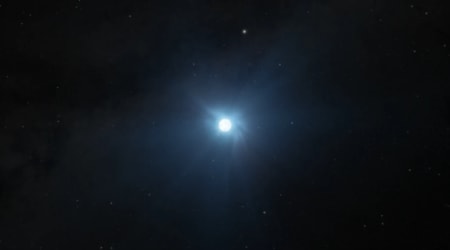
How do we differentiate between stars and massive planets? The answer to this may lie in the way these bodies come into existence. That is why NASA's James Webb Space Telescope looked into 29 Cygni b. Weighing as much as 15 Jupiters and orbiting its host star at an average distance of 1.5 billion miles, it essentially occupies a borderline position between a star and a massive planet.
🆕 Webb is investigating the dividing line between planets and stars 🪐⭐
— ESA Webb Telescope (@ESA_Webb) April 14, 2026
What is the dividing line between stars and massive planets? Scientists think it may be how they formed: a bottom-up approach (clumping together) or a top-down approach (fragmenting into smaller bits) 1/3 pic.twitter.com/DkryVyIuA0
Planets, by definition, come from accretion. This is the slow "bottom-up" method whereby dust and ice get together in protoplanetary disks. With the passage of time, these conglomerates mature into bodies of planetary dimensions. Stars, in contrast, come into existence by the process of gravitational collapse, where huge clouds of gas break down and each piece collapses under its own gravity. 29 Cygni b lies right on this dividing line. While it is massive enough to potentially form like a star, Webb’s observations reveal otherwise. By analyzing the planet’s atmosphere using Webb’s Near-Infrared Camera (NIRCam), a team led by William Balmer of the Johns Hopkins University and the Space Telescope Science Institute detected high levels of carbon dioxide and carbon monoxide—key indicators of heavier chemical elements collectively called metals.
![A wedge (indicated by the blue box) is used to block the light of the host star (labeled A and marked with a star) to reveal 29 Cygni b. [Image Source: NASA, ESA, CSA, William Balmer (JHU, STScI), Laurent Pueyo (STScI); Image Processing: Alyssa Pagan (STScI)]](https://de40cj7fpezr7.cloudfront.net/1ac912bb-9f58-4d01-bbe3-54f570896a70.png)
The research, published in The Astrophysical Journal Letters, revealed that 29 Cygni b has about 150 Earths worth of heavy elements. Going deeper, the ground-based telescope CHARA confirmed that the planet's orbit is aligned with the spin of the star. “We showed that the inclination of the planet is well-aligned with the spin axis of the star, which is similar to what we see for the planets of our solar system,” said Ash Messier, co-author and a graduate student at Johns Hopkins University, in a statement. “Put together, this evidence strongly suggests that 29 Cygni b formed within a protoplanetary disk through rapid accretion of metal-rich material, rather than through gas fragmentation. In other words, it formed like a planet and not like a star,” added Balmer.

29 Cygni b was the first of four targets in Balmer's observation program. All of the targets weigh between 1 and 15 times as much as Jupiter and are located within 9 billion miles of their host stars. To understand the formation of each of these targets better, Balmer and his team plan on comparing how the composition varies between the lower-mass and higher-mass objects.
More on Starlust
Two exoplanets collided—and the impact was similar to the one that created Earth and the Moon
James Webb Space Telescope reveals strange features of auroral footprints of Jupiter's moon Io