Humans can make a round trip to Mars within 153 days, new study reveals

A one-way trip to Mars would take less time than a round trip, which could take a few years. Be it sending a rover or humans, a trip to the Red Planet is incredibly long. But a new study suggests that such travel time can be shortened. The study, published in Acta Astronautica, shows that hundreds of days can be saved by taking cues from the early orbital data of asteroids. This will help wrap up the total mission time within 153 days. To determine optimal routes for planetary missions, scientists calculate fuel needs, work on the optimum design of spacecraft, and precise locations of planets. They hardly consider orbital data from asteroids.
The distance between Earth and Mars changes constantly as they follow different orbits. While planning a Mars mission, the Red Planet’s relative position to Earth is a key parameter. This phenomenon is called Mars opposition. The Red Planet comes close to Earth when Mars is closest to the Sun. But Earth is farthest from the Sun. The two planets come close to each other roughly every 26 months when Earth passes directly between the Sun and Mars. In this alignment, the two planets are on the same side of the Sun, bringing Mars to its closest point to Earth. Such alignment provoked astronomer Marcelo de Oliveira Souza at the State University of Northern Rio de Janeiro (UENF) to think whether early asteroid data (an approximation of an asteroid's path based on a short observation window) could be exploited to find a short trip to Mars.
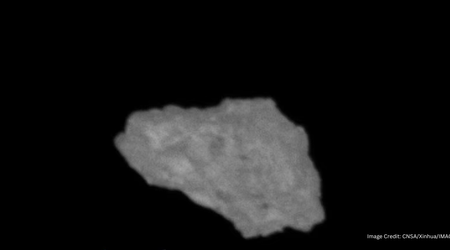
He minutely analyzed the path of an asteroid called 2001 CA21 because its early predicted path crossed the orbits of both Earth and Mars. He searched for paths to Mars that stayed within five degrees of the asteroid's tilt. He calculated that staying close to this angle allows a spacecraft to take a straighter path through space. Then he probed Mars' oppositions from 2027, 2029, and 2031 to detect which one offered the best conditions for a shorter trip. Among these three years, 2031 was the only year when Earth-Mars geometry aligned favorably with the asteroid’s orbital plane.
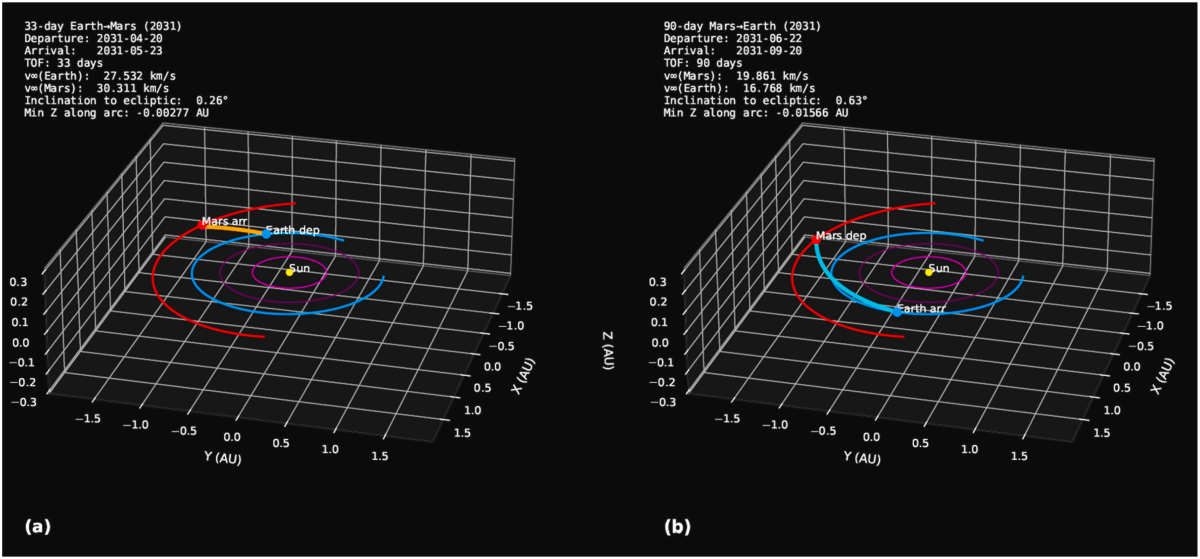
Assuming 2031 is the best year for a Mars trip, Oliveira Souza describes that a spacecraft will depart from Earth on 20 April 2031 and arrive on Mars on 23 May 2031. This means it will take 33 days for a one-way trip. After a stay of 30 days, the spacecraft will take off from Mars on 22 June 2031 and arrive on Earth on 23 September 2031. The spacecraft will lift off from Earth at 27.5 kilometers/sec and land on Mars at 30.3 kilometers/sec. It will leave the Martian surface at a velocity of 19.9 kilometers/sec and arrive on Earth at 16.8 kilometers/sec. The study demonstrates that orbital data of a small body like asteroids may yield vital clues, allowing researchers to make breakthroughs like rapid interplanetary travel.
More on Starlust
Humans can reach Alpha Centauri within lifetime by boarding a light-powered spacecraft