Hubble beautifully captures explosive past of spiral galaxy NGC 1309, 100 million light-years away, in latest image
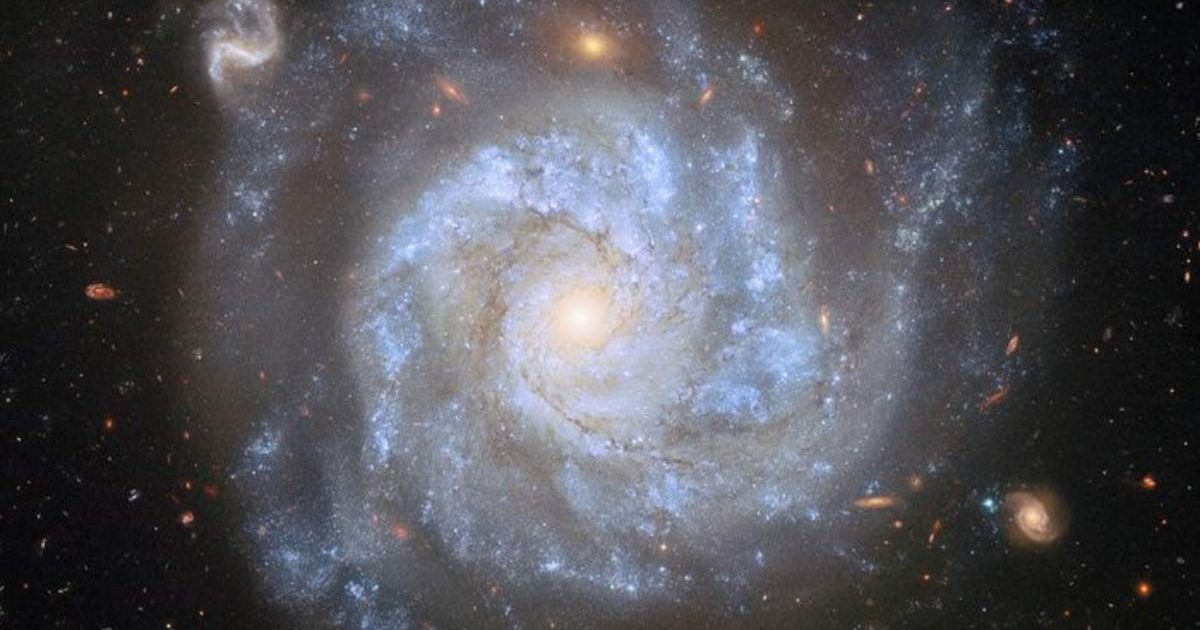
The Hubble Space Telescope has delivered a breathtaking new image of spiral galaxy NGC 1309, revealing its tumultuous past, including two documented supernova events. Located approximately 100 million light-years away in the constellation Eridanus, the galaxy's intricate structure and a backdrop of countless other galaxies are prominently featured, according to ESA Hubble.
The newly released Hubble portrait captures NGC 1309's vibrant blue star-forming regions, obscuring lanes of dark gas and dust, and a bright, pearl-white galactic core. Nearly every luminous point in the expansive image represents a distinct galaxy, with the sole exception of a foreground star from our Milky Way, identifiable by its diffraction spikes. NGC 1309 has been a repeat subject for Hubble, with previous observations yielding images in 2006 and 2014. The galaxy's significance to astronomical research largely stems from two supernova occurrences: SN 2002fk in 2002 and SN 2012Z in 2012.
Our ESA/Hubble Picture of the Week features a supernova-rich spiral! 1/4 pic.twitter.com/5g1pEjafsr
— HUBBLE (@HUBBLE_space) July 28, 2025
SN 2002fk served as a textbook example of a Type Ia supernova, resulting from the cataclysmic explosion of a white dwarf star. In contrast, SN 2012Z presented an unusual case, classified as a Type Iax supernova. While its spectral signature mirrored that of a Type Ia, its luminosity was unexpectedly dim. Subsequently, Hubble observations indicated that this explosion did not obliterate the white dwarf entirely, leaving behind a "zombie star" that remarkably outshone its pre-supernova state. Furthermore, multi-year Hubble data of NGC 1309 marked the first instance where the progenitor white dwarf of a supernova was directly identified in images taken before the stellar explosion.
SN 2012Z, however, was a Type Iax supernova. While its spectrum resembled that of a Type Ia supernova, the supernova did not annihilate the white dwarf, leaving behind a ‘zombie star’ 🧟♂️⭐ that shone even brighter than it did before. 4/4
— HUBBLE (@HUBBLE_space) July 28, 2025
Read more: https://t.co/lAePPWcx7X pic.twitter.com/ueaMUvGnP7
The revelations about NGC 1309 underscore a broader theme in galactic evolution, as evidenced by another recent Hubble capture: the spiral galaxy IC 758. Despite its seemingly tranquil appearance in a 2023 Hubble image, showcasing soft blue spiral arms gently wrapping around a hazy, barred center, IC 758, situated 60 million light-years away in the constellation Ursa Major, also harbors a history of cosmic violence, as mentioned on NASA Science.
In 1999, astronomers detected supernova SN 1999bg within IC 758, marking the dramatic demise of a star considerably more massive than our Sun. While the exact pre-explosion mass of this star remains unknown, ongoing Hubble observations of SN 1999bg's stellar neighborhood are expected to provide crucial data. Researchers plan to use these measurements to estimate the original mass of the progenitor star. The Hubble data may also indicate whether the star that became SN 1999bg had a companion, offering further insights into its life cycle and explosive death.
Supernovae are not merely the end-point for individual stars; they are profound cosmic events that significantly reshape their galactic environments. When a massive star undergoes a supernova, its outer layers are violently ejected as they rebound off the collapsing core. This immense explosion stirs and heats the interstellar medium, the gas and dust from which new stars are born. Such a cataclysmic event can either disperse and heat nearby gas clouds, thereby inhibiting new star formation, or, conversely, compress them, triggering a surge of new stellar births. Crucially, the material expelled by supernovae enriches the interstellar medium with heavy elements forged within the star's core, providing essential building blocks for future generations of stars.