'New star' in the Lupus constrellation is close to being visible to the naked-eye

A new classical nova, officially designated V462 Lupi, has been confirmed in the constellation Lupus, rapidly brightening to naked-eye visibility since its discovery on June 12. Initially detected as an 8.7-magnitude stellar object by the All-Sky Automated Survey for Supernovae (ASAS-SN) on June 12, the "new star" quickly underwent spectroscopic analysis by Yusuke Tampo of the South African Astronomical Observatory (University of Cape Town), as per Sky & Telescope.

Tampo's observations confirmed its identity as a classical nova, characterized by its distinct spectral features and a dramatic increase in luminosity. Following a series of temporary designations, including AT 2025nlr, ASASSN-25cm, and N Lup 2025, the celestial object received its official name, V462 Lupi, on June 16. The nova's ascent in brightness has been remarkable. As of 3 p.m.Eastern Daylight Time on June 17, it had reached magnitude 6.1, making it discernible to the unaided eye from locations with dark skies. This rapid increase is particularly striking given that the progenitor star was previously estimated to be around magnitude 22.3 in the blue band, according to the American Association for Variable Stars (AAVSO) observer Sebastián Otero, who referenced an older photographic plate.

Despite its southerly declination of -40°, V462 Lupi remains bright enough to be observed even from the northern United States. For observers at approximately 47°N latitude, the nova will appear about 3° above the horizon during its meridian crossing. Even with atmospheric extinction causing about a 2.5-magnitude dimming from thick air near the horizon, the nova is expected to remain visible at around magnitude 9. An unobstructed southern horizon will be key for such observations.

For those at latitudes around 40°N, the nova will climb to a more comfortable 10° altitude at meridian crossing, which occurs around 10:30 p.m. local time. From Tucson, Arizona, the nova will reach an even higher altitude of 18°. Nova explosions reaching magnitude 6 or brighter are uncommon, presenting a unique opportunity for skywatchers. Observers are encouraged to view V462 Lupi on the next clear night. A basic Stellarium map can help locate the nova. In contrast, maps from the American Association of Variable Star Observers (AAVSO) can provide precise positioning and aid in tracking its changing brightness in the coming nights.
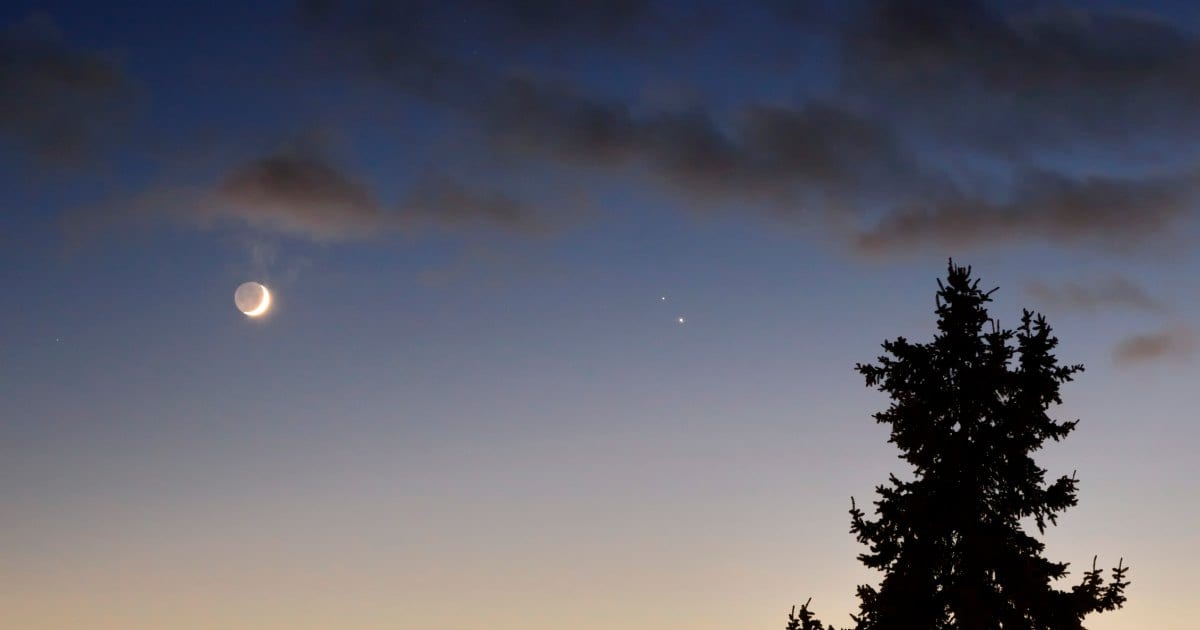
Beyond stellar fireworks like V462 Lupi, the night sky also presents the Solar System's brightest planets: Venus, Mars, Mercury, Jupiter, and Saturn. Their brilliance depends on their distance from the Sun and Earth, their size, and their reflectivity (albedo). While Mercury receives abundant light due to its proximity to the Sun (0.61 AU from Earth), its small, dark, and airless nature (albedo 0.1) makes it hard to distinguish from solar glare. Conversely, the gas giants Jupiter (4.2 AU) and Saturn (8.52 AU) are vast, reflecting about half the light they receive, but their immense distance significantly diminishes their apparent brightness.
Mars, at 0.52 AU, is twice as small as Earth but stands out with its reddish hue (albedo 0.25). Venus, however, consistently shines brightest, owing to its proximity to Earth (0.28 AU, or about 25.7 million kilometers) and its near-Earth size, complemented by its high reflectivity. These diverse phenomena, from erupting stars and the majestic band of our galaxy to the distinct points of our planetary neighbors, collectively highlight the dynamic nature of the cosmos, encouraging everyone to look up and explore.