Heat shield for NASA's Dragonfly mission undergoes thermal testing in New Mexico desert

The heat shield material meant to be used on NASA's Dragonfly mission recently went through stress tests at Sandia National Labs’ Solar Thermal Test Facility in Albuquerque, New Mexico. The material, made out of carbon fiber and a lightweight resin, performed as expected in combined mechanical and thermal testing, even when flaws were intentionally incorporated. These tests were conducted to ensure that the rotorcraft will be able to make it safely through the dense atmosphere of Titan—Saturn's largest moon.
Dragonfly’s heat shield endured a 4,500°F blast—and passed the test.
— NASA Ames (@NASAAmes) June 1, 2026
Units of NASA’s Dragonfly's heat shield faced intense solar radiation and mechanical stress testing @SandiaLabs, confirming that its carbon fiber and resin thermal protection material can withstand the harsh… pic.twitter.com/TSMCAuBqax
“We tested the heat shield as a complete system, including the primary PICA-D material, gap fillers, and potential manufacturing defects,” said Milad Mahzari, the Dragonfly entry vehicle thermal protection system lead at NASA Ames, in a statement. PICA, a material that NASA invented, stands for Phenolic Impregnated Carbon Ablator and was also used to deploy both the Curiosity and Perseverance rovers on Mars. According to Mahzari, the material will undergo additional analysis before the final construction of the heat shield begins.
In order to confirm it can handle a harsh entry into the atmosphere of Saturn’s largest moon, Titan, the heat shield for NASA’s Dragonfly mission completed thermal-structural testing...and it performed even better than expected!
— NASA Marshall (@NASA_Marshall) June 1, 2026
Read more here: https://t.co/dhrPVrT4ET pic.twitter.com/QpD4ABYUrL
To examine the performance of PICA-D, the teams subjected segments of the material to temperatures in the region of 2,500 degrees Celsius (around 4,500 degrees Fahrenheit). This was achieved through an apparatus at Sandia's Solar Tower test facility that features hundreds of calibrated mirror-like elements to converge the Sun’s heat onto a target.
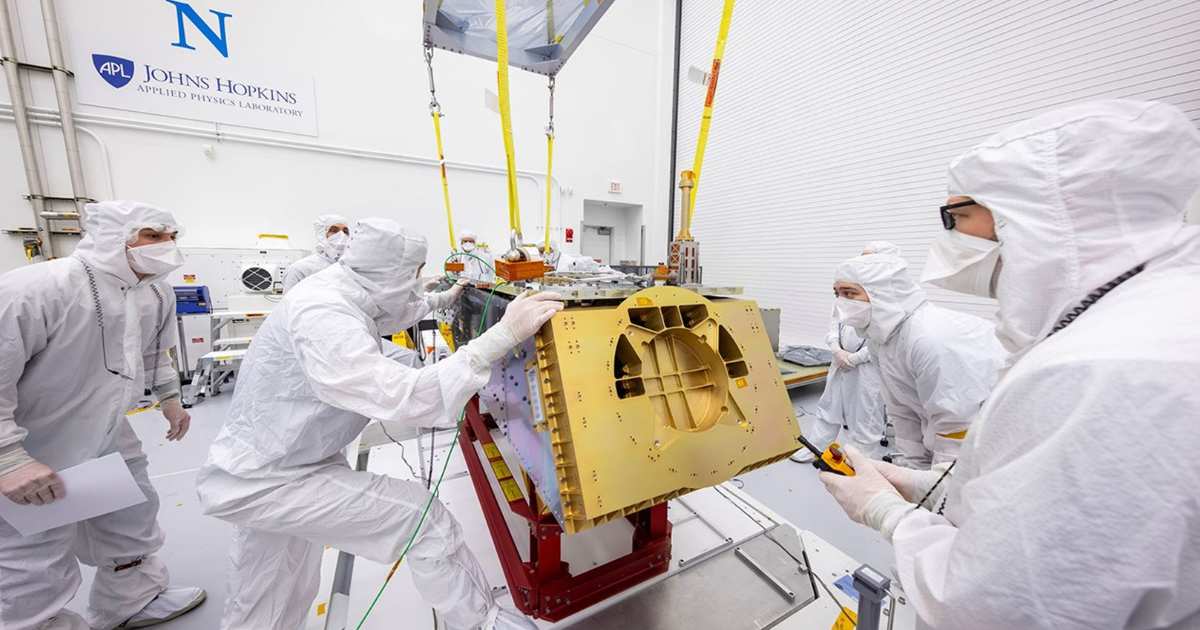
The integration and testing phase, which began in March, continues at the Applied Physics Laboratory (APL), in Laurel, Maryland. This includes work on the rotorcraft's communication systems. In fact, the team recently studied the signal patterns coming from the rotorcraft's high-gain antenna in an APL test chamber that replicates the space environment. Originally developed for NASA's DART, the 34.4-inch diameter antenna is currently flying on the twin ESCAPADE spacecraft.

"A simple way to picture the antenna is as a large flat showerhead: energy enters near the center and spreads out through the slots in a controlled pattern," explained Matt Bray, Dragonfly lead antenna designer at APL. "This design provides a low-cost, durable and compact approach to high-efficiency communications in extreme space environments and also provides aerodynamic benefits." The antenna, which will be attached to the top deck of the lander on a gimbal, will be able to locate Earth from a range of locations on Titan. A thermal insulator called Kapton will cover it so that it stays protected from the frigid environment on the moon, where ambient temperatures can fall to minus 179 degrees Celsius.
Dragonfly's launch is slated for 2028, and it is expected to reach Titan in 2034. The objective of the mission is to unearth insights into the composition of the various surface materials of the moon and observe its geology and meteorology. After all, it is the only moon in the solar system that is understood to have a dense atmosphere.
More on Starlust
Gentle winds on Titan's lakes could trigger massive 10-foot waves, MIT study reveals
Saturn's largest moon, Titan, may have formed from the collision of two older moons, study finds