Are aliens simply off the grid? A theory offers a surprising solution to the Fermi paradox
The Sustainability Solution: A new answer to Fermi's question?
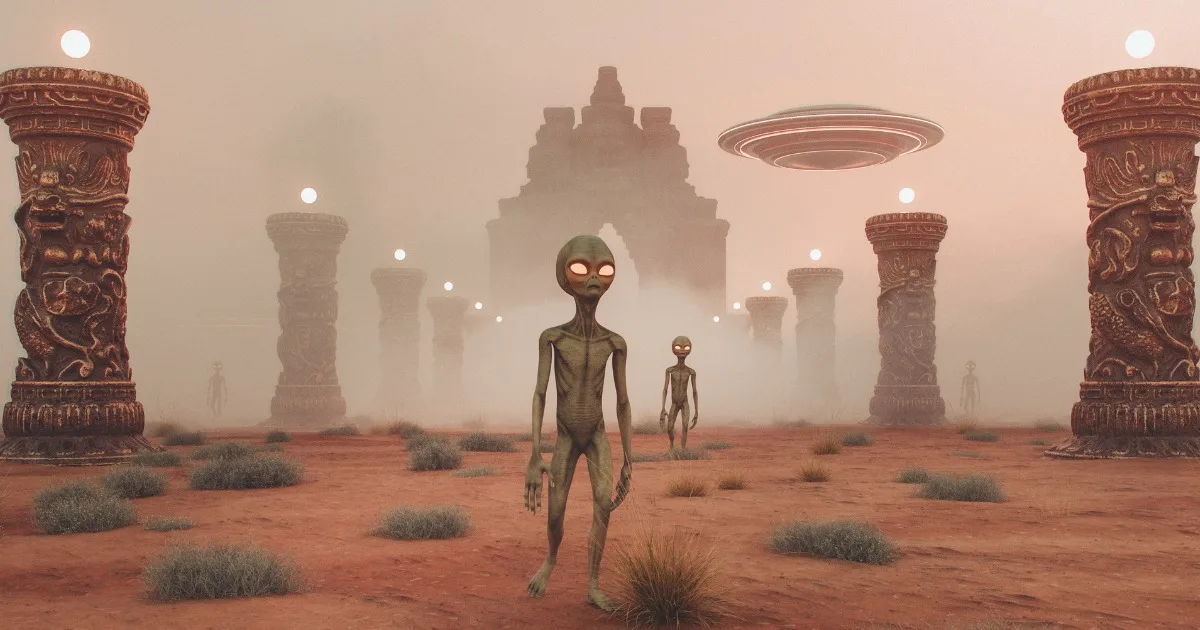
For decades, Enrico Fermi’s famous question, “Where is everybody?” has baffled astronomers. Despite scouring the cosmos for radio signals or megastructures, scientists have yet to find any definitive evidence of extraterrestrial life. However, a hypothesis known as the Sustainability Solution offers a new way of looking at this puzzle. It asserts that in order to achieve long-term survival, advanced civilizations must prioritize sustainable living over endless expansion. This dynamic perfectly explains why humans have failed to find any technosignatures.
Could sustainable living shape the destiny of alien civilizations?

The Sustainability Solution proposes that after a certain point, every civilization faces a decision: adapt to live sustainably within their planet’s limits, or perish. This hypothesis was initially brought to light in 2009 by Pennsylvania State University scientists Seth Baum and Jacob Haqq-Misra. Haqq-Misra and Baum proposed that older, wiser aliens might not be interested in creating massive, energy-hungry structures like Dyson spheres. Rather, they might focus their engineering on seamlessly blending their technospheres with nature.
Technology must ultimately return to the biosphere
The idea of the Sustainability Solution has recently gained further traction. In a 2024 paper available on the preprint server arXiv, philosopher and New York University researcher Lukáš Likavčan argued that technology cannot exist independently forever. If a civilization relies on endless growth, it will eventually use up and damage the natural resources of the host planet, leading to inevitable collapse. That’s because a planet has finite resources, and an ecosystem has a strict limit up to which it can absorb pollution. Thus, the new paper stressed the importance of a civilization's technology folding ‘back into the biosphere.’ Instead of viewing a technosphere as a permanent new geological layer, Likavčan suggested that it should be seen merely as a "transitory armature" of a planet's evolution.
Advanced civilizations might abandon visible technological expansion

Any civilization that hopes to flourish for millions of years would also likely eventually abandon the pursuit of endless technological growth. Recognizing the perils of resource depletion, they would likely integrate their technology directly with nature. Because humans currently assume that technological progress means building bigger, louder, complex technology, scientists try to find massive, artificial traces of technospheres. However, these signatures might not be detectable at all if alien civilizations have already adopted the Sustainability Solution. As Likavčan highlighted in his paper, citing science fiction author Karl Schroeder: “Any sufficiently advanced technology is indistinguishable from nature.”
The future of Earth’s technology might lie within nature
In essence, humanity's current framework for finding alien life might be entirely outdated. Biased by the rapid, unchecked technological development on Earth, scientists often fail to consider the possibility that a mature technosphere might actually function as an extension of nature. According to the Sustainability Solution, Earth’s current technosphere might just be a loud, transitional phase and not our final state. If human civilization on Earth successfully learns to balance its technology with the biosphere, our own technosignatures will eventually fade into the background, making us just as hard to detect as the aliens we are searching for.