Could aliens be communicating like fireflies? This study challenges human bias in ETI search
In our search for alien intelligence, we have been looking for ourselves

We have been looking for aliens for a long time with no success. A new study suggests that the reason may be an anthropocentric bias in our approach.
Take, for instance, Project Ozma in 1960, the first modern attempt at detecting interstellar radio transmissions, which was informed by the progress we had made ourselves in the field of radio communication. We were essentially trying to look for familiar signs from a hypothetical species we knew nothing about. We were, in a way, looking for ourselves.
Consider this: What if the species we were looking for back then was already a hundred years ahead of us in terms of technological development? The Earth itself has become less “radio loud” since the 1960s. This is largely thanks to the shift from high-powered, omnidirectional television broadcasts to highly targeted, low-power satellite beams and enclosed fiber-optic internet cables. It’s true that the search for possible technosignatures has expanded to include laser transmissions, neutrinos, and gravitational waves. But we’ve still had no luck.
Why the search should be expanded to include the non-human
"SETI has traditionally spanned two extremes: an anthropocentric search for human-like technosignatures and an anomaly-based search for signals that deviate from known astrophysics," co-author Estelle Janin told Universe Today. She is a PhD candidate at the School of Earth and Space Exploration at Arizona State University.
The alternative that Janin and her teammates propose de-centers the human in that it considers including non-human modes of communication in the search.
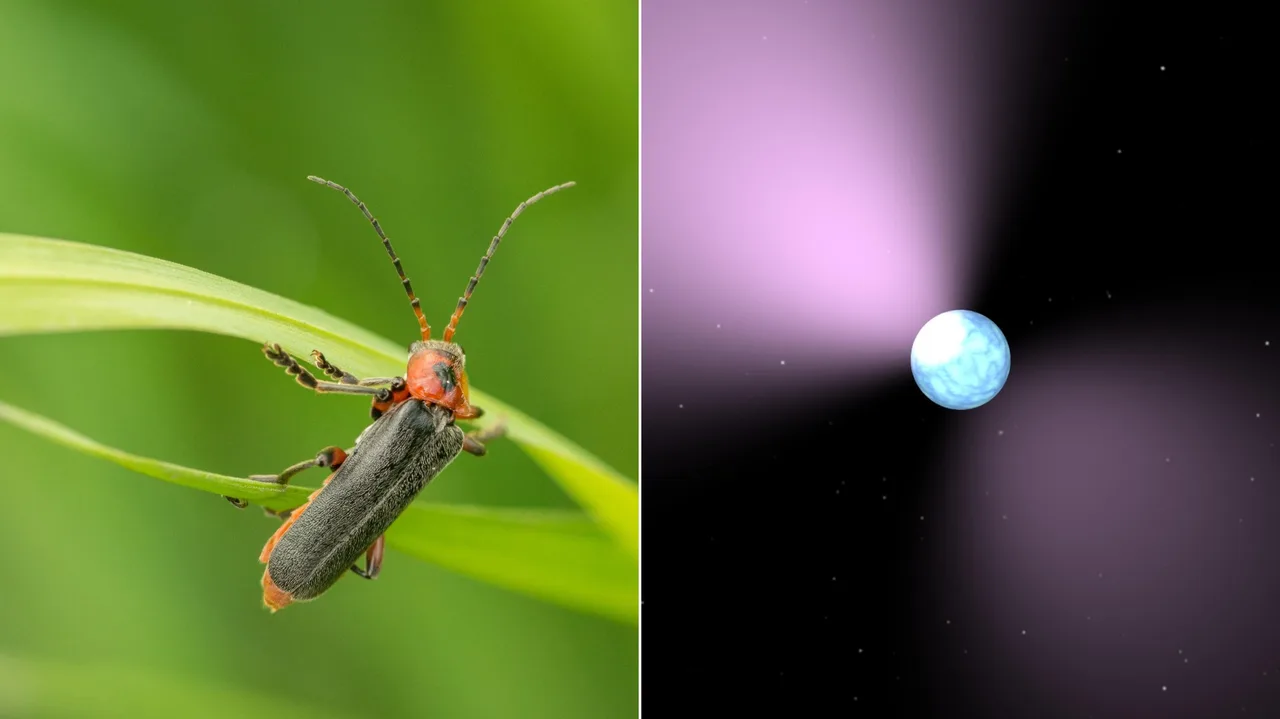
To illustrate the merit of this approach, they looked into fireflies, which produce periodic flashes during their mating season. Shaped by evolution, this signaling pattern allows them to tell fellow species members apart from others, while also acting as a warning signal to help them avoid predators.
“Communication is a fundamental feature of life across lineages and manifests in a wonderful diversity of forms and strategies,” she explained, adding that the inclusion of non-human communication in our search could help us expand our understanding of what alien communication could look like.
The study: Fireflies and pulsar stars

For the study, the researchers created a model that generated an energy-efficient signal. It was similar to the periodic flashes of fireflies that make them stand out from complex visual backgrounds. The team then tested the distinctiveness of the signal against a simulated sky that contained 158 pulsars within an approximately 16,300-light-year search area centered on Earth.
Separating probe-worthy signals from astrophysical noise
The study found that the optimized, firefly-like signals required between 84% and 99.78% less energy than the radiation emitted by most of the natural pulsars. In other words, it showed that highly energy-efficient signals shaped by evolution can stand out from astrophysical noise. We could thus, in theory, detect such artificial signals without having to decode or understand them.
“We show that alien signals don’t have to be complicated or semantically decipherable to be recognized; rather, their inherent structure can be identified as a product of selection and evolution, uniquely and robustly implying the presence of life,” Janin explained. “This approach challenges SETI to consider the broader Earth biosphere and to adopt less anthropocentric methods, grounded in the ubiquitous structural properties of life and communication.”