Is time travel possible? What Albert Einstein's theory of relativity tells us
Einstein changed how we understand time and space

The theory of relativity, proposed by Albert Einstein in two parts in 1905 and 1915, fundamentally changed our understanding of the universe. Einstein demonstrated that time and space can stretch or compress depending on speed and gravity, meaning that time does not pass at the same rate everywhere. A second on the surface of Earth is slightly different from a second experienced by a satellite orbiting the planet. Rather than massive objects like stars and planets simply pushing down on space, their mass warps the fabric of spacetime itself, creating the effect we feel as gravity. Through his theories, Einstein was describing real physical changes, not just illusions, and these concepts became the scientific foundation for exploring whether traveling through time could ever be possible.
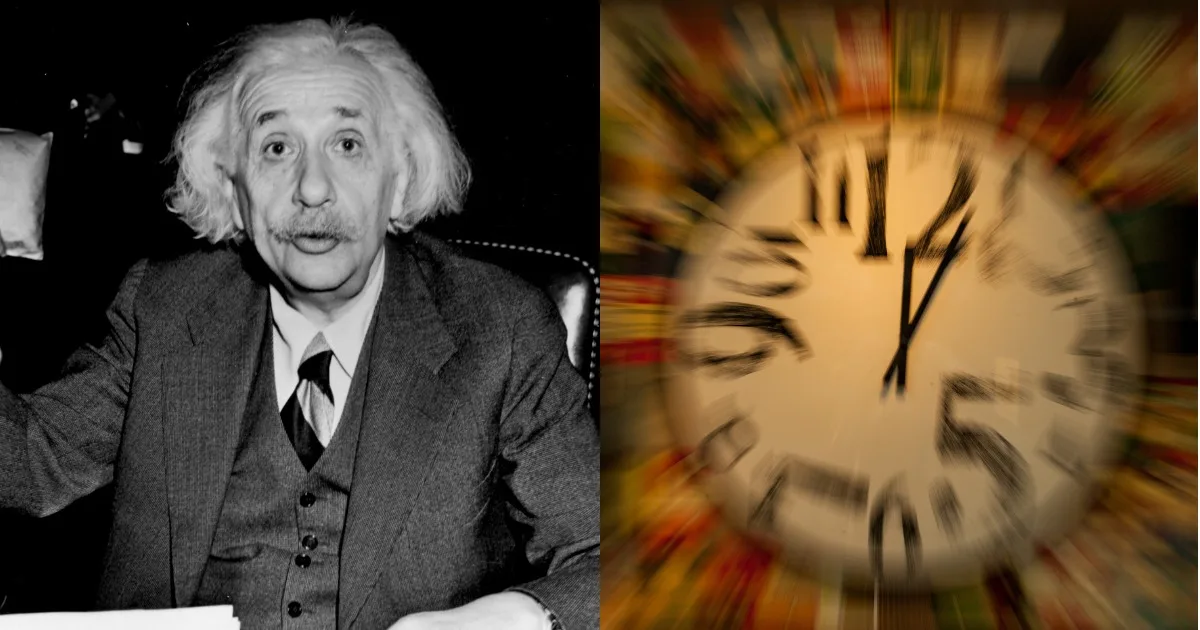
This is an image of German-born American physicist Albert Einstein (1879 - 1955) (L) and a stock photo representing warped time (R).
Relativity makes travel into the future possible
The special theory of relativity, proposed in 1905 by Einstein, suggests that traveling into the future is scientifically possible through due to what is known as time dilation. Light always travels at the exact same speed in a vacuum, no matter how fast an observer is moving, but for an object approaching the speed of light, time slows down. For instance, if a spacefarer took a five-year round trip at 97% of the speed of light, they would return to Earth to find that about 20 years had passed for everyone else. In real life, this phenomenon was famously documented when NASA astronaut Scott Kelly spent nearly a year aboard the International Space Station (ISS). Traveling at roughly 17,500 mph, Kelly experienced time slightly slower than his twin brother Mark down on Earth, widening their age gap by about 13 milliseconds.
Gravity can also slow down time
Time is not only affected by speed, but it also gets warped by gravity. According to general relativity, proposed by Einstein in 1915, mass and energy curve spacetime, and this curvature dictates how time flows. A stronger gravitational field, therefore, means that time nearby will pass more slowly relative to an observer in a weaker gravitational field. Pop culture famously demonstrated this effect in the Christopher Nolan-directed movie Interstellar. When one of the characters visited a planet orbiting a supermassive black hole, they spent only a few hours on its surface, but because of extreme gravitational time dilation, decades passed for his daughter waiting back on Earth.
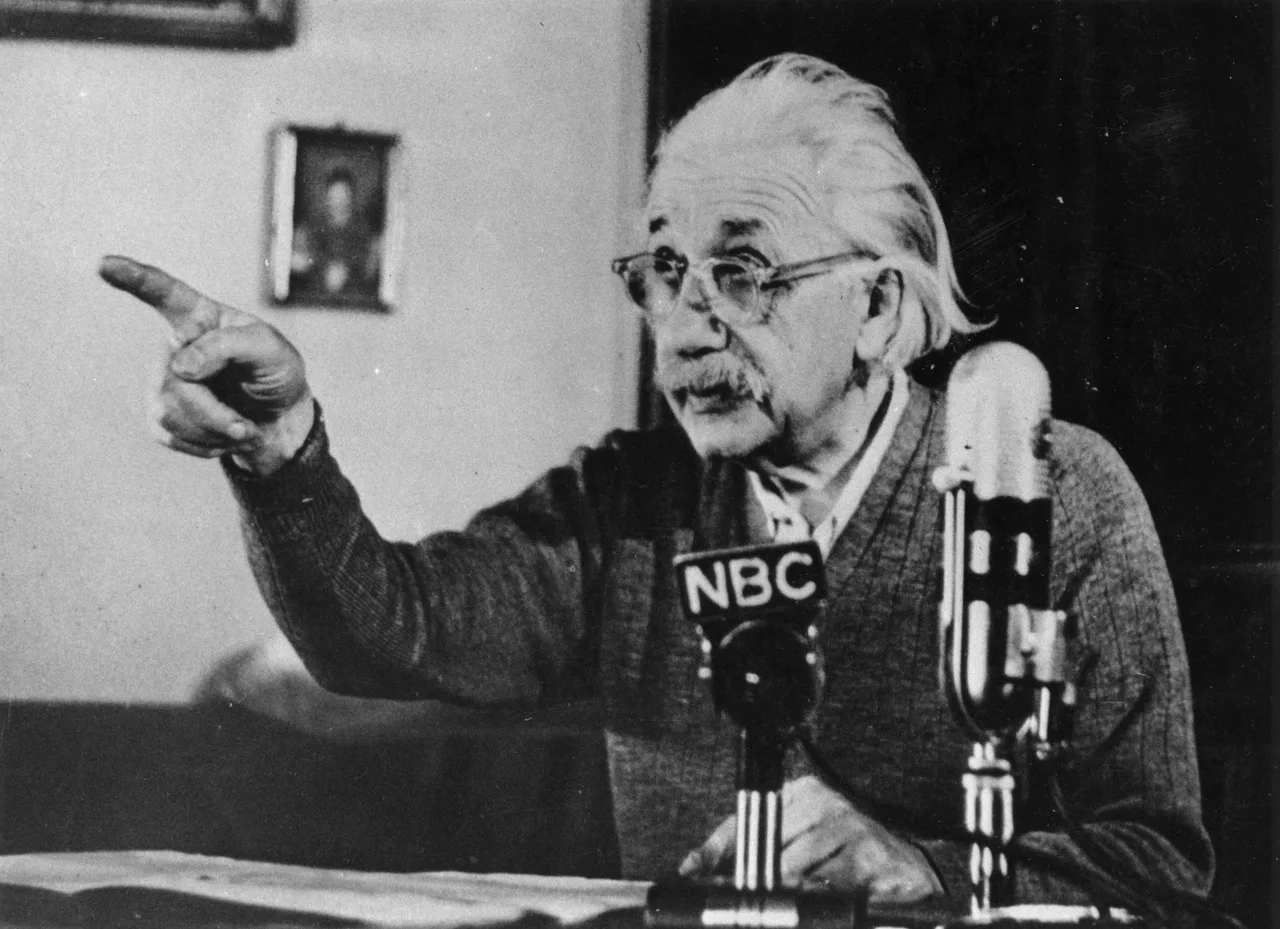
This image shows physicist Albert Einstein delivering a lecture in 1955.
General relativity also allows journeys into the past

Einstein’s theory of general relativity has also teased the hypothetical possibility of traveling back in time, a trope commonly explored in science-fiction. Indeed, the math allows for "closed timelike curves" or pathways through spacetime that loop back on themselves, theoretically allowing a traveler to return to their own past. This mind-bending possibility within Einstein's equations was first identified by Dutch mathematician Willem Jacob van Stockum in 1937, more than 20 years after the publication of general relativity.
Why time travel to the past remains only theoretical
While Einstein’s field equations capture the interactions between matter and spacetime, they allow for multiple mathematical solutions. In 1916, Karl Schwarzschild calculated a solution describing the spacetime around a non-rotating mass. Decades later, in 1963, mathematician Roy Kerr solved the equations for rotating masses. Kerr's model for a rotating black hole hypothetically allows for closed timelike curves, suggesting that mathematically at least, it is possible to visit the past. However, these curves exist in a highly unstable region near the black hole's inner horizon. Even if this were possible, physicists believe that the slightest disruption, such as a single particle falling into the black hole, would lead to the collapse of this region. Due to this extreme volatility, alongside paradoxes that violate causality, time travel into the past remains strictly limited to the realm of theoretical physics.