ESA's Mars Express reveals how the most visually striking cloud on the Red Planet forms
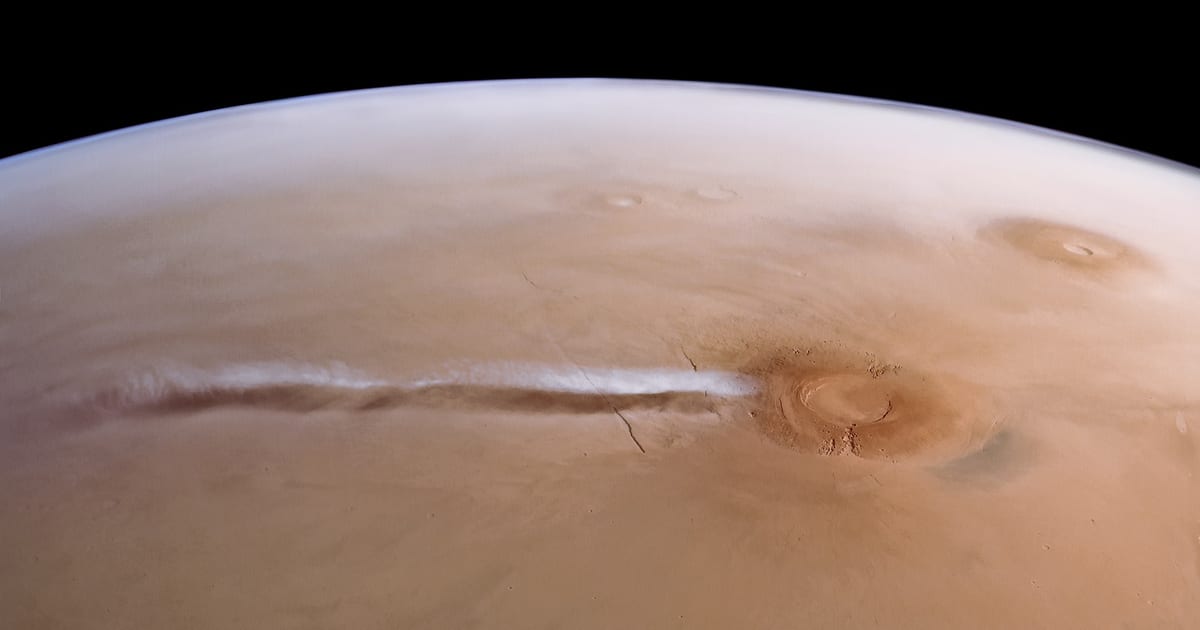
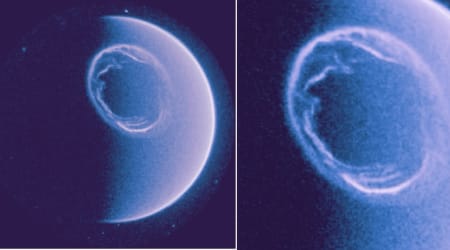
Scientists have found why one of the most curious features on Mars appears periodically. In a study that used data from Mars Express by the European Space Agency (ESA), researchers pointed to the phenomenon that makes the Arsia Mons Elongated Cloud (AMEC) form in the Red Planet's southern hemisphere every spring and summer. What's more, the cloud forms before vanishing every morning during these Martian seasons. Scientists until now had not been able to model the cloud using existing knowledge, but what was described as a "wholly unexpected" mechanism explained how it manifests itself. The paper with these findings was published in Nature Geoscience on October 7, 2026.
Mars’s oddest cloud may be even odder than we thought 🤔 Every spring and summer in Mars’s southern hemisphere a spectacular cloud emerges: the Arsia Mons Elongated Cloud, the most visually striking cloud on the Red Planet. 1/2 https://t.co/JzypvVCy9Q
— ESA Science (@esascience) October 7, 2026
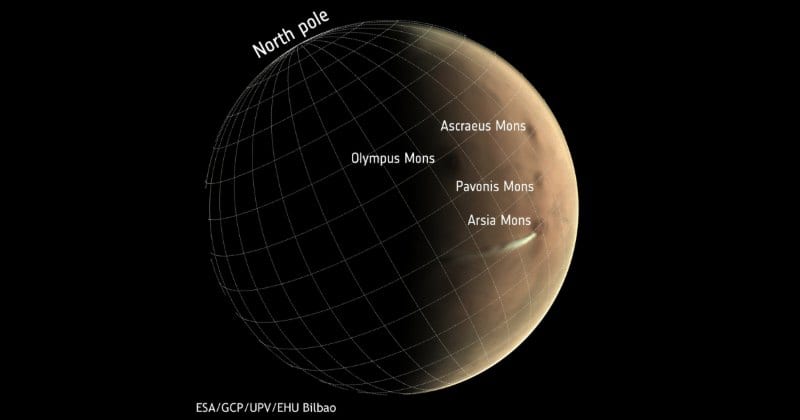
The elongated cloud's name comes from the nearby volcanic mountain called Arsia Mons on Mars that rises over 12 miles high. The AMEC itself becomes over 1,100 miles long. It forms to the west of Arsia Mons, in the direction of the wind. On Mars, a year lasts 669 sols, which equates to 687 Earth days. The elliptical orbit of Mars means spring and summer are shorter in the southern hemisphere. Because of the mountain's location south of the equator, spring and summer span a total of 296 sols. During this phase, Arsia Mons forces winds flowing past it to rise miles high in the thin Martian atmosphere. Clouds formed due to rough terrain features like mountains are known as orographic clouds. Arsia Mons causes the winds to rise and cool by 54 degrees Fahrenheit (30 degrees Celsius) in a matter of 10 minutes, raising the relative humidity.
What makes this cloud special is the fact that in order to form, it doesn't need anything other than water. On Earth, a process called heterogeneous nucleation means particles like dust and salt give water vapor something to cling to. "For the AMEC, it seems that cloud formation takes place without needing any of this ‘stuff’," said Jorge Hernández-Bernal of the Sorbonne Université in Paris, who is the lead author of the study. "Water vapor turns directly into icy cloud particles without any middle step. It’s akin to droplets of condensation appearing in the middle of a room, rather than on a window. We call this homogeneous nucleation, and we’ve never seen it before in a planetary atmosphere," added Hernández-Bernal.
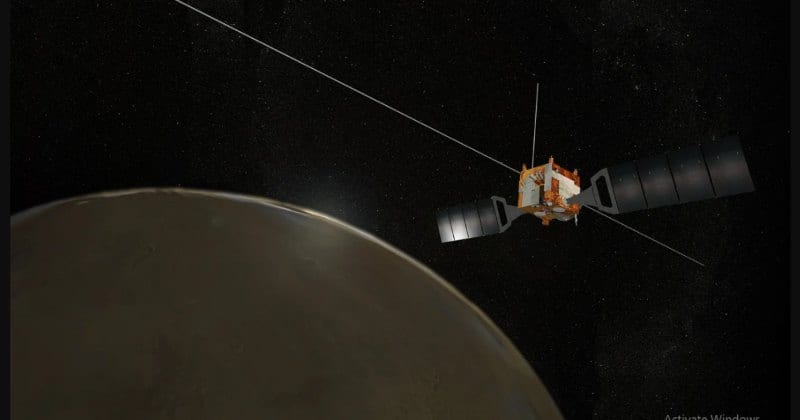
To make this happen, the conditions need to be very humid. In fact, relative humidity levels would have to be over 100,000 times greater than what we experience here on Earth. "We’ve not seen these conditions on Mars before, but our finding now strongly suggests that the planet’s humidity can indeed reach these extreme levels," stated Hernández-Bernal. The findings of the study were based on three cameras that are installed on Mars Express. One of these is the High Resolution Stereo Camera (HRSC). Detailed studies on the AMEC were only possible starting in 2018 due to its fleeting nature. Moreover, thanks to Mars Express' HRSC, this cloud could be imaged in detail for the first time. "Overall, this finding is a true accomplishment for the mission and its scientists: Mars Express discovered the AMEC, has followed up and monitored it for years, and is now helping reveal the secrets of its formation," noted ESA Project Scientist Colin Wilson.
Using Mars Express in combination with a meteorological model of the Red Planet, scientists can now reproduce how this cloud springs to life, something they were not able to do until now. Read more 👉https://t.co/p2vEVZK8Vm 2/2 https://t.co/7cId0UAnW2
— ESA Science (@esascience) October 7, 2026
Previously, simulations created had not precisely matched what could be observed. However, by adding the exotic physics of homogeneous nucleation into their meteorological models, the researchers were finally able to successfully recreate the cloud. Moreover, the phenomenon behind the formation of the AMEC could also open doors to how clouds form in exoplanets. "While clouds on Earth and Mars seem to be governed by the same ‘rules’, understanding this exotic Martian cloud required exotic physics – and this may be true elsewhere in the cosmos," said Wilson.
More on Starlust
Inside Sunbird: Pulsar Fusion's nuclear spacecraft that can cut travel time to Mars in half
ExoMars rover to search for signs of ancient life in vast Martian clay deposit