Distant moons around alien planets may host conditions for life, says new study
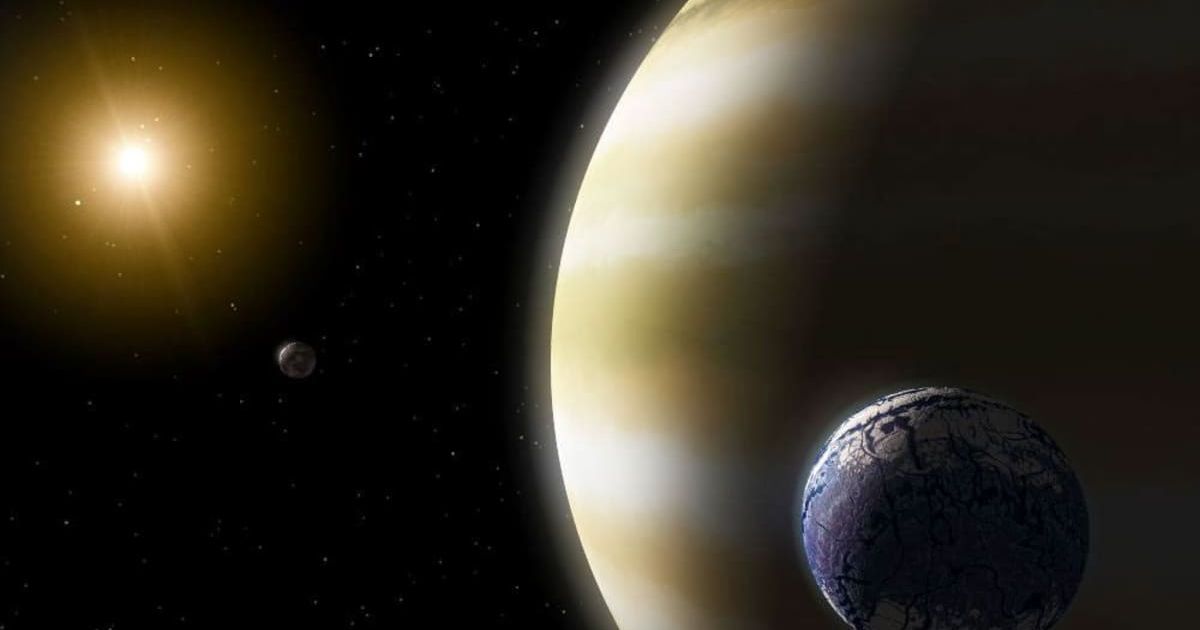
Our Moon is hostile to life. But this doesn’t mean that moons elsewhere in the universe are inhospitable to life. Far away from the solar system, moons of free-floating planets can keep water in oceans liquid for up to 4.3 billion years, a German research team has shown in a paper that is available on the arXiv preprint server. The team from the Origins Cluster of Excellence at the Ludwig Maximilian University (LMU) of Munich and the Max Planck Institute for Extraterrestrial Physics says that such a long time is enough for complex life to evolve. In fact, life on Earth took nearly 4 billion years to evolve and reach its present complex stage.
In their early days, planetary systems pass through unstable conditions. Sometimes, young planets can come too close to each other. This can displace them from their orbits. Defying the gravity of a nearby star, they begin to wander as free-floating planets. In previous research, LMU physicist Dr. Giulia Roccetti showed that as giant planets leave a star system, they take their moons with them. In such a topsy-turvy world, a wandering planet alters the moons’ orbit. The distance between the planet and the moons always changes. The planet exerts tidal forces on the moons, deforming and compressing their interiors. This generates heat on the moons, even in the absence of a star’s energy.
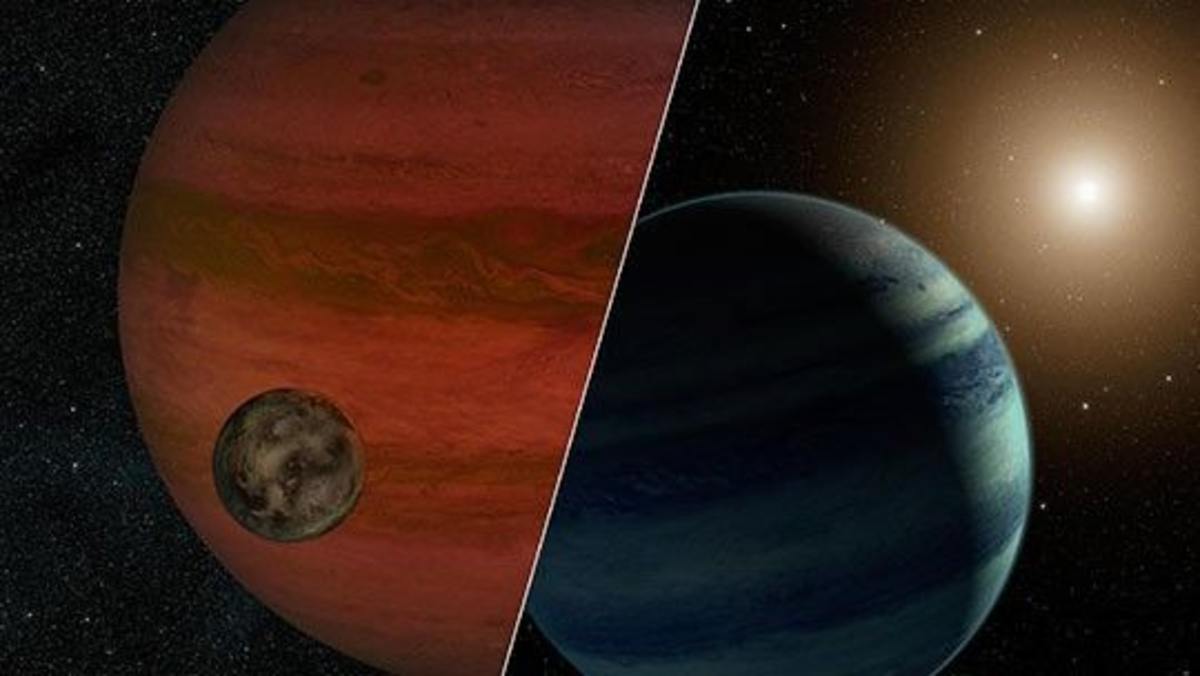
Those moons continue to drift through the cold of interstellar space. But the tidal heating can preserve liquid water oceans on their surface. Next, the researchers wondered whether the exomoons can retain this heat on their surface. On Earth, carbon dioxide acts as a greenhouse gas and can trap heat. Previous studies have shown that carbon dioxide can create life-friendly conditions on exomoons for up to 1.6 billion years. The free-floating systems lack a star and roam through cold voids of space. Under such extremely low temperatures, carbon dioxide could easily condense, allowing heat to escape. The research team then examined whether a hydrogen-rich atmosphere could store heat. Any object can absorb heat and then radiate it at an infrared wavelength, which can pass through molecular hydrogen. But the researchers thought that under high pressure, hydrogen molecules could collide with each other. This briefly form complexes that can absorb thermal radiation, retaining heat in the atmosphere. Besides, hydrogen is a stable element even at extremely low temperatures.
The results point to an alternative scenario where you don’t need the sun to kickstart the process of life. Instead, it provides new clues to the origin of life. "The collaboration with Professor Dieter Braun 's team helped us realize that the cradle of life doesn't necessarily require a sun," says David Dahlbüdding, a doctoral candidate at LMU and first author of the study, in a statement. "We discovered a clear link between these distant moons and early Earth, where high hydrogen concentrations from asteroid impacts could have created the conditions for life." Besides generating heat, tidal forces also shape chemical evolution. As the geology of the moons changes, it triggers local wet-dry cycles – an ideal condition for water to evaporate and condense again. Such wet and dry periods also catalyze the formation of complex molecules, nudging the process toward a path that could spawn life. Free-floating planets are not rare in the Milky Way. Such planets, along with their exomoon, provide us a new picture of habitable environments, letting us know that life could evolve and flourish even in the darkest corners of the galaxy.
More on Starlust
Astronomers have discovered a unique planetary system where planets are arranged 'inside out'
A rare 'teenage' planetary system could help bridge a gap in the study of cosmic evolution