Can a small probe make a trip to the nearest black hole? Astrophysicist suggests a bold plan
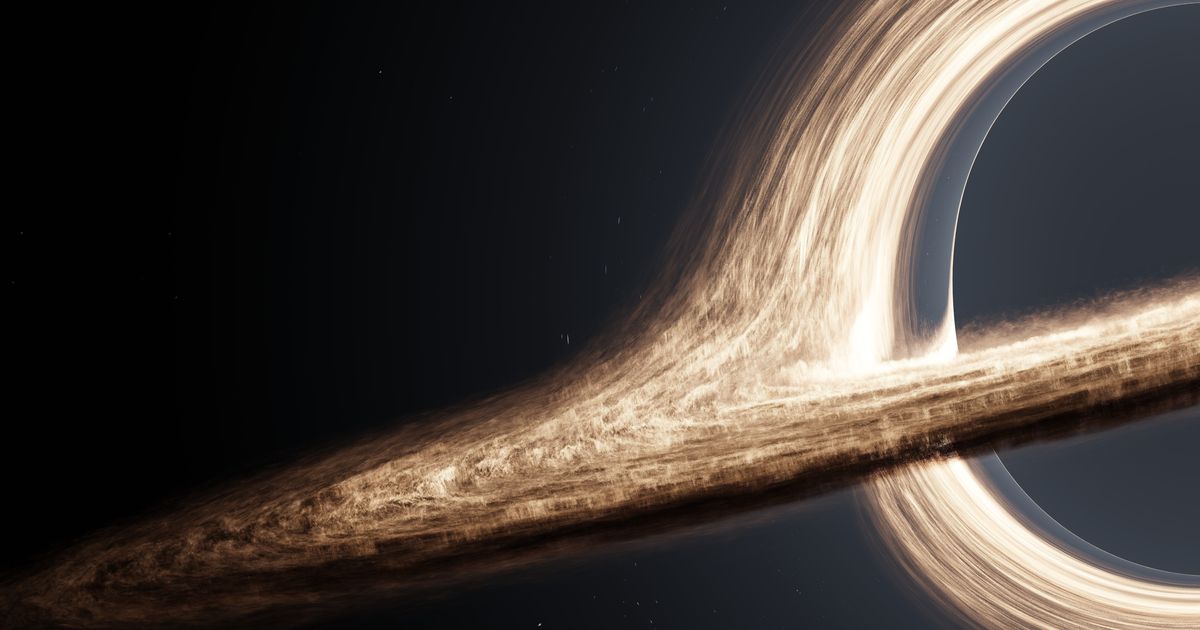
Black holes largely remain in obscurity, as they don’t emit any visible light. They are primarily detected based on the effects they have on their surroundings. But can we embark on an interstellar trip to explore the nearest black hole up close? Astrophysicist Cosimo Bambi of Fudan University in Shanghai discusses such a plan in a paper available on the arXiv preprint server.

The nearest black hole to us is Gaia BH1, located about 1,560 light-years away in the constellation Ophiuchus. This black hole was discovered because of its pull on a nearby star. But there could be more black holes lurking in our cosmic neighborhood that do not display these signs. In the study, Bambi claims our galaxy, the Milky Way, may contain as many as 100 million stellar-mass black holes. Most of them, nearly 92%, are solitary black holes that do not have companion stars. A lone black hole remains invisible as it absorbs all light that comes toward it.
Calculations by Bambi show that we should at least find one stellar-mass black hole for every 1,500 cubic parsecs, where one parsec is about 3.26 light-years. The Milky Way occupies a volume of 150 cubic kiloparsecs. If this volume is modeled as a sphere with a black hole at its center, then the radius of the sphere will be around 7 parsecs (about 23 light-years). This rough estimate indicates that we may find a black hole within 23 light-years of our solar system and as many as 10 within 50 light-years. Bambi says that if one of these black holes were to accrete gas while inside the Local Interstellar Clouds (a complex of warm, partially ionized clouds), then the electromagnetic radiation produced could serve as a telltale sign that could help current and near-future observatories detect the black hole. But would it be possible to send a probe to study it?
To explore the nearest black hole, the hypothesized space probe will have to traverse interstellar space. Proxima Centauri, the closest star to the solar system, lies 4.24 light-years away from the Sun. With the current most efficient chemical propulsion technique that uses liquid hydrogen and liquid oxygen as fuels, a rocket would take over 2,000 years to reach the nearest star. But laser-powered propulsion can change the equation.
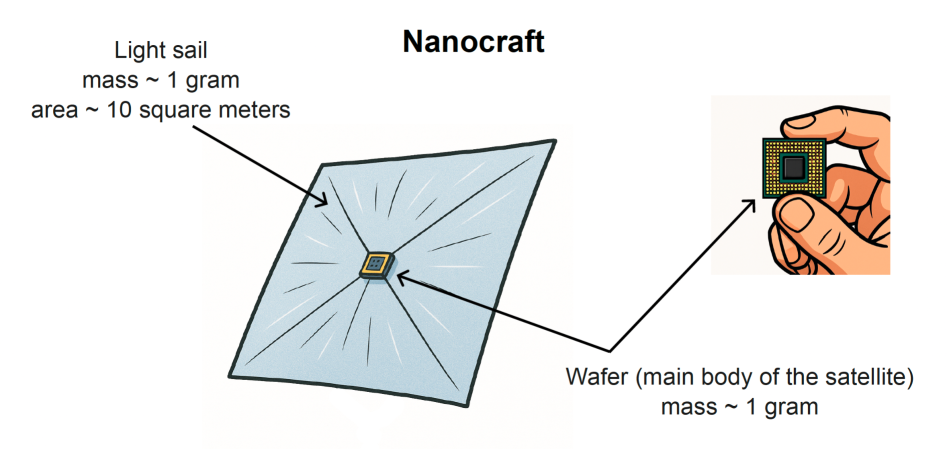
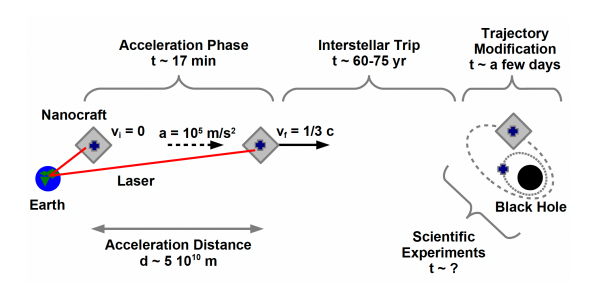
Enter the nanocraft—an ultralight space probe. “There are two main parts: a gram-sized wafer, containing a computer processor, navigation, and communication systems, and a meter-scale, extremely thin, dielectric metamaterial light sail,” Bambi writes in the paper. “High-power lasers strike the light sail, and the resulting radiation pressure accelerates the nanocraft to its target speed.” Such a system could attain almost 90% of the speed of light. There is no way to decelerate such a spacecraft, but Bambi says a flyby of the target would also prove to be sufficient if the probe manages to get close enough. As for the timeline, if the nanocraft manages to attain one-third the speed of light, a trip to the nearest black hole (within 25 light-years of the solar system) would take 60-75 years, and it would take another 20-25 years to send data back to Earth. So, the mission would last almost a century.
All that said, we do not yet have the necessary technology to mount such an ambitious mission even though it is not unachievable. Not to mention, we are yet to detect a black hole within 20-25 light-years of the solar system. Bambi says that finding such a black hole "would already be a breakthrough in physics and astrophysics, because we do not currently know of any black hole accreting from the interstellar medium."
More on Starlust
Black holes are 'much less efficient eaters' than previously suspected, claims new study
Light could power interstellar spacecraft—until it starts slowing them down