Astronomers have caught the first-ever glimpse of star-forming gas in early galaxies
An international team of astronomers has detected far-infrared light emitted by neutral atomic oxygen from the early universe, dating back to when the cosmos was just 700 to 800 million years old. The signal from these neutral oxygen atoms allowed the researchers to gain new insights into the star-forming gas and the surrounding conditions in early galaxies. They also analyzed light emitted by ionized nitrogen atoms, which exclusively trace ionized gas. This helped them disentangle these contributions and isolate the neutral gas component. They have published their results in the Astrophysical Journal.
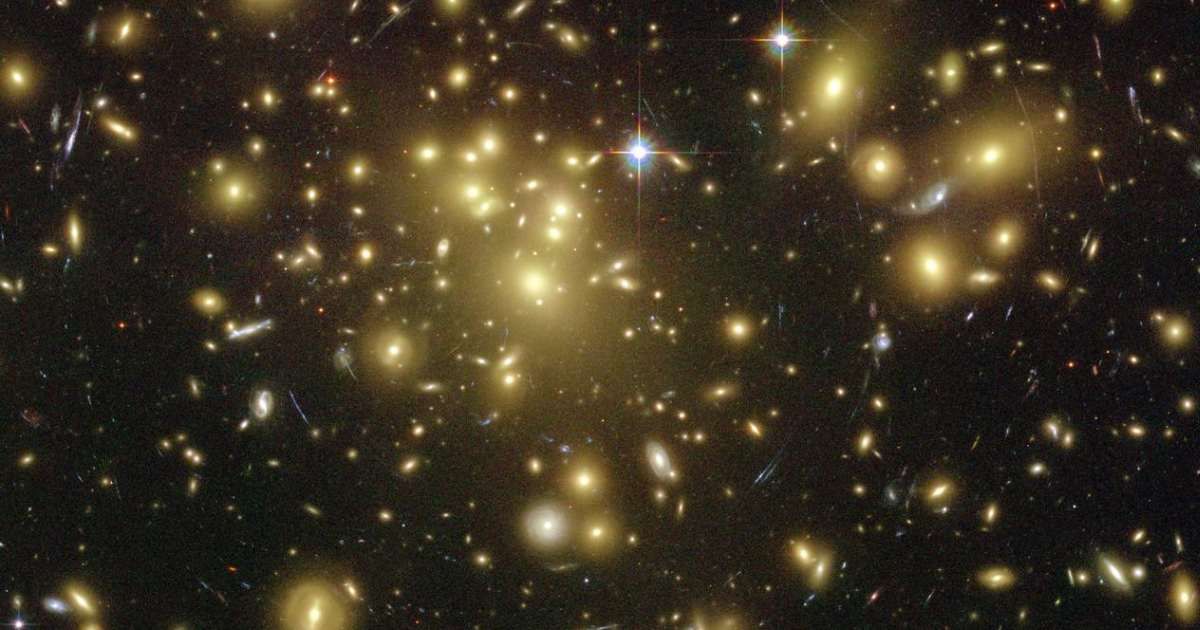
![A1689-zD1, a galaxy seen 700 million years after the Big Bang (background), with the ALMA-detected [O I] line shown as contours and a spectrum. (Cover Image Source: Assistant Professor Yoshinobu Fudamoto from Chiba University, Japan)](https://de40cj7fpezr7.cloudfront.net/d5e8d536-a16e-4631-934b-9ea17150884b.jpg)
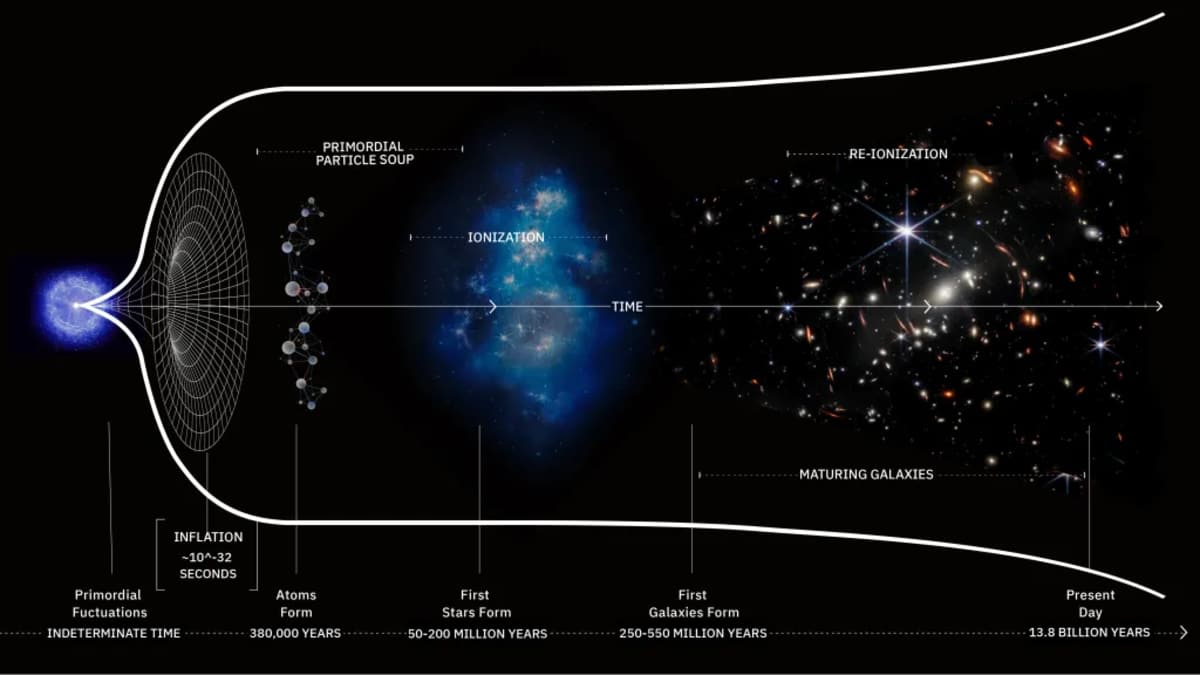
The first galaxies took hundreds of millions of years to form after the Big Bang. Those early galaxies were rich in cold gas that helped spawn the first stars, gradually evolving into the cosmos that we see today. Astronomers have long known that understanding star-forming gas can shed light on how galaxies grew. But directly tracing cold gas—the basic raw material that forms stars—has been a daunting task. Scientists have widely used light signals that come from ionized carbon, but because these emissions can emanate from neutral as well as ionized regions, the signals are historically hard to decode.

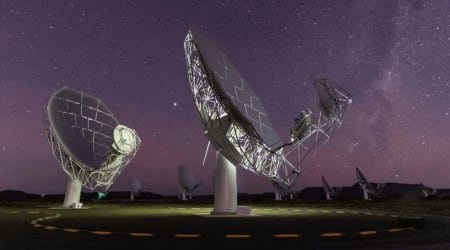
It is also difficult to trace the neutral gas component using modern observatories such as the James Webb Space Telescope (JWST) and the Hubble Space Telescope (HST). While these telescopes excel at observing stars and hot gas in distant galaxies with remarkable clarity, they cannot directly detect the cold fuel of star formation. The researchers solved this problem by using the Atacama Large Millimeter/submillimeter Array (ALMA) in Chile. The team, led by Assistant Professor Yoshinobu Fudamoto and Professor Masamune Oguri from the Center for Frontier Science at Chiba University, Japan, tracked emissions from neutral atomic oxygen, which serves as a direct tracer for the cold, neutral gas that fuels star formation.
With this powerful radio telescope, the team focused on four star-forming galaxies 700 to 800 million years after the Big Bang. They zeroed in on emissions from neutral atomic oxygen in these galaxies and combined these findings with data from JWST, uncovering the physical and chemical conditions of this star-forming material in exquisite detail for such remote galaxies. Next, the researchers probed emissions from ionized atomic nitrogen to measure the ionized gas. If such signals are absent or weak, researchers can conclude that most of the emission in these galaxies originates from neutral gas. This comparison supports the detection of neutral atomic oxygen and helps explain the origin of previously observed signals from ionized carbon.
"Our results represent the most distant direct detection of neutral gas in typical star-forming galaxies to date," said Dr. Fudamoto in a statement. "This analysis unlocks the wealth of existing [C II] observations as a probe of neutral gas in the early Universe." Based on the data from the neutral atomic oxygen, the researchers modeled the physical conditions in which the early galaxies formed and evolved. Gas densities were found to be remarkably high—comparable to those in starburst galaxies, which are known as the most intense star-forming regions. But the early galaxies’ radiation field was moderately lower than in starburst galaxies, indicating that these early systems were home to compact and dense sites of star formation. The researchers say that emissions from neutral atomic oxygen are a handy tool to track down the elusive gas component in the early universe and its contribution to star birth. "We plan to extend these observations to a larger sample of galaxies and, by combining ALMA with JWST and other facilities, build a comprehensive picture of how galaxies formed and evolved from the cosmic dawn to the present day,” added Dr. Fudamoto.
More on Starlust:
JWST spots the edge of cosmic dawn and the universe's first stars may lie just beyond
A supernova remnant may have been found near the Milky Way's central supermassive black hole