A Centaur with Saturn-like rings: NASA's Webb finds Chariklo's rings are changing in opposite ways
![An artist’s illustration of Chariklo, a distant icy Centaur orbiting between Saturn and Uranus, showing its two narrow rings surrounding the small planetary body. [Cover Image Source: NASA, ESA, CSA, Leah Hustak (STScI)]](https://d3hedi16gruj5j.cloudfront.net/817003/uploads/2db79960-b02d-11f1-9c54-4b28def44744_1200_630.jpeg)
Astronomers have found an object with Saturn-like rings, but on an object far, far smaller than Saturn. Chariklo is the largest known Centaur in the outer solar system, orbiting between Saturn and Uranus with a radius of around 125 km (78 miles). Though it is small, it still has two rings around it, a ring system that had made this icy object a subject of interest for astronomers. Gleaning fresh insights, scientists have now discovered that these rings are not static. Instead, they have shown a significant amount of change over the years, and both of the rings are changing in opposite directions.

What did James Webb find about Chariklo’s rings?
The James Webb Space Telescope (JWST) helped astronomers realize Chariklo's ring system was changing with time. In 2022, when scientists observed Chariklo, its rings passed in front of a distant star. This star's brightness showed several short dips, through which scientists gathered useful information about the rings using a technique known as stellar occultation.
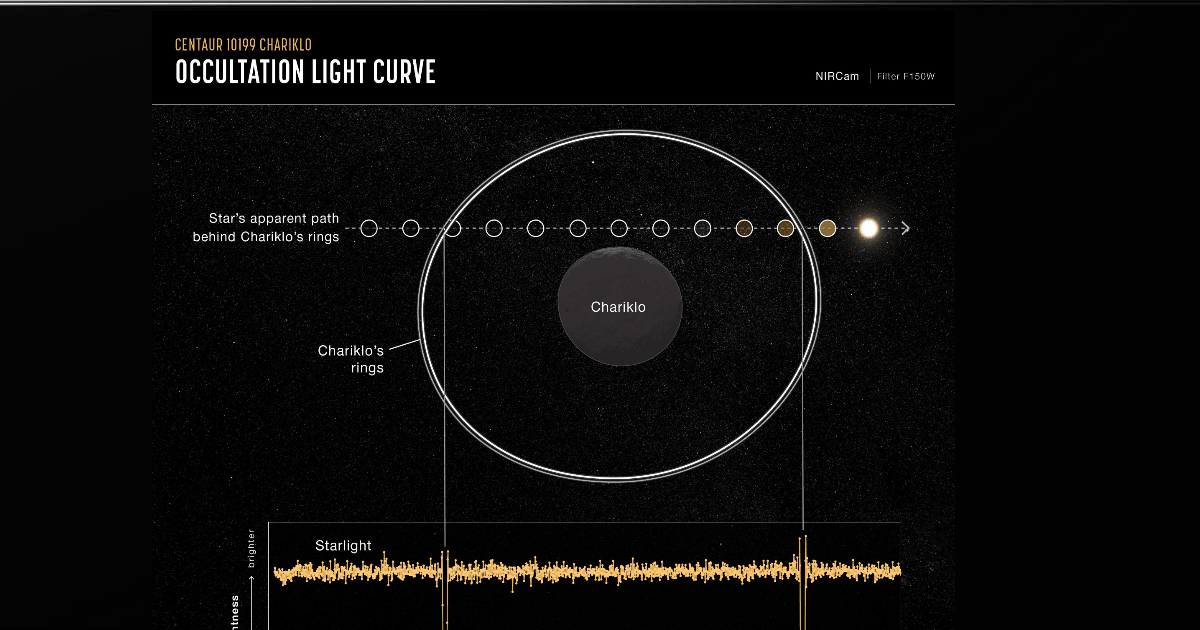
Along with this, they made an interesting observation, published in 2026, that the two rings are not changing in a similar way. When comparing the JWST data to older observations from 2017, the inner ring, which is also called C1R, was more opaque than before, meaning it blocked more of the star's light. The second one, the outer ring C2R, was comparatively less opaque, meaning it blocked less light.

What does Chariklo tell us about ring systems?
This study shows that ring systems may show "dynamic behavior". For instance, Chariklo has already shown that rings can change over time and may not be a permanent or unchanged structure. The notable part of these observations is the short time scale of these changes, meaning they can be observed over a relatively short period of time, which makes it possible to study the evolution of the rings in real time.
The Webb observation also gave scientists a much more detailed look at the rings, with a resolution of about a kilometer, and also helped them understand how particles collide, interact, and redistribute within the system.
Why do Chariklo’s changing rings matter?
The changing rings of Chariklo are important because they can help scientists elucidate how ring systems around small bodies form and maintain their stability. These observations can also underscore that such distant ring systems may involve more intricate processes than previously thought.

Since Chariklo's rings are too narrow to be directly photographed, stellar occultations may offer a way to characterize them through changes in a background star's brightness. Further observations are anticipated to help scientists understand whether the observed changes are caused by the actual evolution of the rings, a wavelength-related effect, or a combination of both.
More on Starlust
How do icy bodies become comets? A Centaur's encounter with Saturn may provide a clue
Distant dwarf planet Quaoar may have a new moon or ring system, scientists claim