A surprising twist in black hole physics: Could they split into two? Here's what scientists say

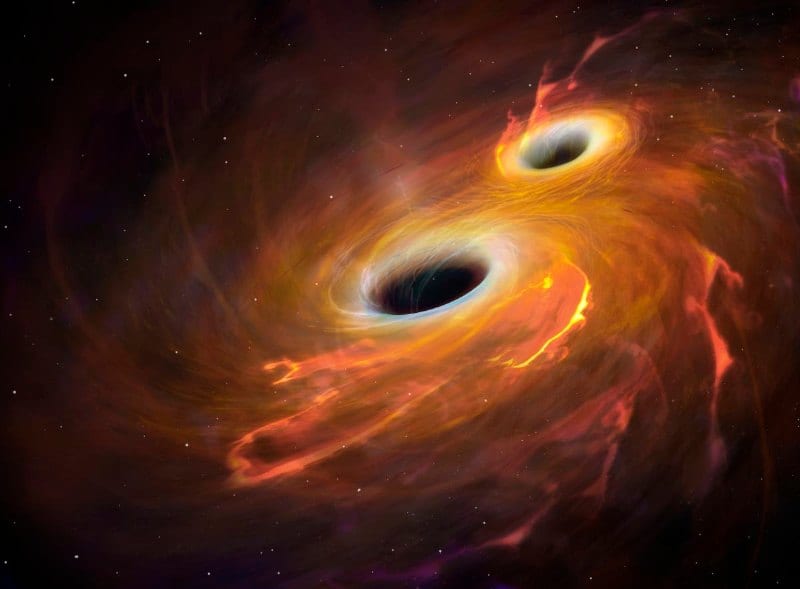
It is quite well-known that black holes can merge when they collide. But can a single black hole split into two smaller ones? This is the question addressed in a new theoretical study, published recently in Physical Review D, which suggests that, under highly restrictive conditions, this extraordinary possibility may not be entirely ruled out. The study examines the physical laws that prevent black holes from splitting and explores circumstances that might allow such an event.
What prevents black holes from splitting?
One factor that prevents black holes from splitting into two is entropy—the number of microscopic ways something can be arranged while it still retains its appearance on the outside. In scenarios where general relativity is followed, a black hole's entropy is proportional to the area of its event horizon, which scales with the square of its mass for a non-rotating black hole. Therefore, two smaller black holes with the same total mass would have less total entropy than a single larger black hole, making fragmentation thermodynamically unfavorable. But can this restriction be overcome in certain scenarios?
The study: An unusual “pair-of-pants” shape
The team found that the entropy hurdle could be overcome in the case of rapidly spinning black holes. This is because spinning black holes exhibit a different relationship between their mass, angular momentum, and entropy than non-rotating ones. It is seen that a spinning black hole shows lower entropy compared to a non-rotating black hole that has the same mass, thereby providing a potential advantage for fragmentation to take place if the black hole's spin is converted into orbital angular momentum as the two smaller black holes move apart. Their combined entropy could then approach that of the original black hole.
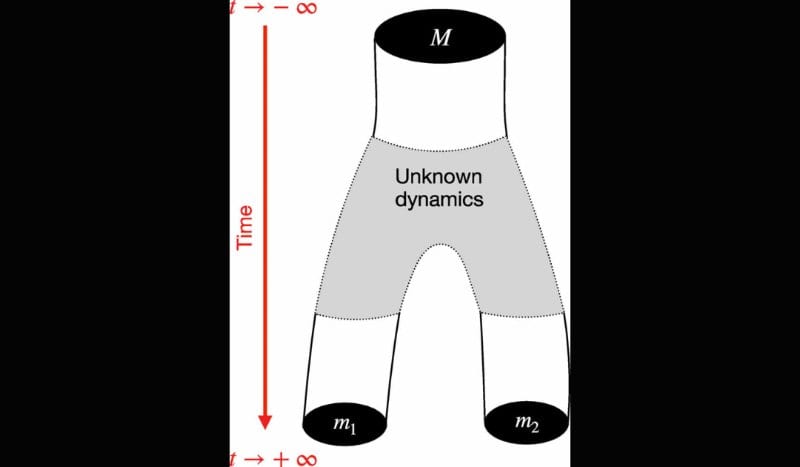
However, fulfilling the entropy requirement alone is not sufficient for splitting. An additional challenge remains: the black holes generated from splitting must possess adequate momentum and energy to move apart instead of immediately falling back together. "When we include this requirement, the window largely closes again, except possibly for black holes rotating close to their maximum possible rate," says Francesco Sannino, co-author of the study and a professor of physics at the University of Naples Federico II in Italy and the Quantum Field Theory Center at the University of Southern Denmark. The unusual study title “When black holes admit pair-of-pants topologies" describes the shape the event horizon would take if a black hole split occurred. Should such a split take place, the horizon would branch into two separate sections through time, much like a pair of trousers.
Exploring different possibilities
The authors looked at more exotic scenarios that include extra spatial dimensions and alternative theories of gravity that are not limited to Einstein’s general relativity. Certain structures resembling black holes in higher-dimensional gravity, such as black strings, can become unstable and split apart.
In some of these circumstances, thermodynamics may favor the occurrence of a split, particularly when the two fragments are very unequal in size. Nevertheless, the study stops well short of claiming that this phenomenon will actually happen. "We cannot yet give a single probability for a black hole to split. It depends on how gravity behaves beyond Einstein's theory, and we are working to quantify this. We expect small primordial black holes to be more prone to splitting than much larger astrophysical black holes," says Sannino.
More on Starlust
What happened to black holes from the Big Bang? Study says they might be alive today as white holes
Black holes are 'much less efficient eaters' than previously suspected, claims new study