What's making Venus' clouds dark in UV light? Scientists may have a clue to nearly 100-year-old mystery

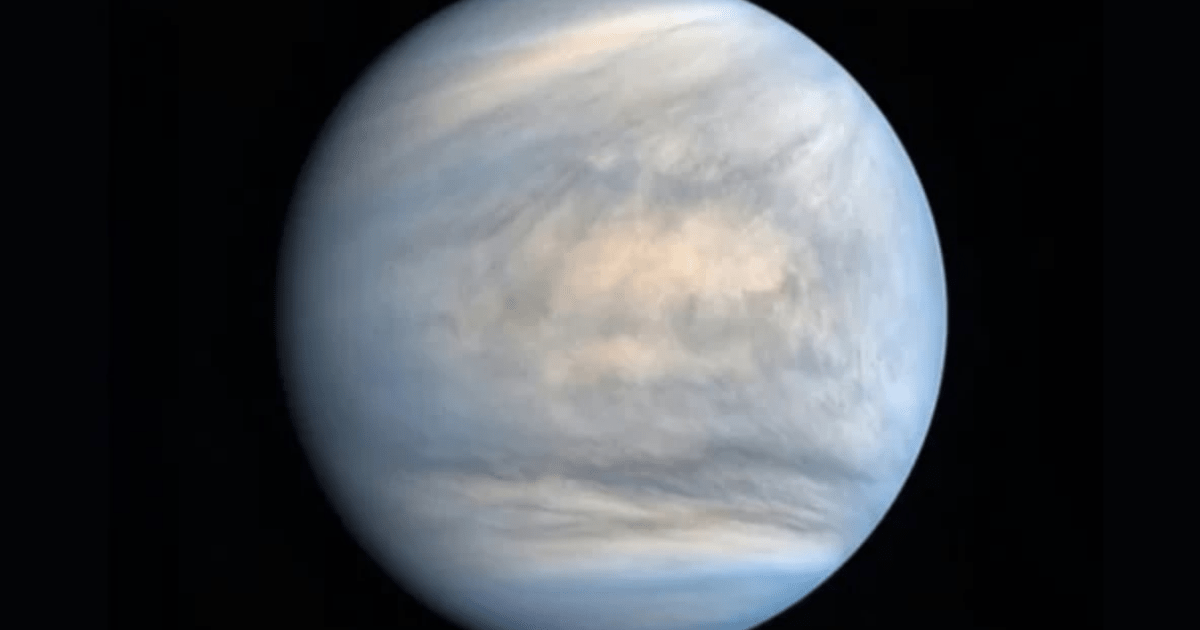
The dark and bright ultraviolet patterns found in Venus' clouds have remained an elusive mystery to scientists for almost a century. Notably, the patterns seen in the ultraviolet images of Venus' clouds suggest that a hidden substance within the clouds absorbs light very strongly. A recent study has revealed that this unknown absorber may either be extremely effective when it comes to light absorption or exist in extremely high concentrations inside Venus' cloud droplets, or both. The research, led by Dr. Jan Spacek from the Foundation for Applied Molecular Evolution, U.S., was published in the Astrobiology journal.
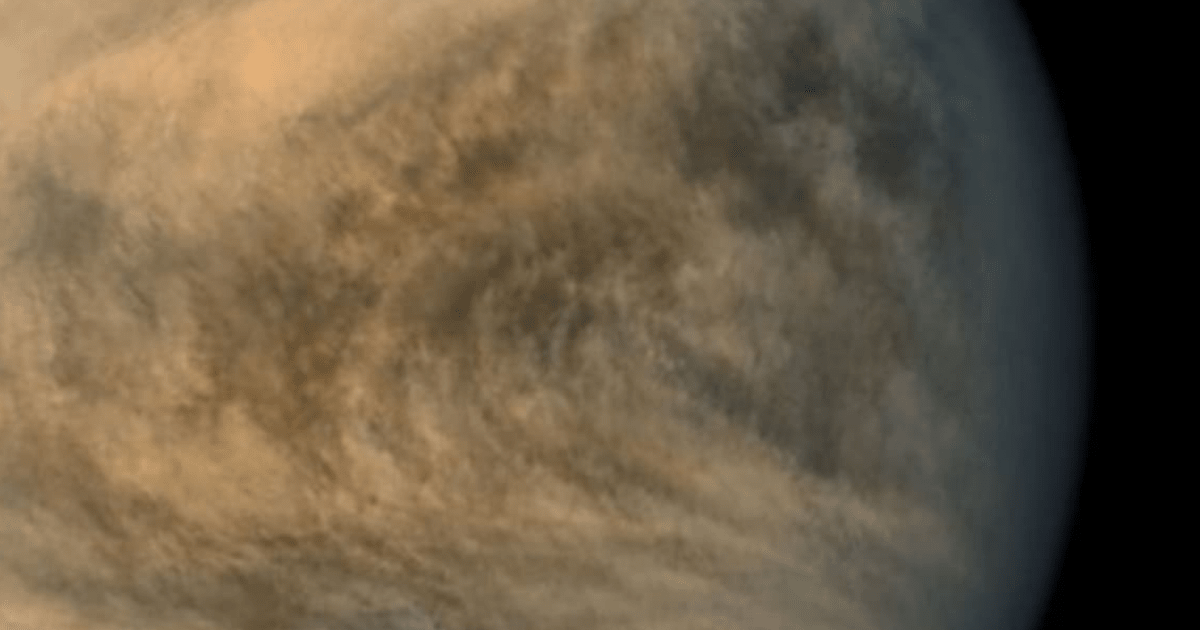
Probing further inside Venus' thick clouds
The study, which combined observations of Venus with a model that describes how radiation interacts with atmospheric constituents, answered the following question posed by Dr. Spacek: If the planet’s cloud droplets were collected and examined in a laboratory, what would be the measured light absorption ability of the liquid contained inside the droplets?
"This is important, as light absorption in a bulk liquid may be correlated with the concentration of light-absorbing material in the solution," explained Dr. Spacek in a statement. Also, Dr. Lee Yeon Joo from the Planetary Atmospheres Group in the Institute for Basic Science (IBS), South Korea, who carried out the model calculations reported in the paper, said that since the substance inside Venus' dense clouds is very effective at scattering sunlight, the brightness that is detected from space is not the same as the absorbing capacity of a bulk liquid estimated in a laboratory. Explaining the approach taken by the model, Dr. Lee stated that by considering the absorbing and scattering abilities of the substance inside the clouds and the atmosphere, the model can quantify the light absorption capacity of the liquid within the cloud droplets.
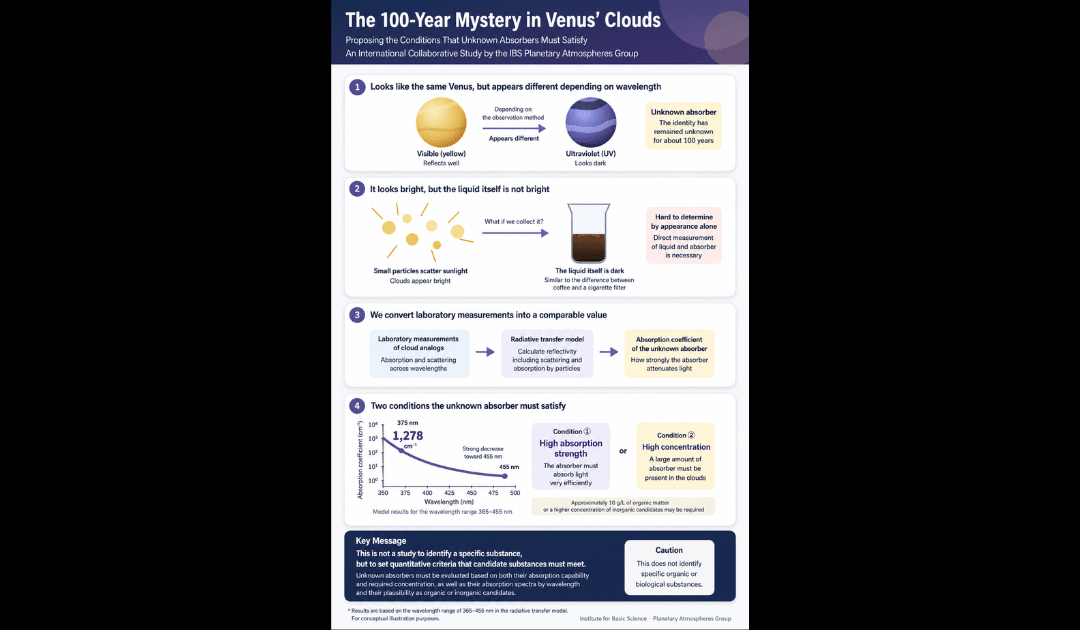
The results observed by the group established striking constraints for the absorber lying in the clouds. They indicated that in the wavelengths ranging from 365 to 455 nanometers, the modeled absorption coefficient attains a value of approximately 1,278 cm⁻¹ at 375 nanometers. This implies that the material needs to be a highly effective absorber of light, be present in huge amounts inside the clouds, or both. The researchers, after intense analysis, suggested that conjugated organic molecules with high absorption can fulfill this requirement. "Organic" here refers to carbon-based compounds and not necessarily molecules of biological origin. Nevertheless, this is only a possibility, and the actual identity of this "mystery material" is still unknown.

What future investigations can reveal
Although the results do not indicate the existence of life or organic absorbers in the clouds, they place quantitative constraints that should be satisfied by candidate absorbers, including having the right concentration, absorption ability, and being aligned with the particle size distribution of Venus' clouds. Future missions to Venus, including one by the aerospace company Rocket Lab, can help further investigate the planet's cloud chemistry.
More on Starlust
Venus shines at its peak evening brilliance on August 16; here’s where to look tonight
Venus is not geologically dormant, new computer simulations reveal