Total solar eclipse 2026: Don’t miss the event if you’re in these US, Canadian, European or African cities today

The day of the solar eclipse is finally here. While Iceland, Greenland, Spain, and a small part of Portugal will experience a total solar eclipse—the Moon fully covering the Sun—residents of the U.S., Europe, Canada, and northwestern Africa will see a partial eclipse, meaning only a portion of the Sun will be blocked by the Moon as they fall outside the path of totality. Don’t miss the eclipse if you’re in the following cities today.

US cities with eclipse visibility (in local time)
Anchorage, Alaska (starts at 7:36 am and ends at 9:09 am)
Fairbanks, Alaska (starts at 7:37 am and ends at 9:18 am)
Juneau, Alaska (starts at 7:41 am and ends at 9:08 am)
Bangor, Maine (starts at 12:54 pm and ends at 2:49 pm)
Boston, Mass. (starts at 1:01 pm and ends at 2:46 pm)
Detroit, Michigan (starts at 1:03 pm and ends at 2:08 pm)
New York, New York (starts at 1:07 pm and ends at 2:38 pm)
Philadelphia, Penn. (starts at 1:11 pm and ends at 2:35 pm)
Portland, Maine (starts at 12:57 pm and ends at 2:27 pm)
Washington, D.C. (starts at 1:17 pm and ends at 2:27 pm)
Canadian cities with eclipse visibility (in local time)
Edmonton (starts at 10:02 am and ends at 11:15 am)
Halifax (starts at 1:58 pm and ends at 3:58 pm)
Montreal (starts at 12:50 pm and ends at 2:38 pm)
St. John’s (starts at 2:28 pm and ends at 4:37 pm)
Toronto (starts at 12:25 pm and ends at 2:23 pm)
Winnipeg (starts at 11:25 am and ends at 12:40 pm)
European cities with eclipse visibility (in local time)
Berlin, Germany (starts at 7:15 pm and ends at 8:38 pm)
Dublin, Ireland (starts at 6:12 pm and ends at 8:05 pm)
Kraków, Poland (starts at 7:18 pm and ends at 8:04 pm)
Lisbon, Portugal (starts at 6:39 pm and ends at 8:29 pm)
London, U.K. (starts at 6:17 pm and ends at 8:06 pm)
Madrid, Spain (starts at 7:36 pm and ends at 9:16 pm)
Milan, Italy (starts at 7:27 pm and ends at 8:35 pm)
Nuuk, Greenland (starts at 3:30 pm and ends at 5:39 pm)
Oslo, Norway (starts at 7:02 pm and ends at 8:49 pm)
Paris, France (starts at 7:22 pm and ends at 9:09 pm)
Stockholm, Sweden (starts at 7:03 pm and ends at 8:46 pm)
Vienna, Austria (starts at 7:22 pm and ends at 8:13 pm)
Saint Petersburg, Russia (starts at 7:59 pm and ends at 9:00 pm)
African cities with eclipse visibility (in local time)
Algiers, Algeria (starts at 6:42 pm and ends at 7:42 pm)
Casablanca, Morocco (starts at 6:48 pm and ends at 8:20 pm)
Dakar, Senegal (starts at 6:25 pm and ends at 7:34 pm)
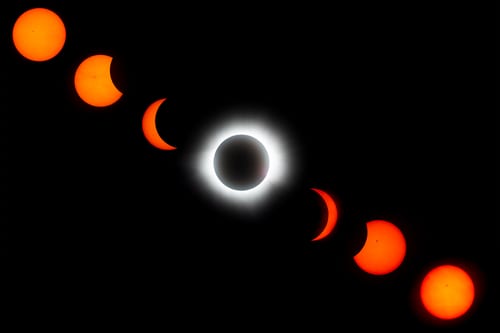
Notably, the eclipse will reach the U.K., Ireland, mainland Europe, and Africa in the evening. In Spain and at the northwestern tip of Portugal, the Sun won’t be fully eclipsed shortly before sunset in late evening. Three Spanish cities—Leon, Zaragoza and Valencia—fall in the path of totality, along with Reykjavik in Iceland. According to NASA, the timing in mainland Europe and Africa will give observers a chance to see a sunset eclipse.
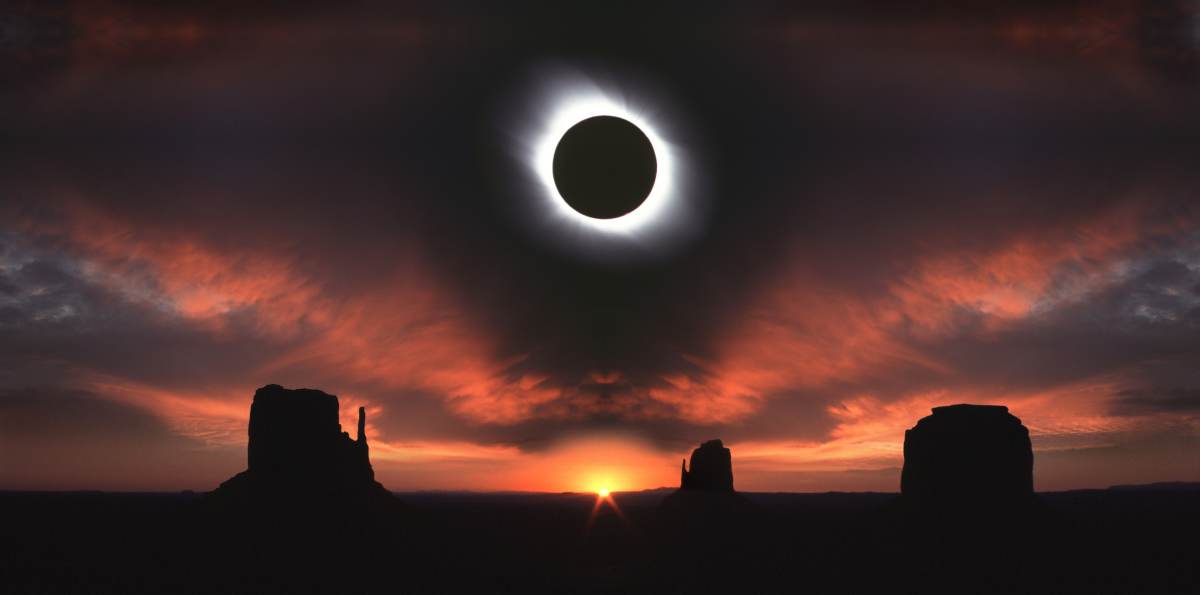
In case you are not in a location from where the eclipse is expected to be visible, there are several livestreams planned by NASA, the European Space Agency and other observatories. We at Starlust.org will also stream the eclipse live on our Facebook page, bringing you views from Spain, Germany, Norway, Iceland, the UK, Italy, Canada, and the US. Check out other sources to watch the event live from any corner of the world.
More on Starlust
Total solar eclipse 2026: 10 amazing things to see during this rare celestial event