Scientists trace 'ghost particle' event to distant galaxy trillions of times brighter than Sun
![The gravitationally lensed galaxy nicknamed "Shadow Blaster," which astronomers have identified as the likely source of the high-energy neutrino event IC 210922A. [Cover Image Source:International Gemini Observatory/NOIRLab/NSF/AURA/ALMA (ESO/NAOJ/NRAO)]](https://d3hedi16gruj5j.cloudfront.net/807402/uploads/6ad48580-6adf-11f1-8d22-3f77774a8410_1200_630.jpeg)
The fiery cauldron of stars like the Sun and supernovas churn out neutrinos. Trillions of them zip through space and everything, leaving no trace. This is why they are dubbed "ghost particles." Now, a team of astronomers has detected a distant, bright galaxy that could be a new neutrino source candidate and has published their findings in the journal Nature Astronomy. Trillions of times brighter than the Sun, the galaxy is about 11 billion light-years away and nicknamed "Shadow Blaster." This remote neutrino source may provide the long-sought link between high-energy neutrino birth and distant star-forming galaxies.
Neutrinos are not just one of the fundamental particles of the universe but are also the most abundant of those with mass. Instruments laid out on Earth have detected high-energy neutrinos since the 1960s. This has allowed scientists to identify a small number of nearby neutrino sources. However, they have not been able to account for the total amount of neutrinos detected by the instruments. This suggests that there are major source populations that still remain hidden. In search of such sources, the astronomers, led by Yuji Urata of MITOS Science Co., LTD. in Taiwan, followed up on a high-energy neutrino event, dubbed IC 210922A, coming from a region of space in the direction of the constellation Eridanus. This was detected in 2021 by the National Science Foundation (NSF) IceCube Neutrino Observatory in Antarctica.
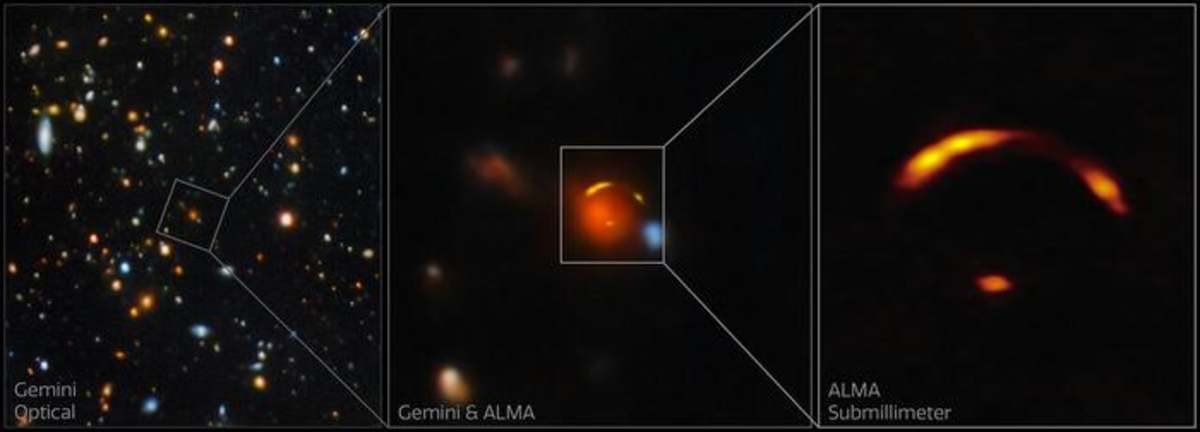
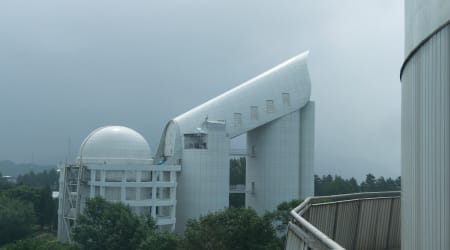
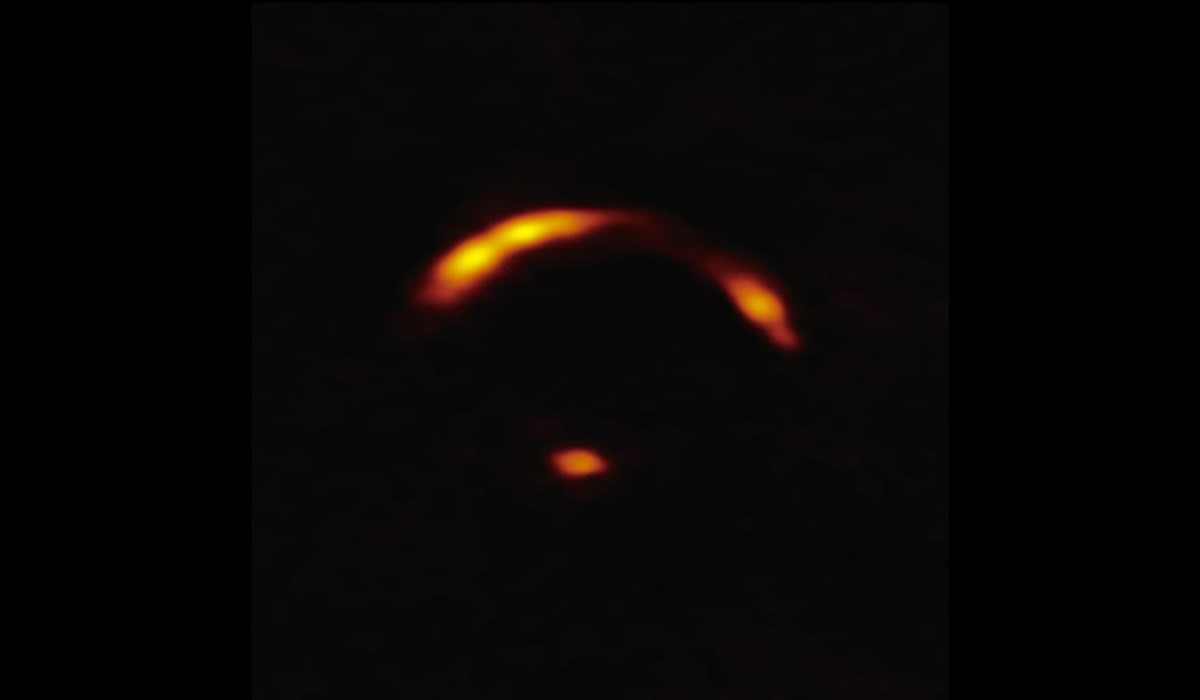
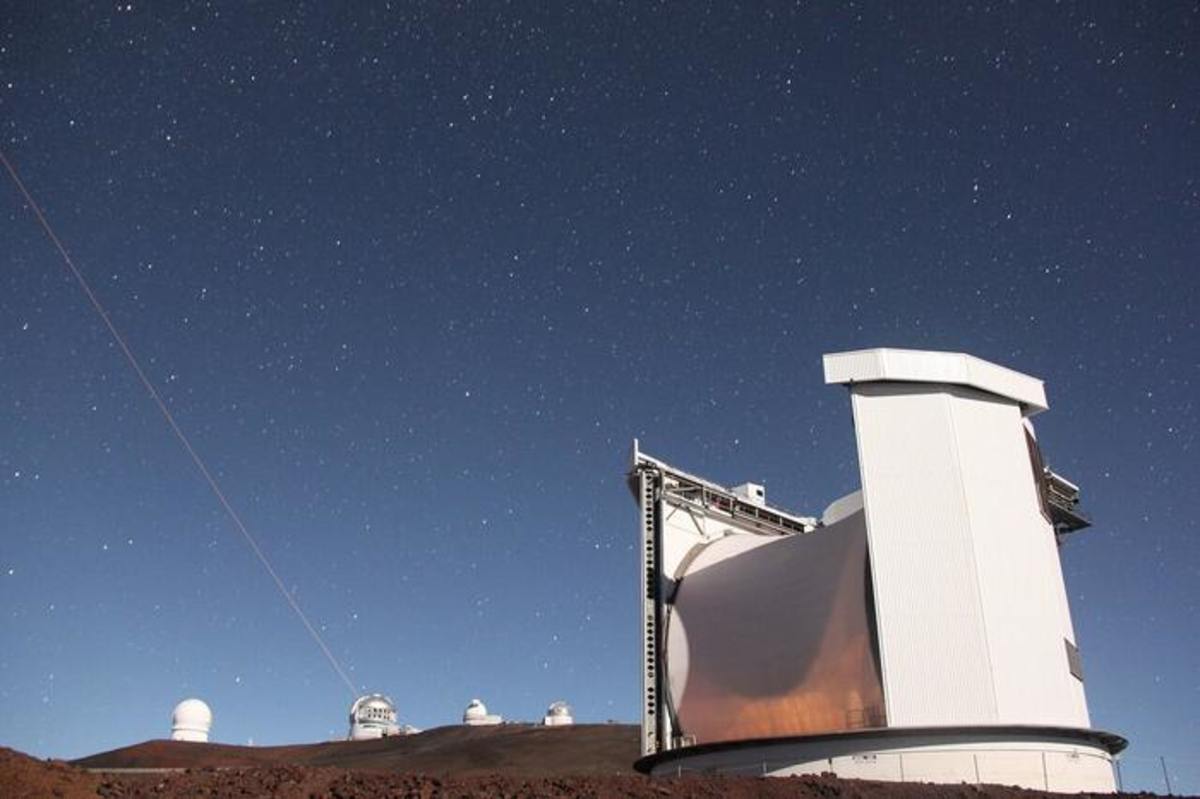
A couple of days after the IceCube Neutrino Observatory had alerted the scientific community to the neutrino event, Urata and his colleagues began observations with the James Clerk Maxwell Telescope (JCMT) and the Submillimeter Array (SMA) and eventually discovered Shadow Blaster. Its location and brightness provoked them to observe it further with the Atacama Large Millimeter/submillimeter Array (ALMA). This time they found that Shadow Blaster is lying behind a strong gravitational lens. Its lensing effect unveiled the internal structure of the galaxy, which would otherwise have been too distant and too faint to be studied in detail. But to better understand how the lensing effect amplified the neutrino signal, they needed to determine the distance, nature, and mass distribution of the foreground galaxy. The researchers estimated all these, using two instruments on the Gemini North telescope: the Gemini Multi-Object Spectrograph (GMOS) and the Gemini Near-InfraRed Spectrograph (GNIRS). “The combined GMOS and GNIRS data helped us measure the distance to the lensing galaxy and determine that it is a massive elliptical galaxy. This information was crucial for estimating the lens mass distribution and constructing a model of the gravitational lens,” said Urata in a statement.
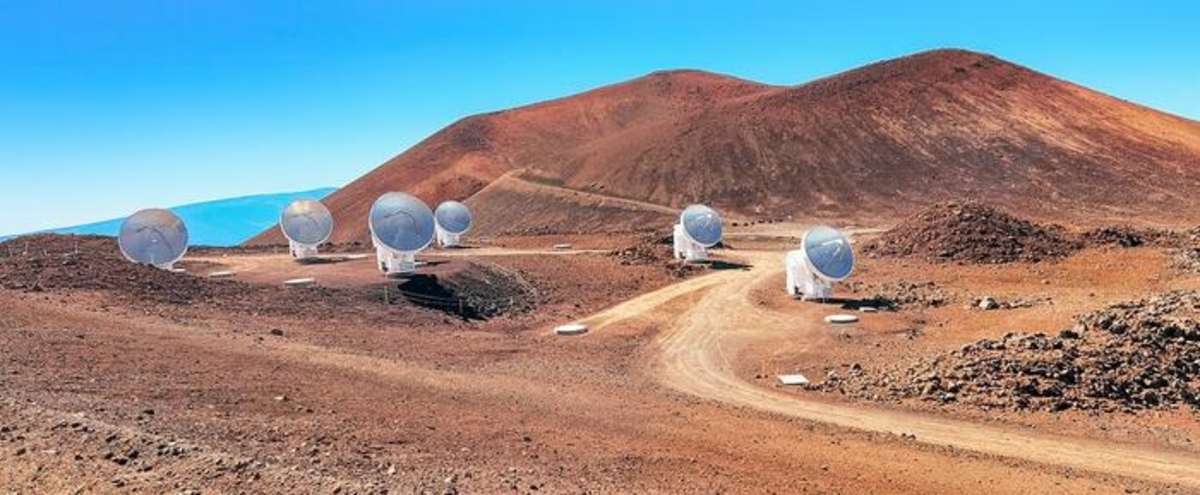
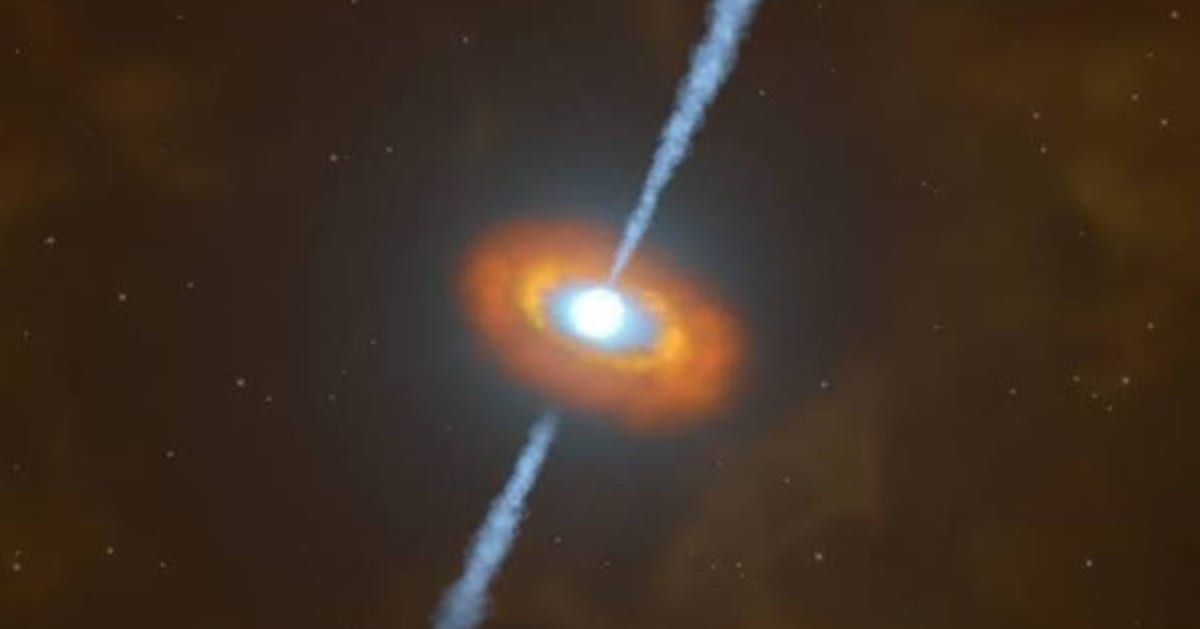
Next, the team combined the lens model with the ALMA imaging data. This revealed that the central region of the galaxy contains an extremely compact core that is rich in gas and dust and spawning stars at an astonishing pace. Theory states that such extreme environments act as particle accelerators and produce neutrinos. Moreover, the galaxy doesn’t seem to have an active black hole, suggesting that neutrinos not only originate in black-hole jets but can also come from a region that is busy in forming stars at an accelerated rate. “This breakthrough shows how particle detectors and telescopes become far more impactful when they work together, opening a powerful 'multi-messenger' window on the Universe,” said Martin Still, Program Director, NSF Office of Research Infrastructure. “By combining signals from particles and light, scientists can explore distant cosmic environments and events in unprecedented detail—revealing phenomena that were once only theoretical.”
Hidden behind the thick layers of dust, galaxies like the Shadow Blaster abound in the universe but are difficult to detect. They date back to an epoch when such active star-forming galaxies were producing large numbers of cosmic rays, streams of high-energy particles that can form neutrinos. “Our analysis suggests that this population could contribute up to roughly 20% of the observed diffuse neutrino background measured by IceCube,” said Urata. The researchers say extensive follow-up searches reveal that Shadow Blaster is the most plausible candidate to be linked to IC 210922A. “If confirmed, Shadow Blaster would be the first-ever individual dusty star-forming galaxy directly linked to a high-energy neutrino event,” Urata added.
More on Starlust
Massive water tank located 600 meters below ground can help deepen understanding of ghost particles
Astronomers have finally solved the mystery of how galaxy-killing winds formed in the early universe