Where is the universe's missing matter? Scientists have found a way to track it down
Missing matter doesn’t always mean invisible dark matter. It could be the same stuff that makes up stars and planets, yet a large portion of such matter remains undetected. Now, researchers from the Canadian Hydrogen Intensity Mapping Experiment (CHIME)/Fast Radio Bursts Collaboration, including McGill University and MIT, have developed a new method to hunt down the universe's long-missing ordinary matter by combining galaxy locations with ultrabright flashes of radio waves known as fast radio bursts (FRBs). The researchers have reported their findings in a paper published in the Physical Review Letters.
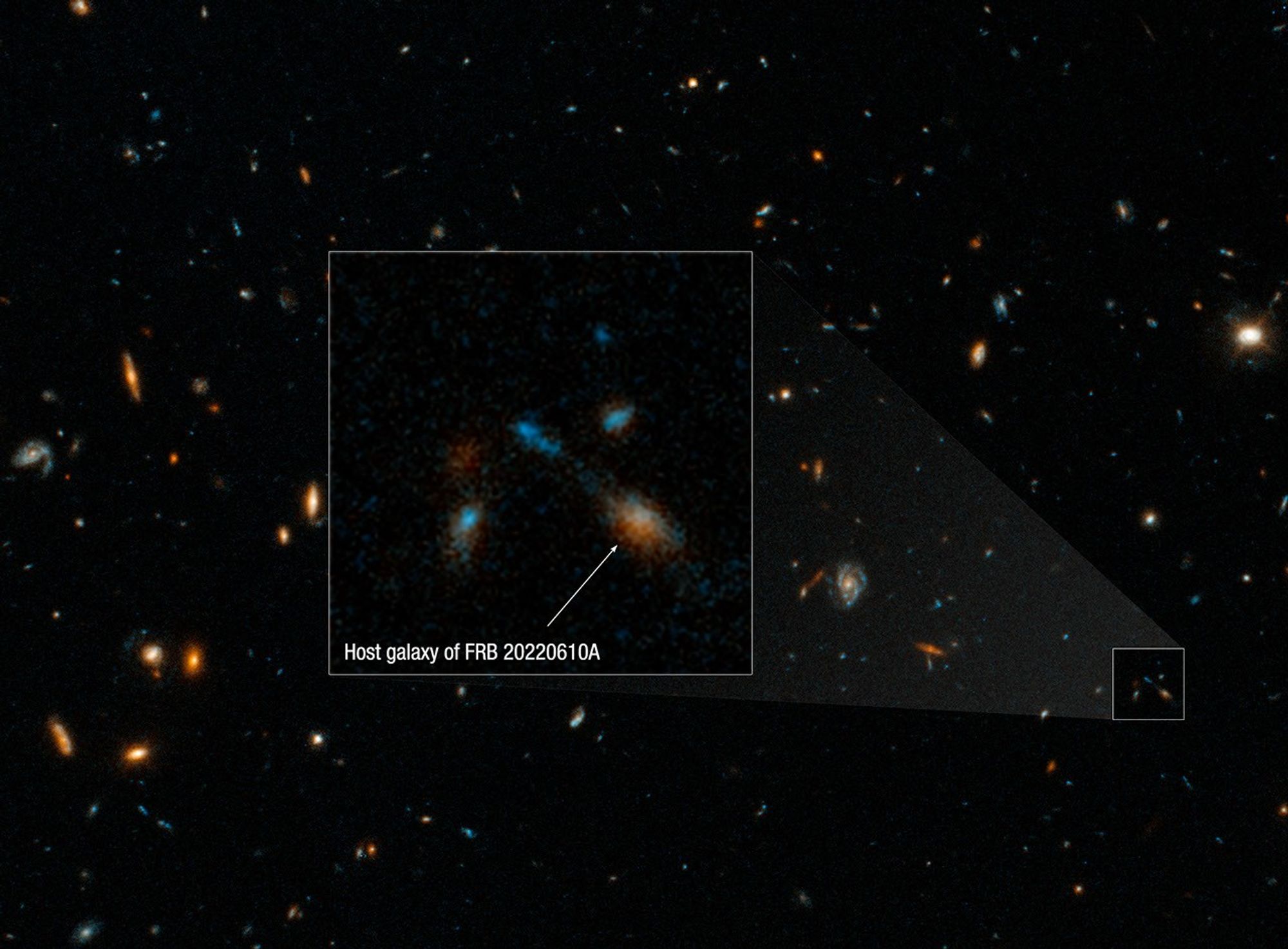
First discovered in 2007, FRBs are incredibly bright flashes of radio waves that last only a few thousandths of a second before disappearing. These signals travel across vast stretches of space and pass through clouds of gas and scattered particles before reaching Earth. This interaction causes the radio waves to spread out slightly, an effect astronomers call smearing. The more matter an FRB encounters, the greater the smearing becomes.

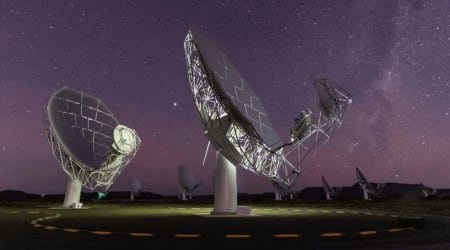
The team realized that these bursts could serve as natural probes of the invisible material filling the universe. The researchers studied 2,870 fast radio bursts detected by the Canadian Hydrogen Intensity Mapping Experiment (CHIME)/FRB collaboration. The results portrayed a stunning picture of missing matter that forms diffuse halos, extending far beyond galaxies and galaxy groups. “We find that, overall, where there are more galaxies, there tends to be more missing matter around them,” says Haochen Wang, a graduate student in MIT’s Kavli Institute for Astrophysics and Space Research, in a statement.
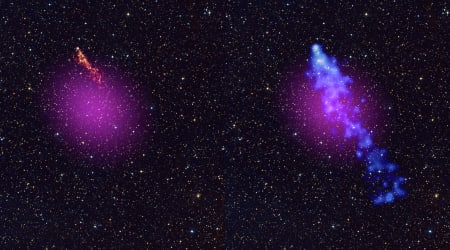
The team found that the FRBs with higher-energy (blue waves) pass less affected through the missing matter, arriving at a detector before the delayed FRBs with lower-energy (red waves) which are more smeared in time. By measuring each FRB’s various wavelengths, the scientists were able to tell the amount of matter that FRBs might have traversed before reaching detectors of CHIME. The researchers then linked these measurements with the locations of over 6 million galaxies captured by the Dark Energy Spectroscopic Instrument (DESI) in Tucson.
They then looked for an association between the missing matter and the galaxies and the location of one relative to the other. A pattern emerged out of this analysis. Missing matter was found to be scattered far away from galaxies and galaxy clusters, forming diffuse puffs that stretch roughly four million light years. The findings show that black hole jets or exploding stars hurl matter out of galaxies and are much stronger processes than previously thought. “We are finding that the activity in galaxies is messier than we thought,” Wang says. “They’re more like fountains, and really push out gas to very large distances.” The study is also proof that fast radio bursts can be used to look for missing matter in the universe.
More on Starlust
Exceptionally detailed map of the sky reveals over 13 million radio sources across the universe
New technique to allow LIGO to look farther into the universe for neutron star mergers