We may have been looking for alien signals on the wrong radio channels

For years, astronomers looking for intelligent extraterrestrial civilizations have scanned the skies for a small part of the radio spectrum. To date, they haven’t heard anything. To expand the horizons of the search, however, Louisa Mason of the University of Manchester used an almost untapped part of the radio spectrum: the high-frequency millimeter and submillimeter bands. Mason presented her research at the Royal Astronomical Society's National Astronomy Meeting last week.

Most SETI (Search for Extraterrestrial Intelligence) attempts have focused on a narrow stretch of the radio spectrum known as the “water hole”—lying between the natural radio frequencies emitted by hydrogen and hydroxyl (1.42 to 1.66 GHz). According to a recent study, it is difficult to detect such narrow signals because radiation from a star distorts the signals when they leave their home planet. This spreads the original signals across multiple frequencies, making them difficult.

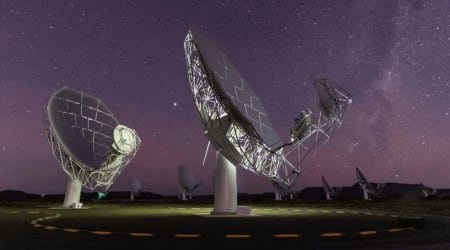
While looking for an alternative way, Mason turned her attention to the Atacama Large Millimeter/submillimeter Array (ALMA) in Chile. She didn’t request valuable telescope time. Instead, she sifted through the data that had already been collected for other astronomical purposes. Her goal was to search for narrowband radio signals, the kind of transmissions that nature rarely produces but advanced technology might. "For decades, SETI searches have concentrated on a relatively small part of the radio spectrum. We wanted to ask what might happen if we looked somewhere very different," Mason said in a statement.

By analyzing two small frequency windows of ALMA, she didn’t find any convincing alien signals or technosignatures. But the study shows the potential of these unexplored radio frequencies, which are accessible and worthy of future investigation, opening an entirely new chapter in humanity's search for intelligent life. "The millimeter and submillimeter radio bands remain almost completely unexplored for SETI, so this is really about opening up a new area of parameter space to search," Mason said. Moreover, her research also highlights an overlooked opportunity in radio astronomy. Whenever astronomers point a radio telescope toward a distant galaxy, a star-forming cloud or countless stars slip into the telescope’s field of view. These unintended targets, known as stellar bycatch, have usually been estimated using catalogs such as Gaia. Mason, however, used the sophisticated Besançon Galactic Model. This model not only helped her estimate the stars cataloged by Gaia but also those that are very faint and distant.

A previous SETI survey involving 1,327 telescope pointings had estimated that it had captured 288,000 stars using Gaia. But when Mason applied her technique to the same survey, the count increased to 6.1 million. "Even a very small observation can contain a huge number and diversity of stars that we might never have intended to study,” Mason explained. “By combining high-frequency observations with galactic simulations, we can better understand exactly what we've searched and where we should look next."
More on Starlust
In our search for alien life, a swarm of space telescopes could be the missing link
Size matters: A planet needs to be at least as big as Mars for alien life to survive on it