Scientists discover how black holes acquired 'squashed' orbits just before the merger
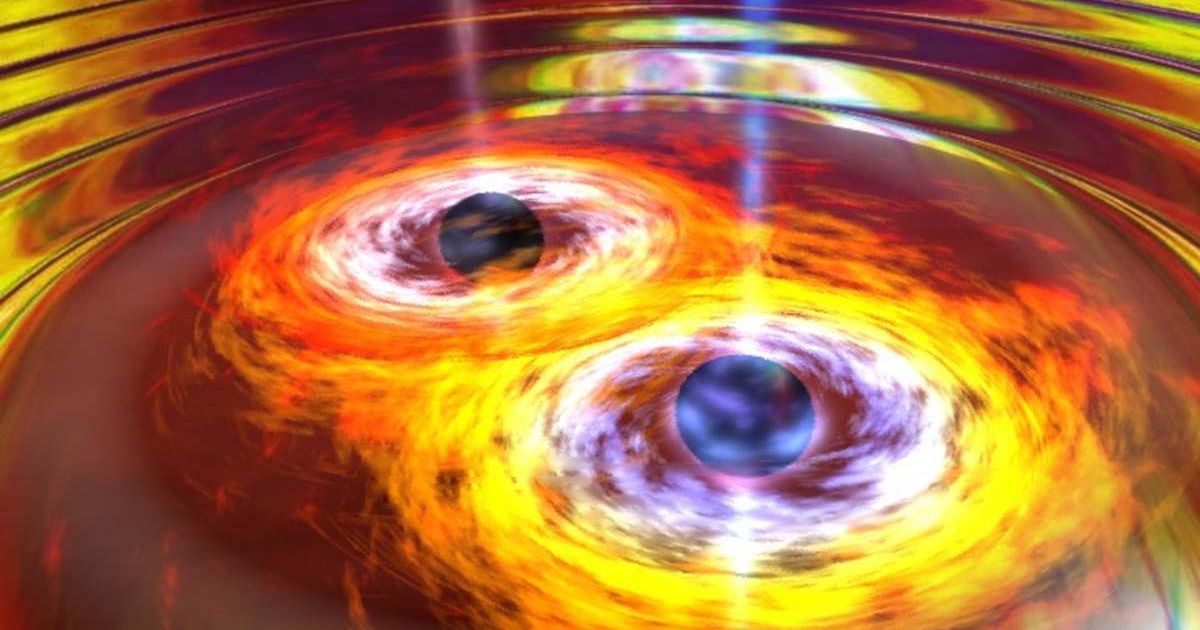
The merger, officially labeled GW200208_222617, was registered by the Laser Interferometer Gravitational-Wave Observatory (LIGO) and the European Virgo detector.
PUBLISHED OCT 9, 2025
As two super-massive black holes spiral around each other and eventually merge, they create gravitational waves (Representative Cover Image Source: NASA)

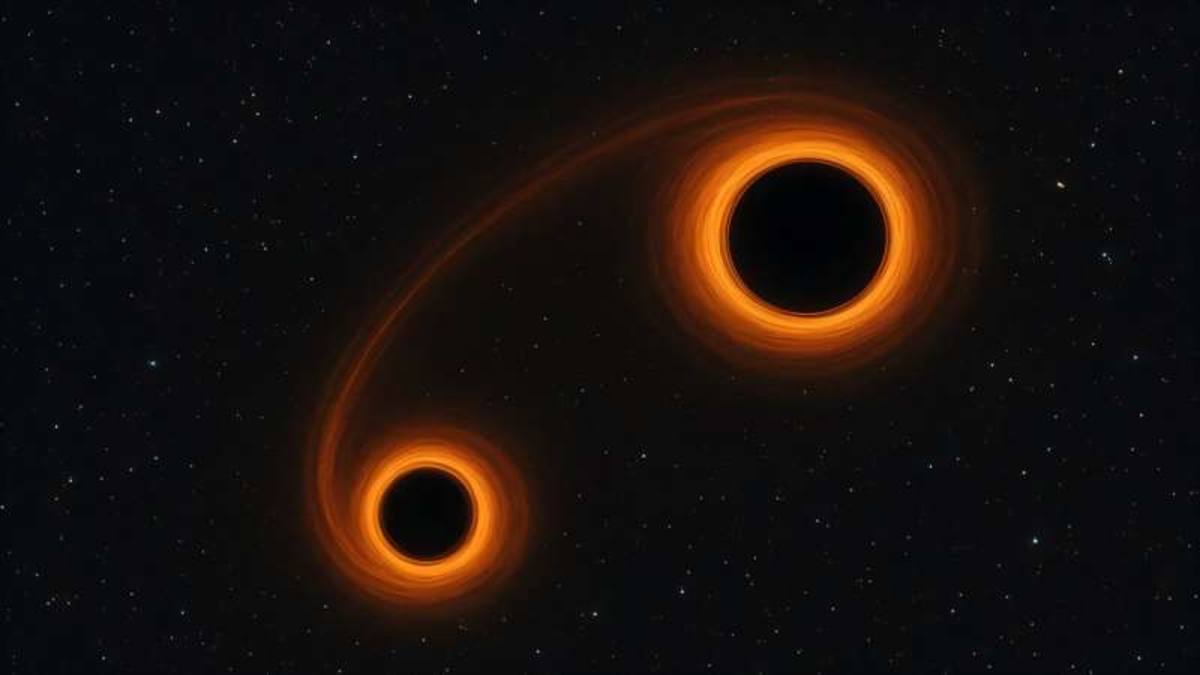
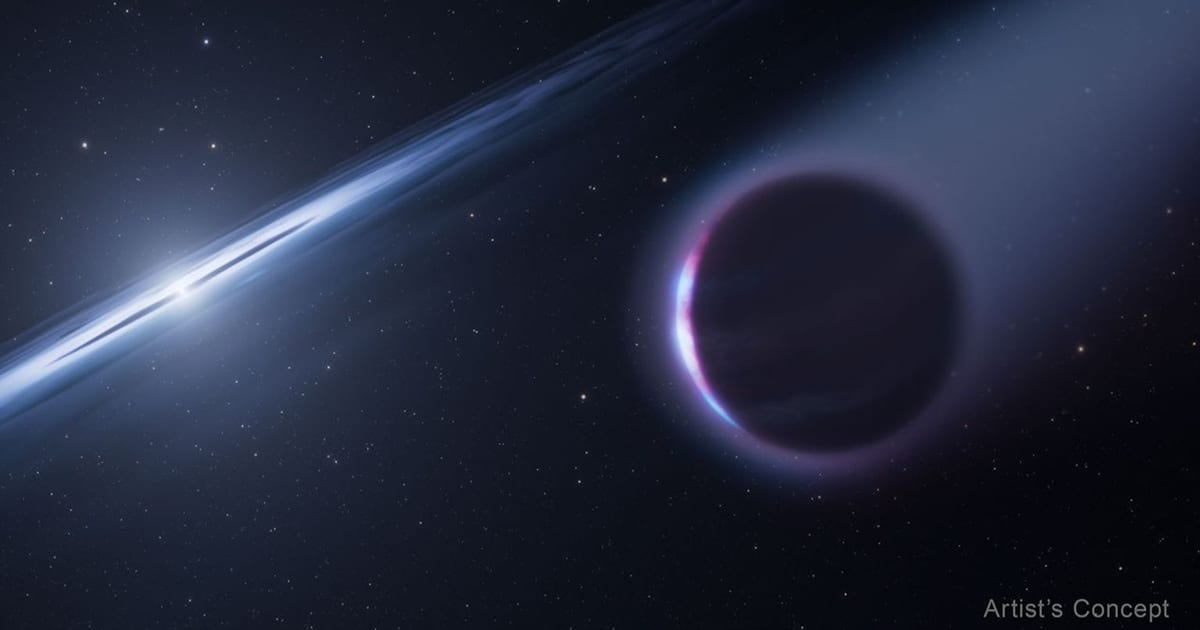
An international team of scientists has pinpointed the likely birth scenario for a rare black hole collision observed with a highly non-circular, or "eccentric," orbital path just before the merger. The findings, published in Physical Review D, provide a crucial clue in understanding the formation of these cataclysmic cosmic events, as mentioned by Cardiff University

The international team used simulations of three possible formation scenarios for the event, known as GW200208_222617 (Cover Image Source: Cardiff University)
The international team used simulations of three possible formation scenarios for the event, known as GW200208_222617 (Image Source: Cardiff University)

The merger, labeled GW200208_222617, was detected by the Laser Interferometer Gravitational-Wave Observatory (LIGO) and its European counterpart, Virgo. It is one of only a handful of binary black hole mergers exhibiting clear evidence of a significantly oval-shaped orbit, a "squashed" trajectory, near the time of its final inspiral.
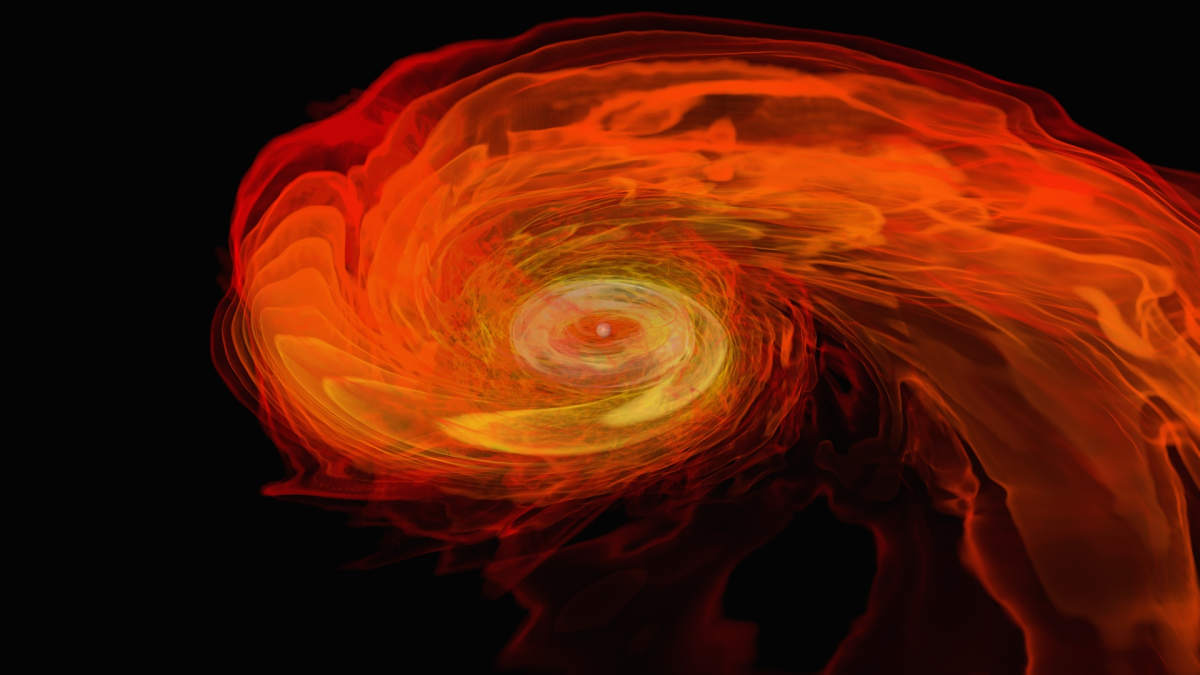
This supercomputer simulation shows one of the most violent events in the universe: a pair of neutron stars colliding, merging and forming a black hole (Image Source: NASA Image and Video Library | NASA)
This supercomputer simulation shows one of the most violent events in the universe: a pair of neutron stars colliding, merging, and forming a black hole (Representative Image Source: NASA Image and Video Library | NASA)

The energy from such violent celestial events is released in the form of gravitational waves, which are "ripples" in the fabric of spacetime, per LIGO Caltech. These cosmic ripples were first predicted by Albert Einstein in 1916 as part of his general theory of relativity. Einstein’s mathematics showed that massive, accelerating objects, such as black holes or neutron stars orbiting each other, would disrupt spacetime, causing waves that propagate outward at the speed of light. Detecting these waves allows scientists to gather information about their cataclysmic origins and the fundamental nature of gravity.

An artist's impression of gravitational waves generated by binary neutron stars (Image Source: Caltech-JPL | R. Hurt)

Researchers performed detailed simulations of three plausible formation channels for the binary, according to Cardiff University. Their analysis suggests that the black holes most likely originated in either a complex, three-star system (a "field triple") or a crowded region, such as a star cluster, where gravitational interactions are frequent and intense. “Confidently detecting eccentricity is crucial for identifying how the binary black holes that we see with gravitational waves are forming,” explained Dr. Isobel Romero-Shaw, lead author on the study. She noted that black holes that have orbited together for long periods typically have circular orbits. An eccentric orbit strongly indicates that the pair was either a recent gravitational capture or that its path was warped by external forces, such as a third star.
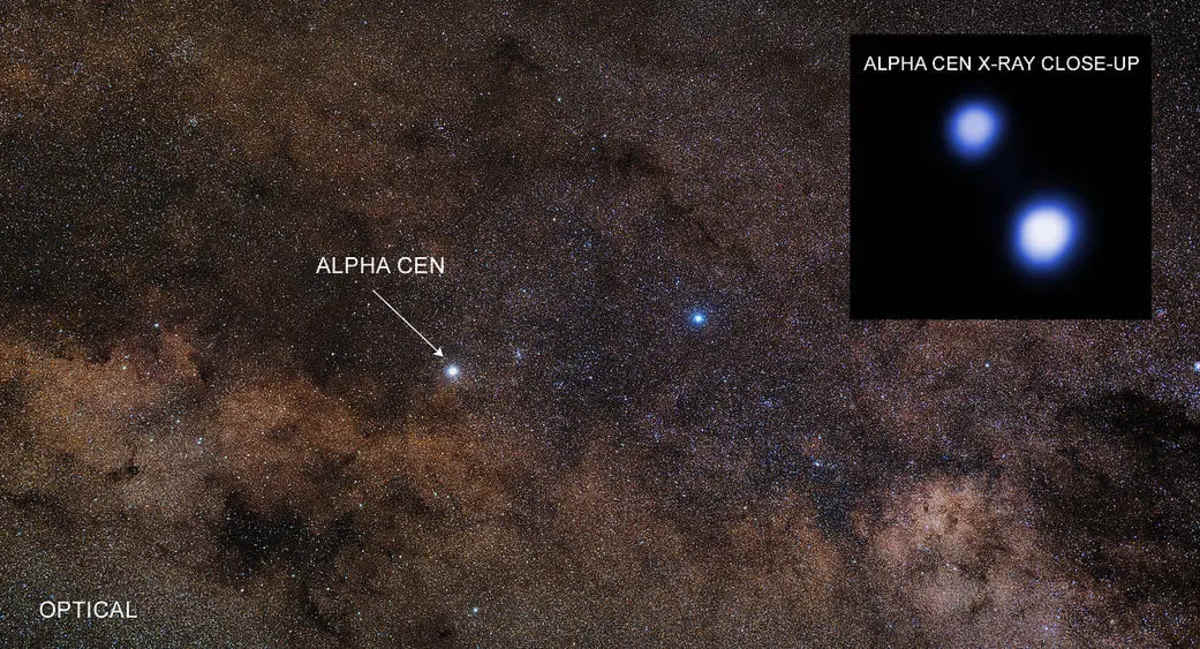
A new study involving long-term monitoring of Alpha Centauri indicates that any planets orbiting the two brightest stars are likely not being pummeled by large amounts of X-ray radiation from their host stars (Representative Image Source: NASA)

The team concluded that a formation within a densely populated system is far more probable than a scenario involving a single, massive disk of gas orbiting an active galactic nucleus. According to Dr. Romero-Shaw, “Eccentricity is ‘smoking gun’ evidence that a binary did not form in full isolation." If the black holes had evolved without external interference, their orbit would not retain a detectable eccentricity by the time it is observed.

This breakthrough is key because a single confirmed eccentric event narrows down the origins for a much larger fraction of the overall black hole population detected by gravitational-wave observatories. The findings provide a roadmap for refining detection models, ultimately helping scientists confidently map the evolutionary history of binary black holes across the observable universe. Understanding how these binaries form and merge helps scientists refine fundamental models of the cosmos, advancing our knowledge of space, time, and gravity itself. The study’s implications could dramatically reshape theories on the overall population of black holes detected throughout the universe.

More on Starlust

MIT scientists now suggest 'ghost particle' detected in Italy may be remnant of an ancient dying black hole

Largest ever black hole merger, 225 times the mass of the Sun, detected by LIGO-Virgo-KAGRA
MORE STORIES

The celestial event this month is a rare one, with the Moon retreating to an apogee from Earth's center.
33 minutes ago
The three interstellar objects are unique, billion-year-old fragments and kinetic artifacts collected from countless extrasolar systems across the galaxy.
4 hours ago
English physicist and science communicator Professor Brian Cox draws parallels between the journey of 3I/ATLAS and that undertaken by humanity.
8 hours ago
Conspiracy theories can be put to rest as new evidence from the MeerKAT radio telescope has emerged.
1 day ago
Consecutive X-class solar flares have set the stage for severe space weather to strike on November 11 and 12.
1 day ago
The observation, made on November 9, unveiled a shockingly complex jet system that overshadows prior data, immediately casting doubt on the comet's origin.
2 days ago
The object, discovered by Gennady Borisov on November 2, 2025, quickly became the focus of speculation amid the curiosity surrounding 3I/ATLAS.
2 days ago
To assess Martian viability, scientists subjected yeast cells to Mach 5.6 shock waves and the corrosive perchlorate salts common on the Red Planet.
6 days ago
These impacts pack surprising power; a mere 11-pound meteoroid can blast a 30-foot (9-meter) crater, ejecting 75 metric tons of lunar soil.
6 days ago
Sunspot AR3474 detonated with an X1.8 solar flare on November 4, sending an ultraviolet wave silencing South America's shortwave radio communications.
7 days ago