Record-breaking, wobbling black hole jets are starving a nearby galaxy of stars
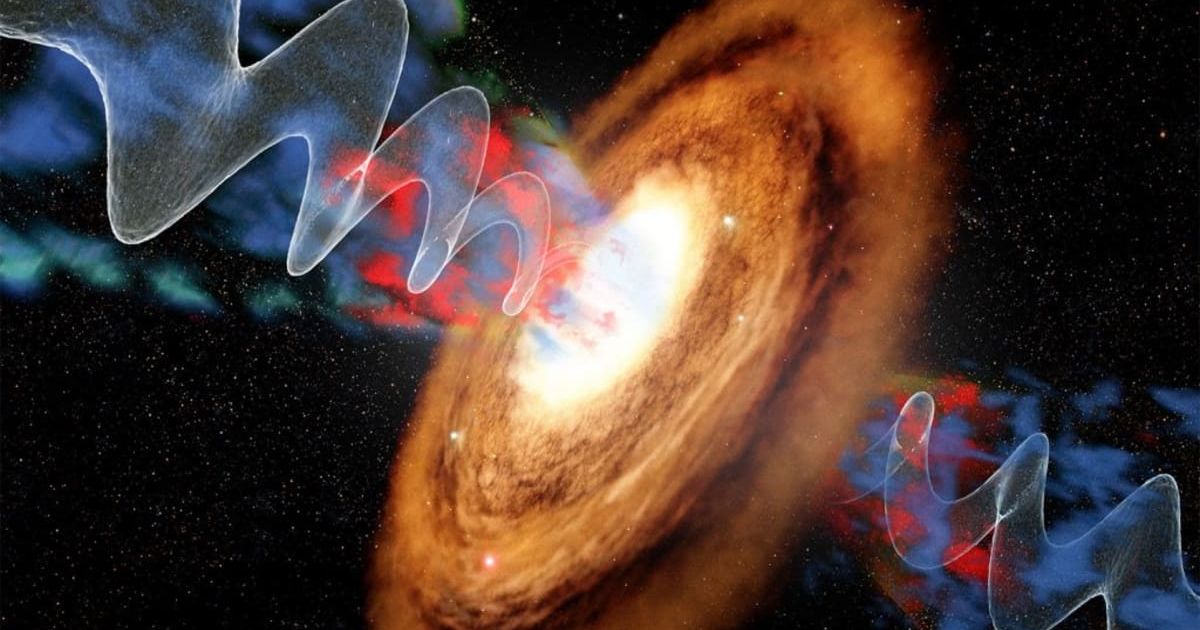
Astronomers have detected a rare, massive, record-breaking plume of superheated gas erupting from a nearby galaxy, proving that a central black hole's influence extends far beyond its host galaxy's core. The discovery concerns the galaxy VV340a, which, thanks to the W.M. Keck Observatory in Hawai'i, has been observed harboring an enormous "wobbling" jet.
NEW from #AAS247: The NSF Very Large Array Helps Reveal Record-Breaking Stream of Super-Heated Gas from Nearby Galaxy
— National Radio Astronomy Observatory | NRAO (@TheNRAO) January 8, 2026
Astronomers using the VLA have identified an enormous, galaxy-scale stream of super-heated gas erupting from the nearby galaxy VV 340a.https://t.co/DzYoxq63yY
This jet has blown gas up to 20,000 light-years away from the galaxy's center—that's farther than what has been seen before—and created a trail of cosmic debris that reveals a long history of volcanic-like activity. Most importantly, the study published in the journal Science says these black hole "outflows" are strong enough to substantially alter a galaxy's physical future.

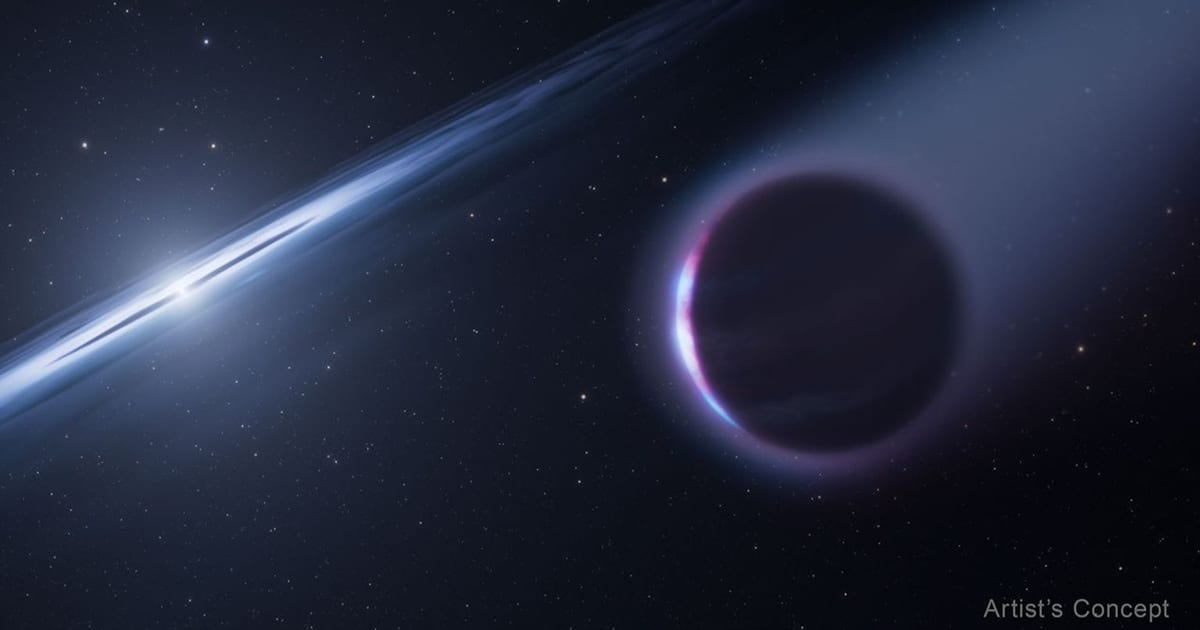
The observation was enabled by the Keck Observatory, combined with NASA's James Webb Space Telescope and the Very Large Array (VLA) radio telescopes. The VLA data revealed that the jets shooting out from the black hole are not straight lines. Instead, they twist into a helical, S-shaped pattern. This occurs because the jet "precesses," meaning it wobbles like a spinning top, spraying high-energy plasma across the galaxy as it rotates. “This is the first time we’ve seen a precessing, kiloparsec-scale radio jet driving such a massive outflow in a disk galaxy," said lead author Justin Kader, a researcher at UC Irvine, in a statement. The sheer force of this wobbling jet is dragging cooler gas away with it. Material is being ejected at a phenomenal rate, removing enough gas to make about 20 new suns per year from the galaxy. By stripping away this vital gas, the black hole "starves" the galaxy of the raw material it needs to form new stars.
The discovery came as a shock because of the type of galaxy involved. These violent, wobbling jets are found in old, elliptical galaxies. Finding one in a young, active spiral galaxy like VV 340a, which is, in fact, also in the early stage of a merger with another galaxy, is highly unusual. According to researchers, it suggests that even "healthy" galaxies may go through phases in which their central black holes turn against them, potentially changing their evolution forever. Similar events like this could happen in galaxies like our own Milky Way. “There’s no clear fossil record of something like this happening in our galaxy, but this discovery suggests we can’t rule it out,” Kader said. “It changes the way we think about the galaxy we live in.”
![VV 340A is seen edge-on to the left in this image of VV340. [Image Source: NASA, ESA, the Hubble Heritage(STScI/AURA)-ESA/Hubble Collaboration, and A. Evans(University of Virginia, Charlottesville/NRAO/Stony Brook University)] (Edited by Starlust staff)](https://de40cj7fpezr7.cloudfront.net/477c05b9-0ceb-4db0-a182-2855dfb3bff9.png)
The research group has decided to conduct a study that will determine whether there is a second supermassive black hole at the center of the galaxy. The gravity of the second black hole could be the reason for the main jet's wobbling, thus confirming the very existence of a rare binary black hole system. "We’re only beginning to understand how common this kind of activity may be,” said Vivian U, an associate scientist at Caltech/IPAC and the second and senior author of the study.
More on Starlust
Astronomers witnessed black hole shredding a massive star like it was 'preparing a snack for lunch'