One half of Mars is 400 degrees warmer than the other: What scientists discovered about the planet's interior
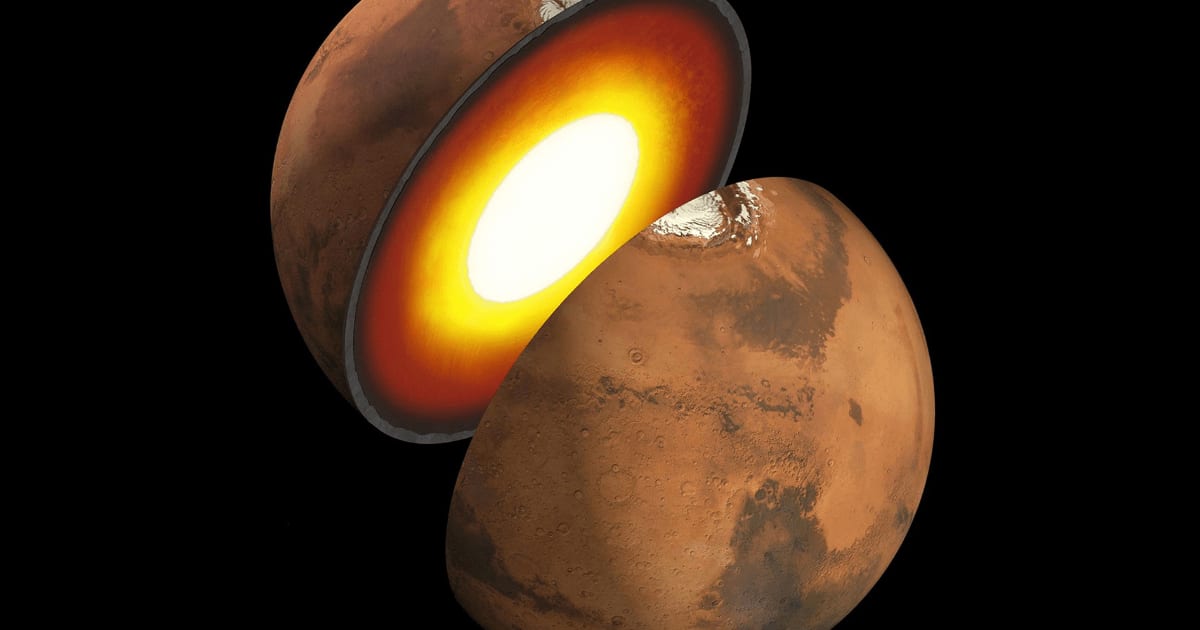
The Red Planet continues to surprise. A new study has brought forward a glaring discrepancy between the northern and southern hemispheres of the planet. Gravitational measurements have revealed that Mars' southern interior is hotter by around 200 to 400 degrees Celsius than the northern half. The research, published in the journal Nature, was led by Caltech alumnus Alexander Berne, who is currently a postdoctoral associate at the University of Arizona.
The surprising revelation of asymmetry
During his doctoral research at Caltech, Berne came up with a model that can decipher the structure of a planetary object's interior based on variations in gravitational data. Berne and his colleagues then used the model to delve deeper into the features of Mars, i.e., to comprehend the interior structure of Mars.
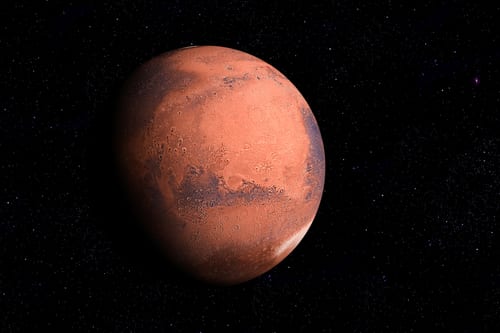
The team analyzed data acquired over decades from varying Mars missions—Mars Global Surveyor, Mars Odyssey, and Mars Reconnaissance Orbiter. Based on this data, Berne and his team measured minute deviations in the spacecraft's velocities, using these to reconstruct the gravitational field around Mars. But how does this information on gravitational fields give us a peek into the interiors of Mars? The answer lies in the seasonal variations exhibited by the gravitational forces applied by the Sun on Mars due to Mars' elliptical orbit and tilted rotation axis.
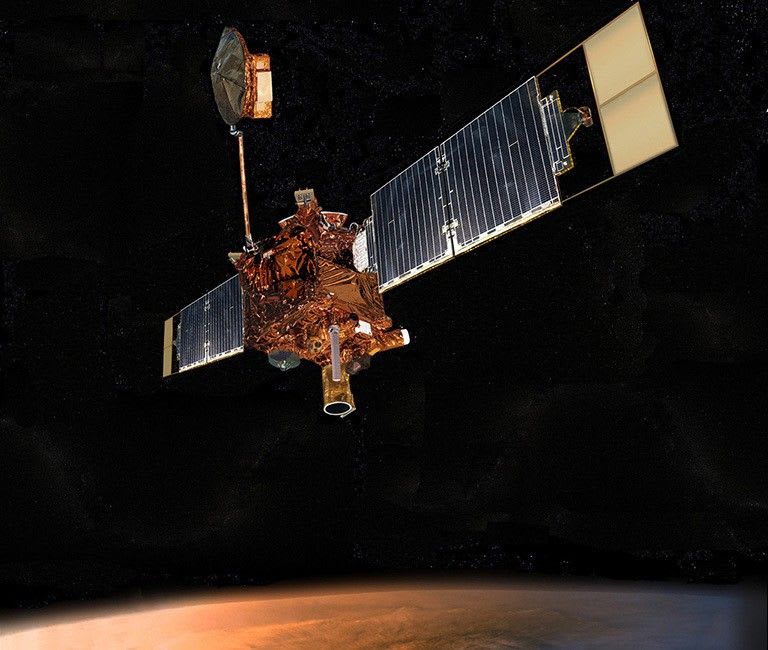
To isolate Mars' gravitational signatures, the research group reprocessed the above-mentioned tracking data from the Mars orbiters using the tidal tomography method. This technique, which was earlier applied to map the depths of Earth and the Moon, had never been applied to Mars. These time-varying gravitational signals ultimately unraveled a picture of the Red Planet's interiors. The final results displayed deviations from the symmetric scenario by around 300 percent.

"Scientists usually assume that the interiors of planetary bodies are generally spherically symmetric, but this is not necessarily true," Berne explained in a statement. "As we get more gravity data, we can determine the three-dimensional intricacies of a planet's interior structure. These inferences, in turn, give us a blueprint for designing future missions and scientific exploration of these worlds. Understanding the interior structure of planetary bodies helps us unravel the processes that shaped their formation and evolution."
What this bizarre anomaly suggests
This new discovery can help answer many intriguing questions about Martian phenomena, such as magnetic anomalies detected in iron minerals in the southern hemisphere. A thermal discrepancy observed in the south implies the existence of a powerful magnetic field that could generate magnetic variations between the northern and southern hemispheres. "The dichotomy that we see between north and south is important to understand because it gives information about processes that may have influenced the hydrology of Mars, including the formation of basins that may have held water," explained Amirhossein Bagheri, a co-author of the paper and a postdoctoral researcher at Caltech.

As for what resulted in the thermal difference between the two hemispheres, there are a few hypotheses. It may have its origins in a giant impact that released heat from the north, spontaneous convection in the Martian southern mantle, or thick geological features that did not allow excess heat to escape.
More on Starlust
Data from Chinese rover suggests Mars had liquid water as recently as 757 million years ago
Scientists need to know this before we travel to Mars: How much of the planet's dust can be inhaled?