NASA’s James Webb Telescope provides stunning look at chaotic star birth 3,300 light-years away
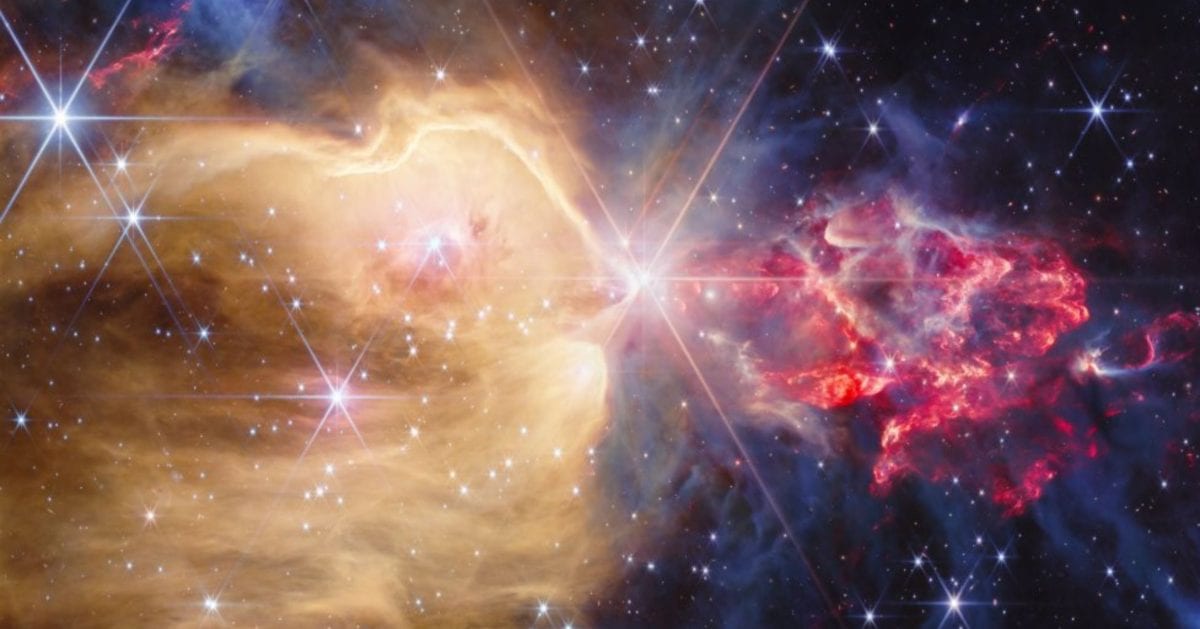
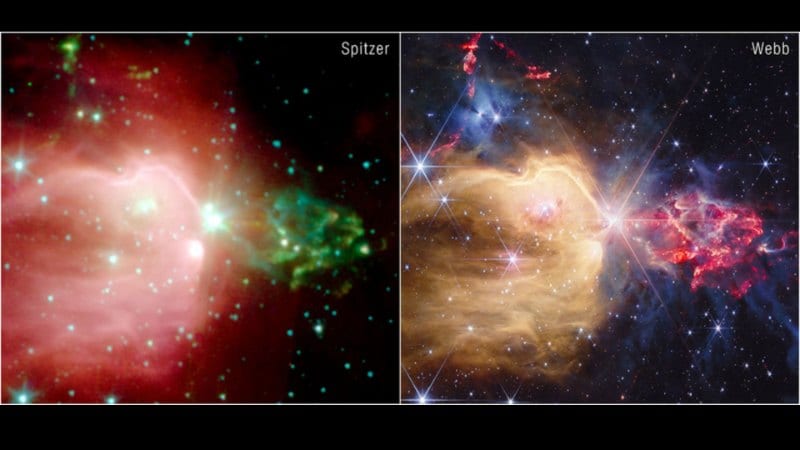
The James Webb Space Telescope (JWST) has showcased its prowess yet again by revealing different violent stages of star formation. According to NASA, the observatory has unveiled stars hidden in the dust of a stellar nursery known as NGC 7129, which lies approximately 3,300 light-years away. This nursery is harboring stars in different stages of development, and they are reshaping the environment in which they are maturing. This region has been previously imaged by the Spitzer Space Telescope, but Webb’s infrared capabilities have presented it like never before.
It's alive! 🧟 @NASAWebb unveiled numerous stars formerly hidden by clouds of dust in this stellar nursery known as NGC 7129, which resides about 3,300 light-years from Earth. Learn more about this region – and tour it in an interactive experience >> https://t.co/INygVgPNKb https://t.co/Z2BOwGxCxy
— NASA Marshall (@NASA_Marshall) October 25, 2026
We get the best idea of Webb’s infrared abilities by comparing this view to the image captured by Spitzer years ago. “Webb’s high spatial resolution reveals many rich structures in the region’s gas, building on research done previously by NASA’s retired Spitzer Space Telescope,” NASA said in a statement.
Stars form in thick clouds of gas and dust, and a telescope must be able to peer through these clouds to see them. Thanks to Webb’s unmatched infrared sensitivity, it can image stars hiding in dusty regions, something that is impossible for most telescopes. One of the prominent features of the new image by Webb is the star named LkH(alpha) 234 that is visible in the center of the picture. According to NASA, it is a pre-main-sequence star, which has finished gathering mass from its surroundings and is getting hotter due to contraction under gravity. As its temperature rises, the star, which has a mass of around 5 to 8 solar masses, will start fueling itself by fusing its own hydrogen like our Sun.
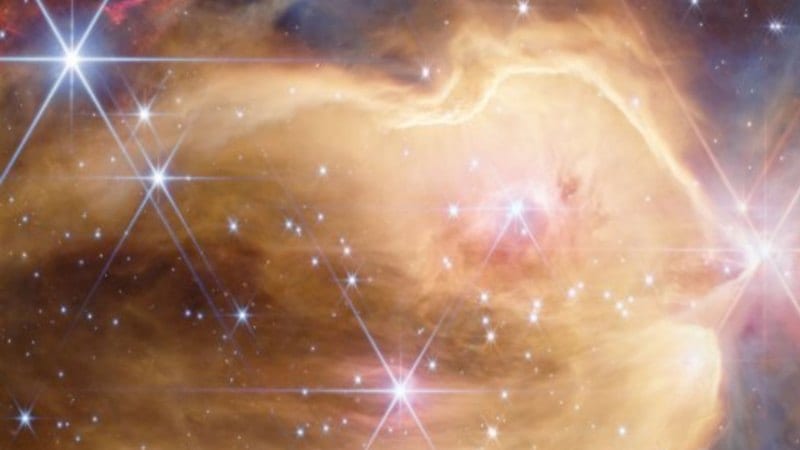
There are two major regions of star formation next to the central star. On its left is a cavity that appears gold in color. The golden color represents a dense, hot hydrogen gas cloud, which is being carved by the outflows from LkH(alpha) 234. Scientists say the outflow is not just blowing away the hydrogen gas but also creating conditions for even more stars to form. As you can see, there are several more pre-main-sequence stars in the golden cloud that are emitting stellar winds and are creating smaller cavities within the cavity.
NASA has highlighted another major feature in this golden region. The stars embedded within it are generating intense light and radiation, which are heating up the hydrogen gas. As the gas heats up, it pushes against the colder and denser molecular gas outside the cavity, creating a boundary above it called a photodissociation region. “In this region, the molecules of hydrogen break down into atoms. By influencing the temperature and chemistry of the region, this collection of stars offers insight into how these molecular clouds will gradually erode over millions of years,” the statement said.
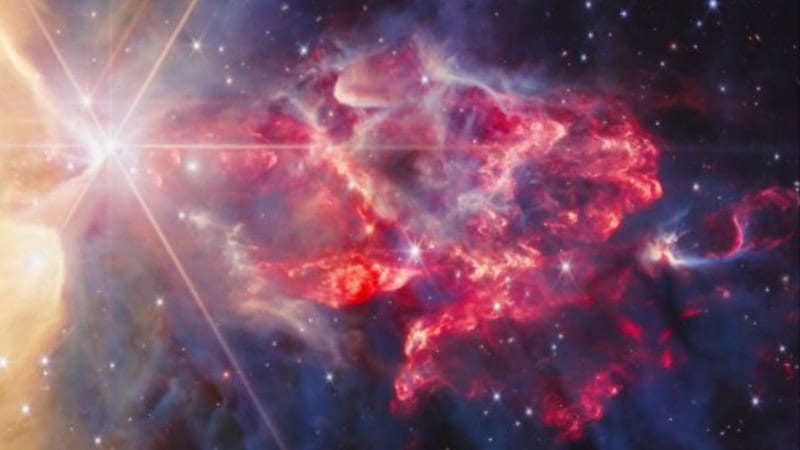
On the right side of the central star is a region represented in red. This chaotic region hosts numerous protostars—stars in their earliest phase when they are still gathering mass from material around them. Protostars are created after molecular clouds of gas and dust initially compress and fragment. The red region got its texture because the protostars are accumulating mass and releasing superheated material, which interacts with the dense, gray, and translucent matter around them. Astronomers hope that this new Webb data will reveal how the stars and protostars in this region influence the gas and dust surrounding them.
More on Starlust
Supermassive black hole-powered blazar breaks record for most distant object of its kind ever found
A dead star is leaving behind a bizarre 42-light-year-long trail, China’s Einstein Probe finds