NASA's James Webb cuts through dust to reveal 16.5 million never-before-seen stars in Cigar Galaxy
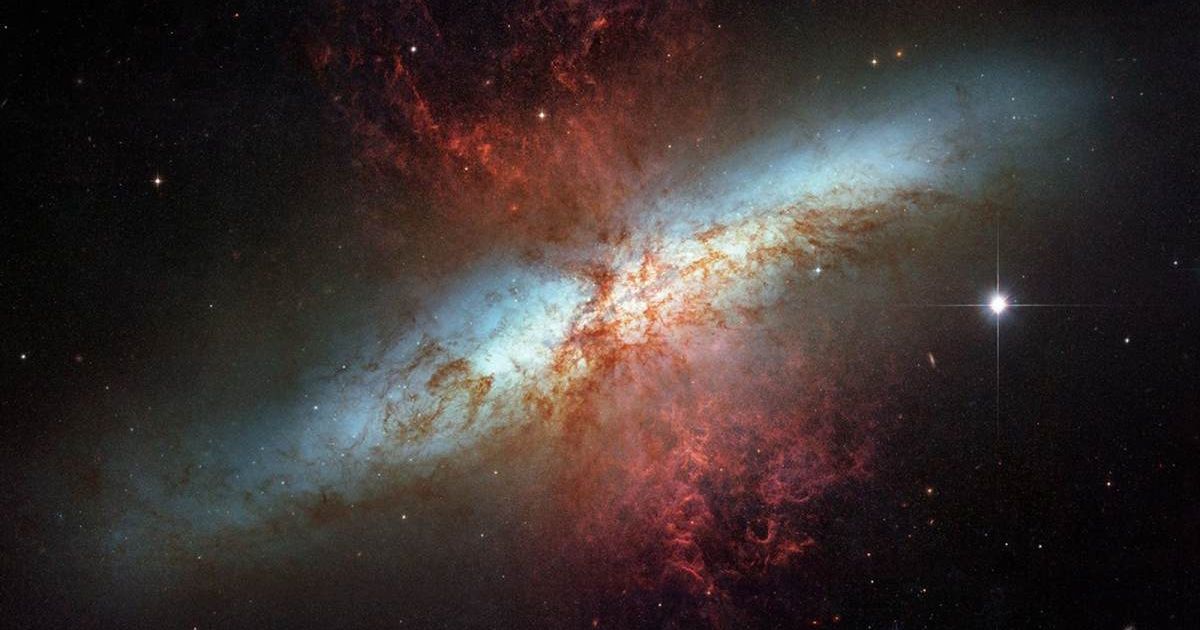
M82, nicknamed the Cigar Galaxy, has been shrouded in thick clouds of dust for millions of years, making it difficult for astronomers to see what’s actually happening inside its dense core. Now, thanks to the longest and most detailed observation of the galaxy to date, NASA's James Webb Space Telescope (JWST) has finally cut through the haze. After 65 hours of observation with its NIRCam instrument, Webb revealed roughly 16.5 million individual stars in M82, along with structural details no previous telescope had the power to capture.
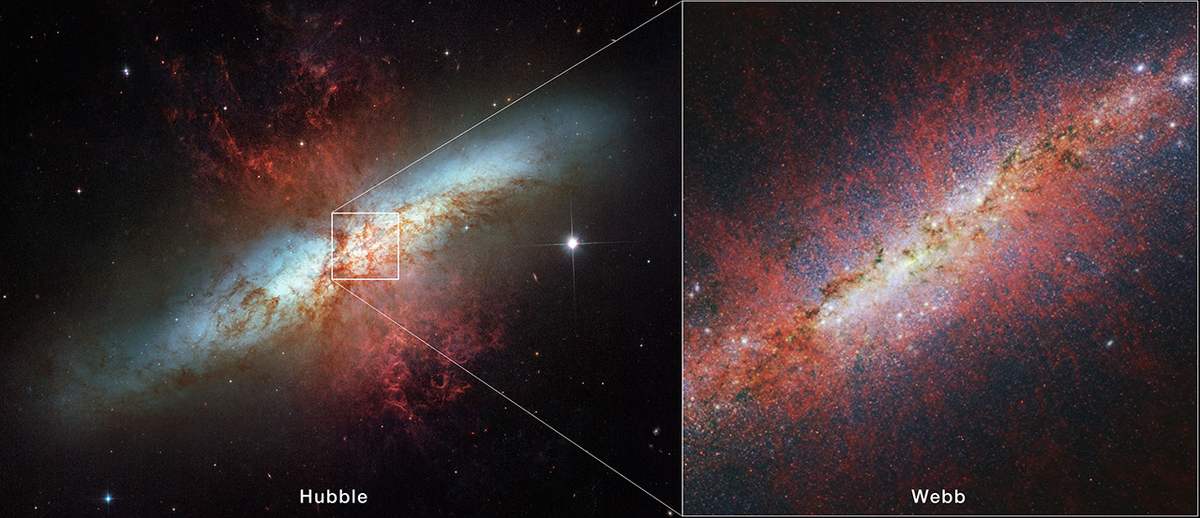
M82 sits about 12 million light-years from Earth and is forming stars at a pace 10 times faster than our own Milky Way. In the cosmic scale, this frantic activity is but a passing phase, and researchers estimate this process run its course in a few hundred million years, as per NASA. This intense star formation was triggered by a massive gravitational interaction—specifically, a close flyby with its larger galactic neighbor, M81. Webb's new images show the galaxy's disk is distinctly lopsided, with the two sides extending to different distances from the center. That asymmetry lines up perfectly with what scientists expect from a galaxy that has been violently pulled and reshaped by a tidal encounter.
Why has the Cigar Galaxy been so hard to study?
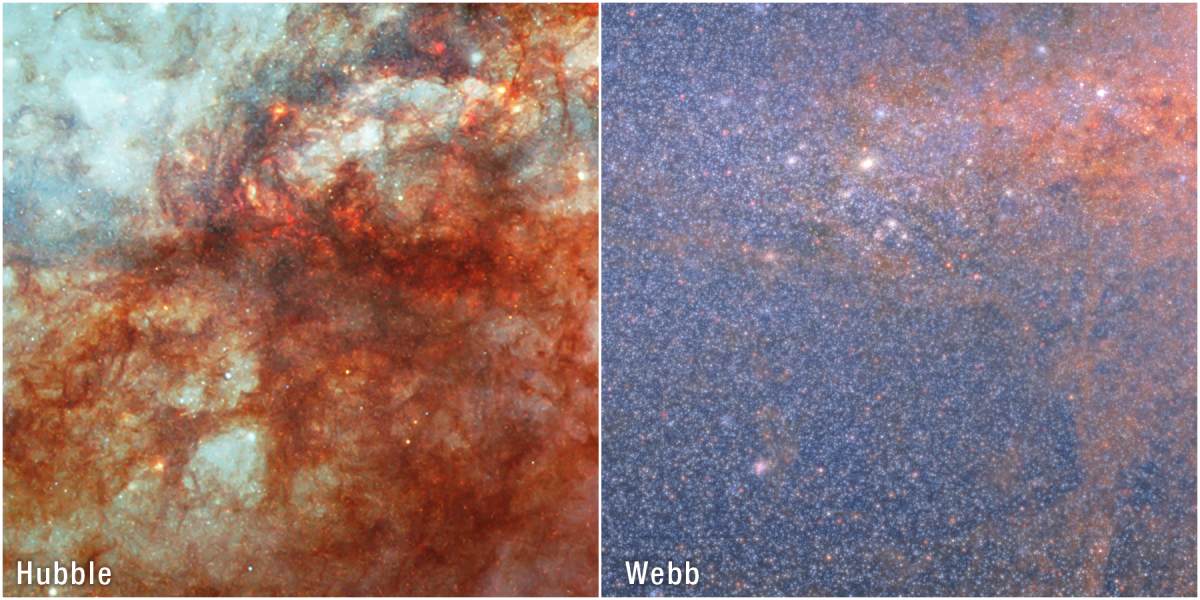
Earlier observatories, including NASA's Hubble Space Telescope and the now-retired Spitzer Space Telescope, tried to map M82 but ran into hurdles. Webb's predecessor Hubble had the resolution to see fine structural details but operated primarily in visible light, which was completely blocked by the sheer volume of dust around M82. Spitzer, meanwhile, was an infrared telescope capable of seeing through the dust, but its smaller mirror lacked the resolution to map the galaxy sharply. This is where JWST proved to be a game-changer. By combining infrared sensitivity with an enormous, high-resolution mirror, Webb can pierce the galactic haze, allowing the team to see the galaxy's disk and outflows in far sharper detail than ever before.
Adam Smercina, a NASA Hubble Fellow at the Space Telescope Science Institute and incoming Assistant Professor at Tufts University, who led the project, said, "M82 is a mess, but it's a beautiful mess. We don't fully understand what's going on, especially concerning its evolutionary history. What could have triggered such an elevated rate of star formation? How long has this galaxy been driving plumes of material away from its center?” He added that the galaxy works as a natural laboratory for studying how stars form and how that activity pushes material outward into space.
So, how did scientists pull this off?
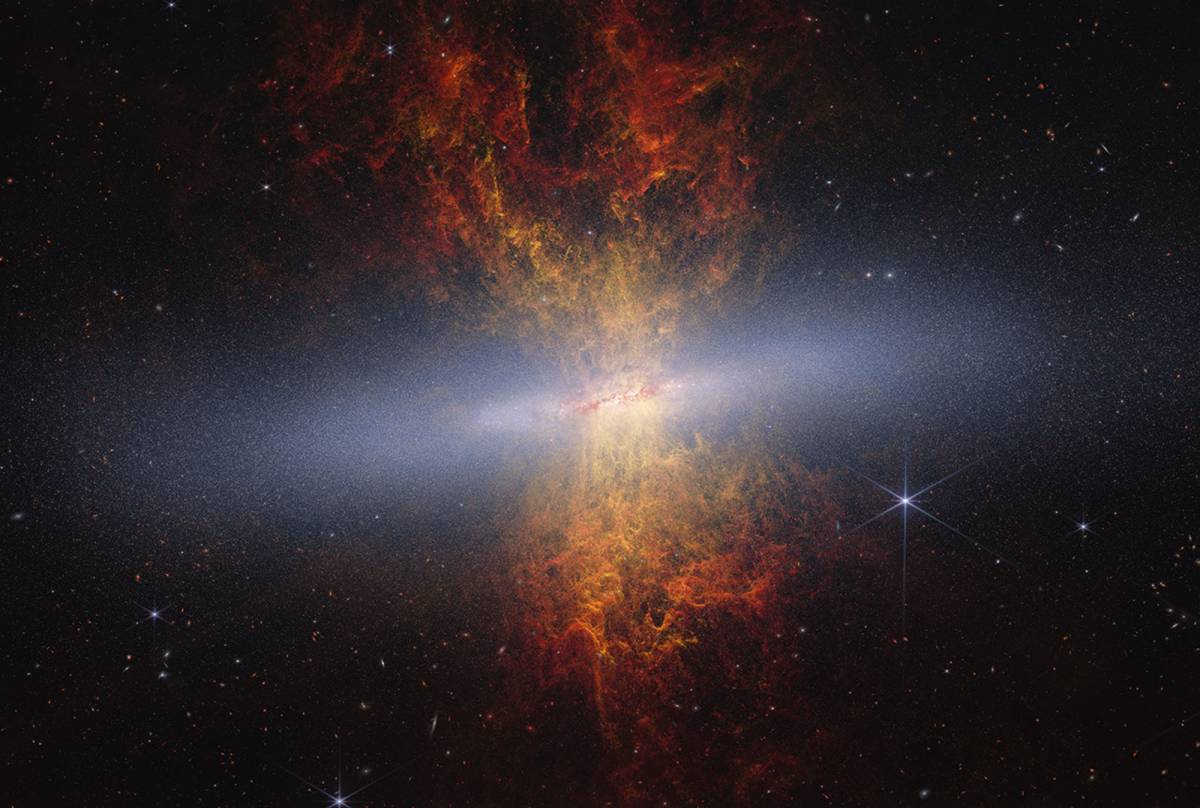
In the new images, stars show up as small blue specks scattered across the galaxy, yet that is still only a fraction of the stellar population actually present. The vast majority of M82's stars remain too faint to detect, even for JWST's massive mirror. Benjamin Williams of the University of Washington, who worked on the study, said, "The sheer number of stars that we were able to resolve with Webb is incredible. It's a whole different world from what we've been able to see with other telescopes. All of these stars collectively provide a detailed fossil record of the formation and evolution of M82." Observations from the telescope also revealed the galaxy's large-scale outflows, tracing massive hourglass-shaped plumes of gas and dust being driven above and below the disk by the intense energy of star formation. These outflows are highly structured: ionized gas appears as yellow tendrils closer to the disk, while small dust grains—specifically, complex molecules called polycyclic aromatic hydrocarbons—glow orange farther out.
Researchers plan to combine this data with older observations from Hubble and other missions to build a more complete timeline of how M82 became what it is today. Commenting on what’s ahead, Kristen McQuinn of the Space Telescope Science Institute said, "Galaxies are such intricate ecosystems that if you truly want to understand them, you have to pull datasets from different missions together. One mission cannot fully answer all of the questions we have about M82. [...] When you marry the datasets, you expand what you can probe, and the questions that you can pose are even more complex."
More on Starlust:
10 strangest things Hubble Space Telescope has discovered in space
NASA's Habitable Worlds Observatory may find signs of alien life with this proposed upgrade