Micrometeoroids and solar wind are constantly changing the Moon. New study finds how.
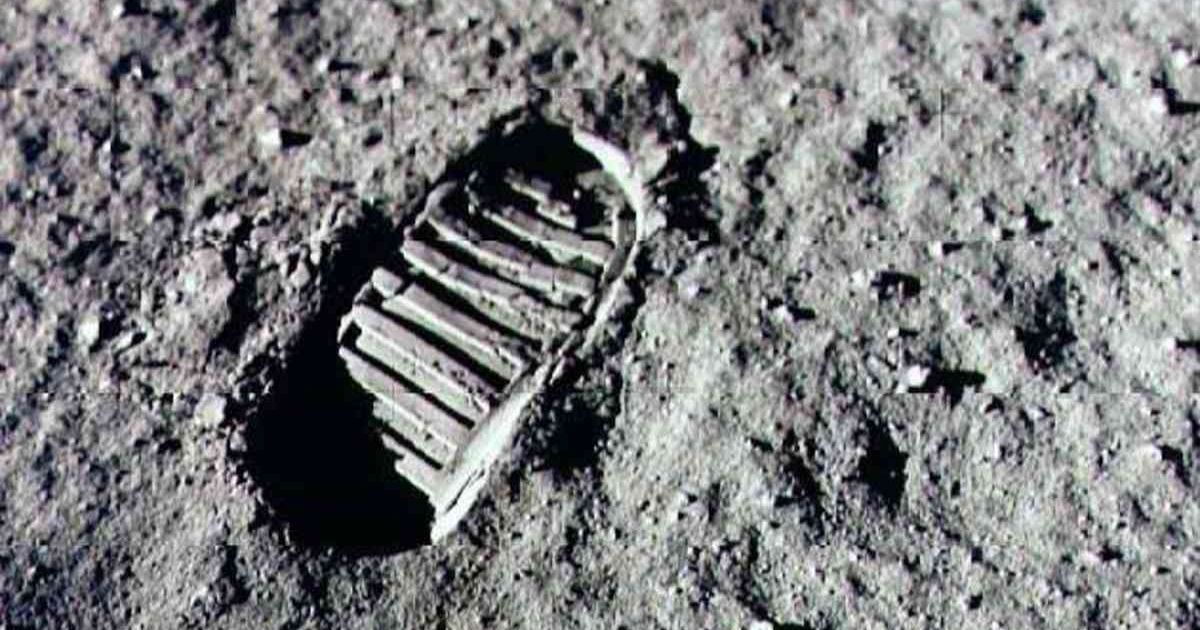
As an airless celestial body, the Moon retains its surface in pristine form for billions of years. Even tiny impacts by micrometeoroids are not erased. Such impacts continuously alter the structure, composition, and optical properties of surface materials. Now, to understand these processes at the tiniest of scales, a team of Chinese scientists has looked into impact glass returned by China’s Chang’e-5 mission. The team has published its results in the Proceedings of the National Academy of Sciences of the United States of America and the Journal of Geophysical Research: Planets.
For the study published in the Journal of Geophysical Research: Planets, the researchers used aberration-corrected transmission electron microscopy, scanning transmission electron microscopy, and spectroscopic analyses to look into the Chang'e-5 impact glass. They found iron-rich tiny droplets inside silicon-rich glass. Silicon-rich droplets were also found inside iron-rich material. The droplets were amorphous, meaning that they lacked the orderly structure of crystals.
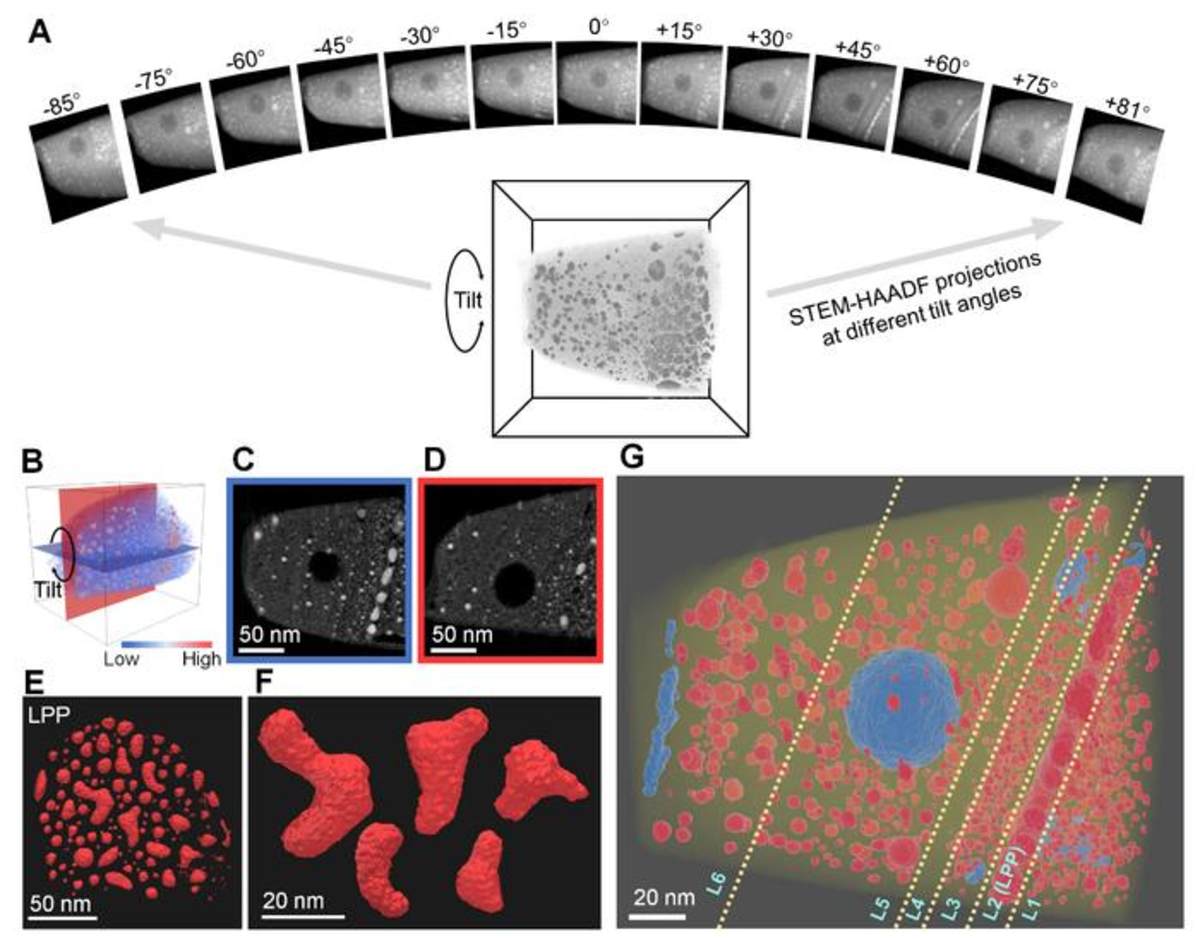
The droplets were found in clusters that had partially merged and grown. "The results suggest that micrometeorite impacts not only induce local melting of lunar regolith, but can also trigger silicate liquid immiscibility on extremely short timescales, with rapid quenching preserving the transient phase-separated structures in impact glass where different materials separated from one another," said a statement published on EurekAlert. Next, the Chinese team focused on nanophase metallic iron in the impact glass—a major product of lunar space weathering. For this purpose, the team used electron tomography, including energy-dispersive X-ray spectroscopy and electron energy-loss spectroscopy.
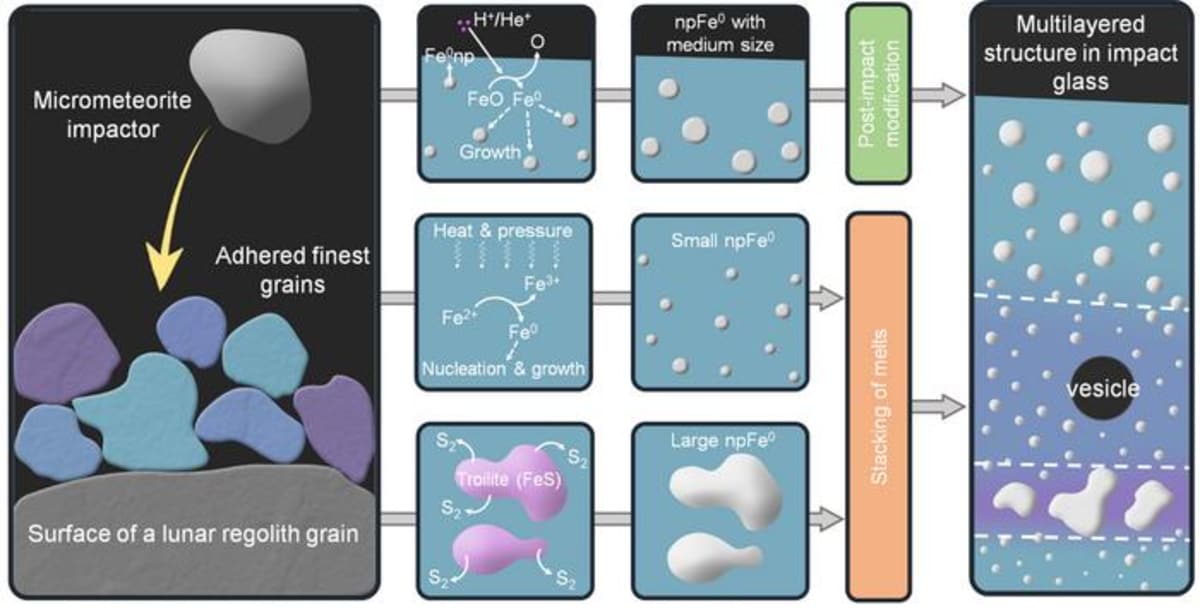
Such sophisticated imaging techniques allowed the researchers to shed light on their three-dimensional distribution, morphology, local abundance, and iron valence states of nanophase metallic iron at the nanometer scale. In one reconstructed volume, the researchers identified 1506 iron nanoparticles. Each particle had an average diameter of around 3.4 nm and a median diameter of approximately 2.9 nm. However, the particle size varied depending on the layer in which the particles were found. Different layers also exhibited distinct number densities and nanophase iron volume fractions. In a local large-particle layer, iron volume fraction reached up to 30% of the volume.
But how did the iron nanoparticles form? To find an answer, the researchers combined structural reconstruction with elemental and iron valence-state analyses. "The study showed that the sulfur-rich layer containing irregular large particles mainly originated from iron sulfide decomposition," the statement read. Many layers characterized by high concentrations of small particles had a great deal of Fe²⁺ disproportionation, which is a process via which Fe²⁺ is both oxidized and reduced. Closer to the outer surface, the team found signs of later modification caused by the solar wind, promoting glass-structure modification and nanophase metallic iron particle ripening. Further analyses revealed that metallic iron in mature impact-glass domains could reach 7.1% of its weight, exceeding previous bulk-soil estimates for Chang'e-5 samples. On microscopic scales, lunar regolith exhibits a notable heterogeneous distribution of nanophase iron.
More on Starlust
Astroparticle physicist proposes to build an observatory on the Moon’s South Pole—here's why
Fungi could help transform barren Martian regolith into fertile farmland, latest study suggests