Hubble captures stunning image of Calabash Nebula—a space gourd
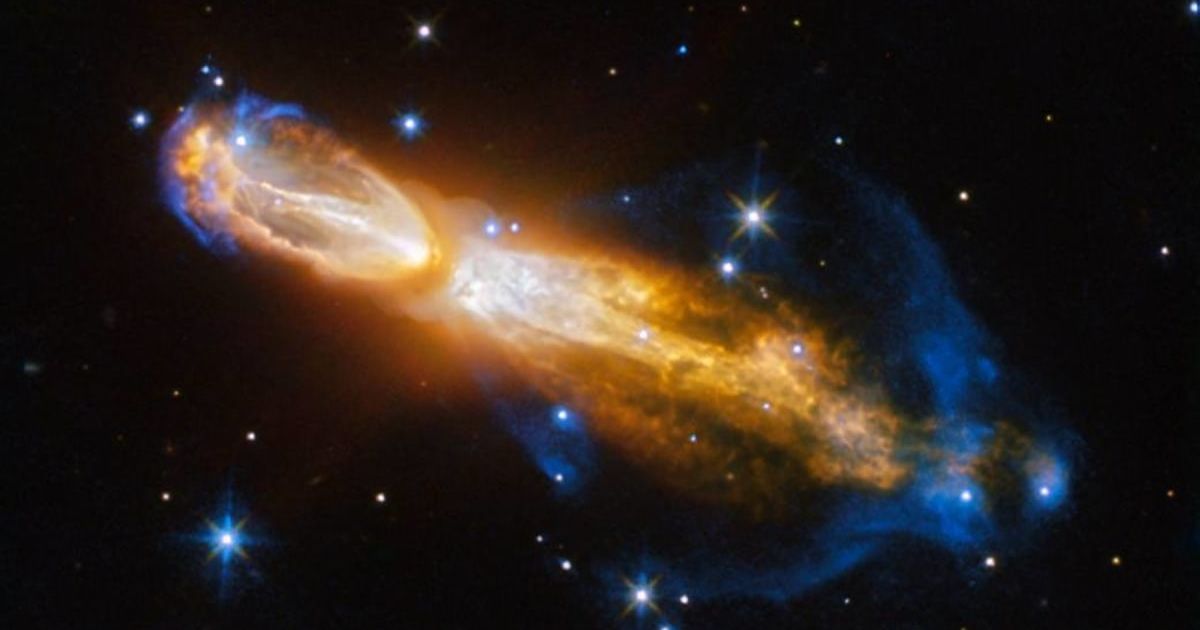
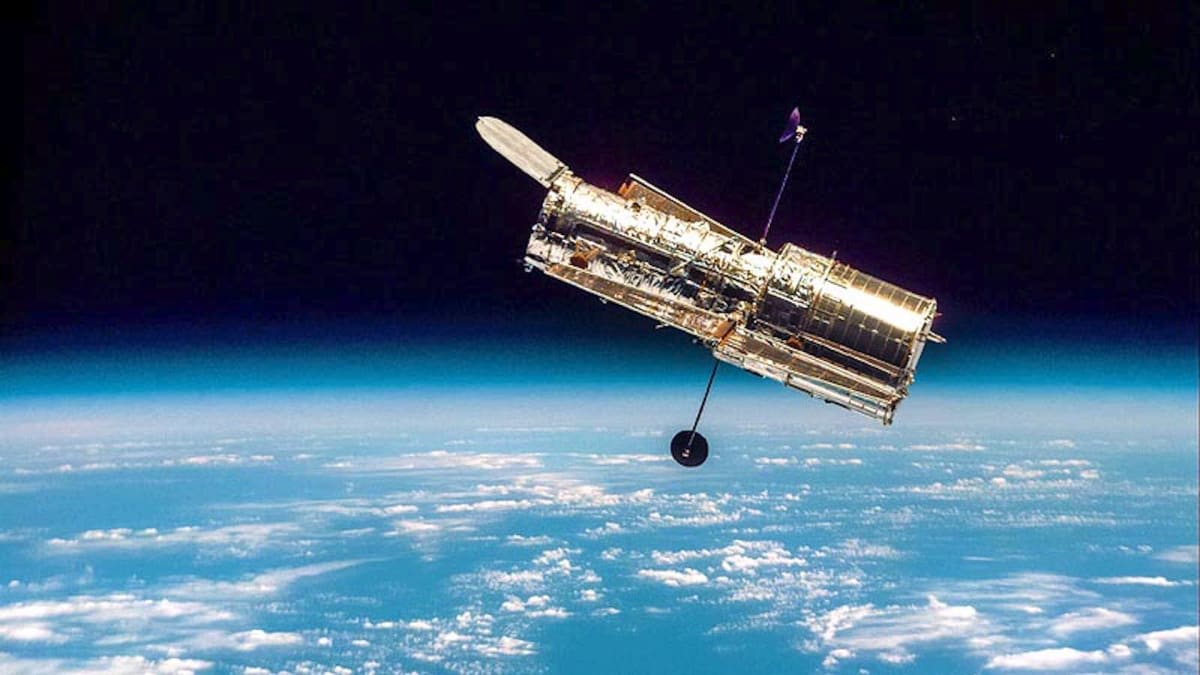
From helping scientists ascertain how old the universe is to the discovery of supermassive black holes, NASA's Hubble Telescope has been one of the most fruitful instruments in modern-day astronomy. In fact, not too long ago, it gave us a peek into another rare sight, that, as tragic as its name sounds, is one of the most beautiful sights to unfold in outer space. NASA announced that the Hubble was able to capture the death of a low-mass star in an image of the Calabash Nebula released on February 3, 2017.
The Calabash Nebula spans about 1.4 light-years and is named after the uneven shape of a calabash gourd. Its striking appearance is attributed to it being noticeably unusual, with a lopsided feature, with one stream of outflow extending farther than the other. The object also goes by another, less flattering nickname, the Rotten Egg Nebula, per NASA. That name comes owing to the large amounts of sulfur mixed into the gas and debris, an element infamous for producing a rotten-egg smell when combined with other substances.
The image captured by the Hubble shows a dramatic but short-lived transition of the star from a red giant to a planetary nebula. The star looks swollen in size owing to it being heated up, and is seen rapidly shedding its outer layer composed of gas and dust. Much of the star's original mass is being carried away in the thick material that can be seen in yellow-orange, blasting outwards in opposite directions at thundering speeds of almost 600,000 miles per hour.
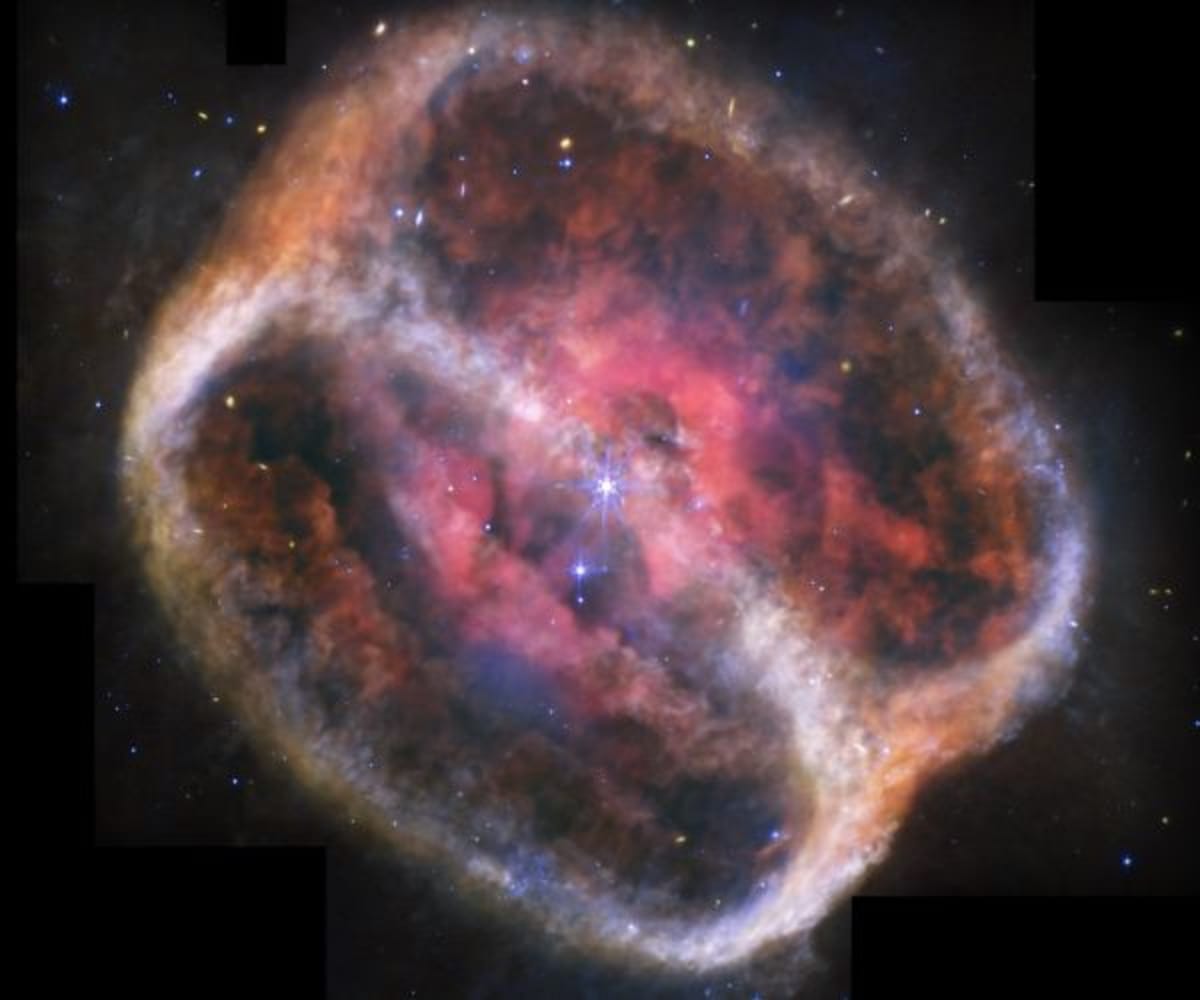
It is very rare for scientists to catch a glimpse of these stars during this phase, as the process takes place at a blistering pace by cosmic standards. Even though stars keep shining for billions of years, this phase only lasts for a few thousand years. In the years to come, the star will continue peeling away all its material, which will finally reveal a dense stellar remnant referred to as the white dwarf. The remnant will let out powerful ultraviolet light, which will, in turn, energize the surrounding gas, making it glow. That glowing shell is called a planetary nebula, which spreads out and fades over a span of tens of thousands of years.
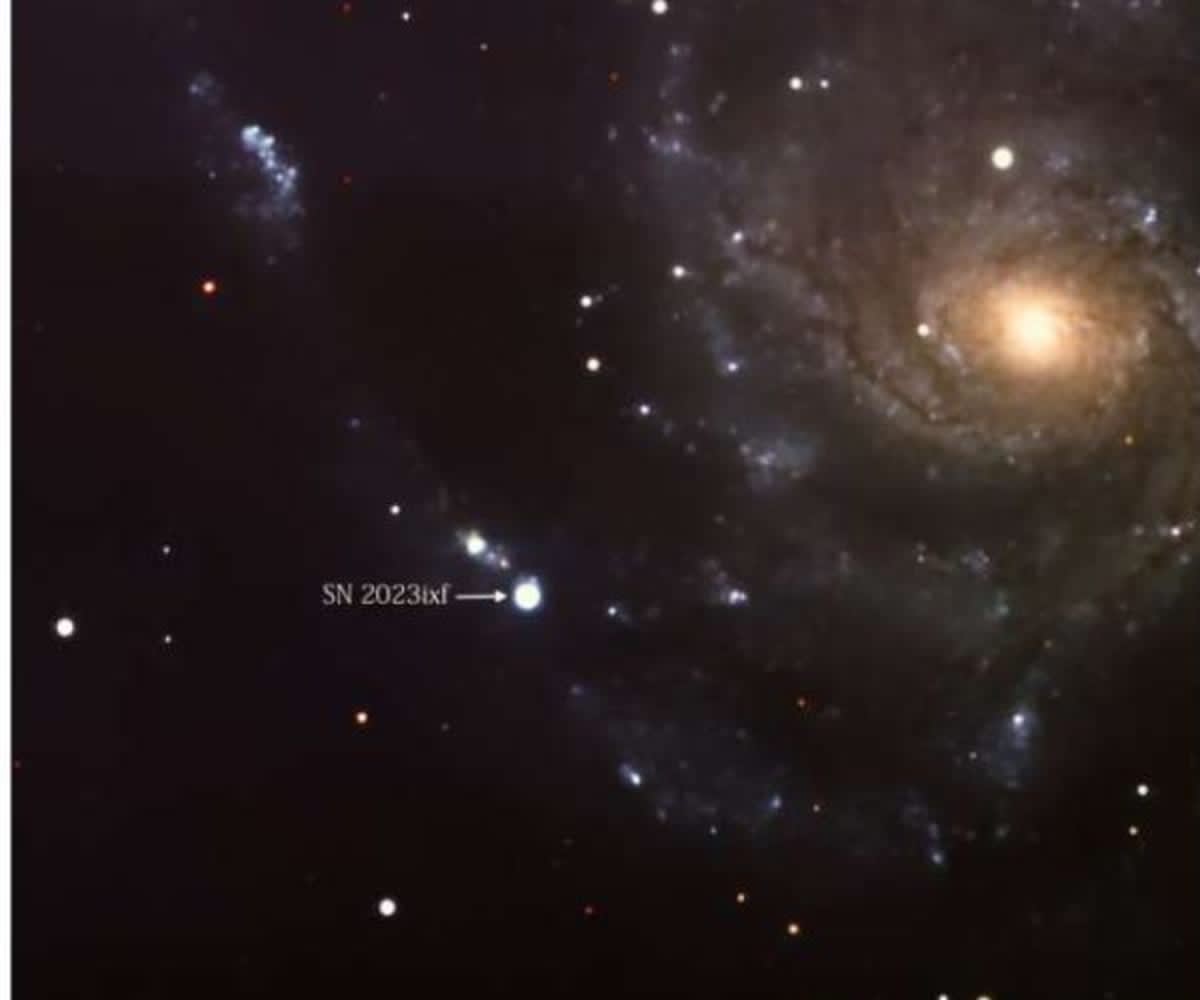
A 2023 study led by Dr. Zhang Jujia from Yunnan Observatories of the Chinese Academy of Sciences and Prof. Wang Xiaofeng from Tsinghua University had also revealed that a dying star ejects massive materials in its surroundings. The scientists got a rare front-row seat to this thanks to a supernova called SN 2023ixf. The researchers found that the parent star of the supernova lost material at a mass loss rate of 0.0006 solar masses per year during the last two to three years before the explosion. This outflow of gas moved at ~55 km/s and formed a dense shell close to the star. A consideration of this mass-loss rate, the high wind velocity, and pre-explosion observations taken over two decades ago suggested that SN 2023ixf could have been born of a short-lived yellow hypergiant that was a red supergiant before explosion, per Phys.org.
More on Starlust
Astronomers unveil stunning first image of rare dead star that had two massive explosions
For the first time, astronomers chronicled 130 years of a dying star's transformation