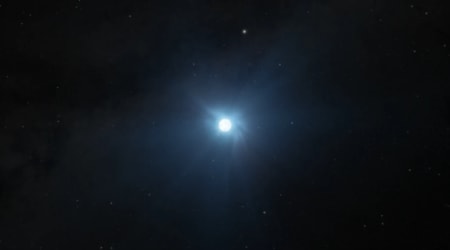
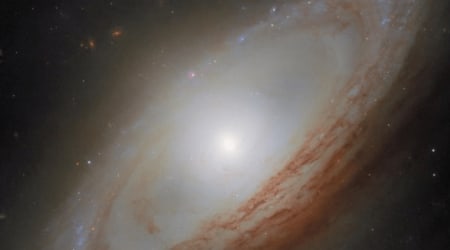
NASA telescope spots roaming giant black hole that's eating stars: 'Space Jaws'

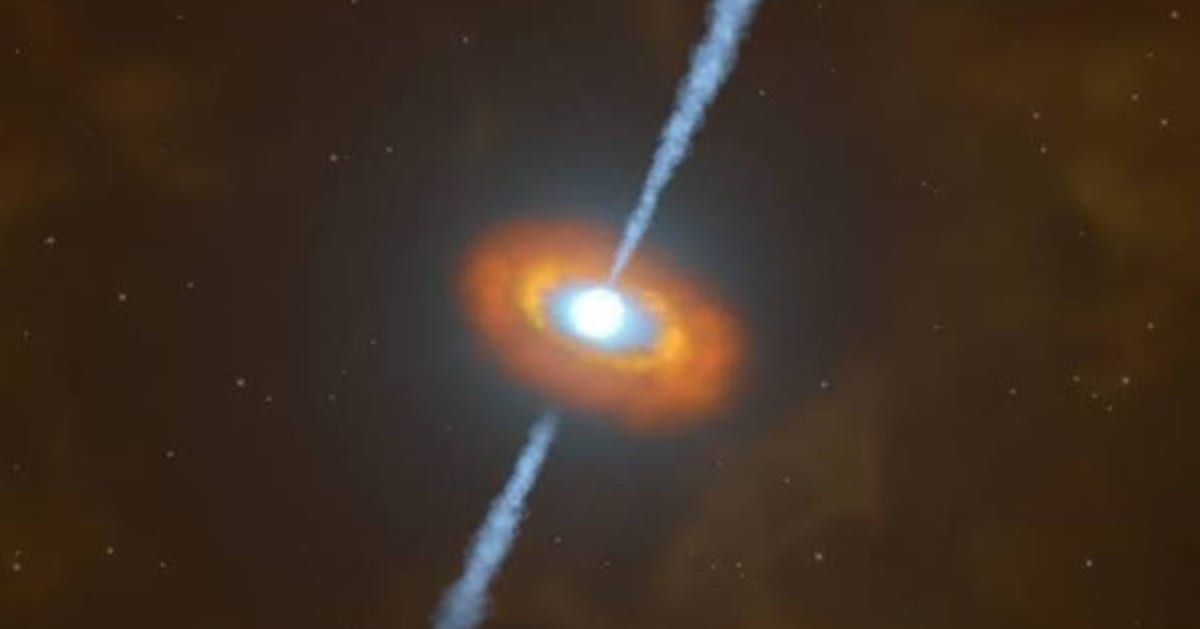
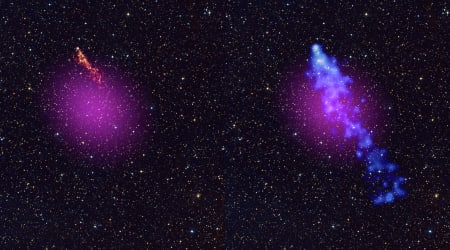
NASA's Hubble Space Telescope has been able to pinpoint a black hole dubbed "Space Jaws" in a burst of light. The black hole with the same mass as around 1 million suns was found when it tore apart and swallowed a star, as per NASA. This new phenomenon is known as a tidal disruption event (TDE) that spreads a burst of radiation. It was dubbed "AT2024tvd," and astronomers were able to pinpoint the black hole using the Hubble Telescope. These observations were backed up by NASA’s Chandra X-Ray Observatory and the National Radio Astronomy Observatory's (NRAO) Very Large Array telescope.

The data showed that the black hole was offset from the galaxy's center and revealed details of black hole physics. This was the first time an offset TDE was identified from around 100 TDE events recorded by optical sky surveys. This TDE was only 2,600 light-years away from the black hole at the galaxy’s center, according to Hubble’s optical precision. AT2024tvd's host galaxy has a second, larger black hole in the galactic core, both of which co-exist but are not bound by gravity. The smaller black hole might have merged into the bigger one at the galaxy’s center.

"Theorists have predicted that a population of massive black holes located away from the centers of galaxies must exist, but now we can use TDEs to find them," stated astronomer Professor Ryan Chornock of the University of California, Berkeley, as per Newsweek. “It opens up the entire possibility of uncovering this elusive population of wandering black holes with future sky surveys," added UC Berkeley astrophysicist Yuhan Yao, who led the study on the discovery. The paper is being prepared for publication in the latest issue of The Astrophysical Journal Letters.

When stars get stretched or “spaghettified” by the gravitational tidal forces of a black hole, the remnants are pulled into its orbit. This pushes out shocks and outflows with high temperatures, visible in ultraviolet and visible light, as per NASA. The flare from the black hole resembled a supernova but was very hot and had broad emission lines of hydrogen, helium, carbon, nitrogen, and silicon. The flare was first observed by the Zwicky Transient Facility at Caltech’s Palomar Observatory, before it was pinpointed and recorded by NASA’s Hubble Space Telescope.

The question of how a smaller black hole traveled farther from the center was hypothesized by astronomers. Previous research had indicated that black holes were ejected from the centers of galaxies due to three-body interactions. The black hole with the lowest mass was kicked out in this event, resulting in its current proximity to the center. “If the black hole went through a triple interaction with two other black holes in the galaxy’s core, it can still remain bound to the galaxy, orbiting around the central region,” Yao explained about the black hole activity that was offset.

An alternative theory was that the black hole was a remnant of a smaller galaxy that merged with the host galaxy more than 1 billion years ago. This could lead to an eventual spiraling into the central active black hole, way ahead in the future. However, Erica Hammerstein, a UC Berkeley postdoctoral researcher, scoured the Hubble images and did not find evidence of a past galaxy merger in Hubble's images of the galaxy. However, she added that there was substantial evidence previously that showed galaxy mergers highlight the rates of enhanced tidal disruption event rates.