Here are some quick facts about 3I/ATLAS ahead of its closest approach to Earth

Discovered in July by the ATLAS telescope in Chile, this comet is on a one-way trip through our solar system.
Hubble Space Telescope reobserved 3I/ATLAS on November 30, with its Wide Field Camera 3 instrument. (Cover Image Source: NASA, ESA, STScI, D. Jewitt (UCLA), M.-T. Hui (Shanghai Astronomical Observatory)

A rare visitor from deep space reaches a major milestone on December 19: Comet 3I/ATLAS will make its closest approach to Earth at 1 a.m. EST (6 a.m. GMT). Discovered in July by the ATLAS (Asteroid Terrestrial-impact Last Alert System) survey telescope in Chile, there are a number of reasons why this icy traveler stands out. Let's take a look at some of them.

Comet 3I/ATLAS streaks across a dense star field in this image captured by the Gemini Multi-Object Spectrograph (GMOS) on Gemini South at Cerro Pachón in Chile (Cover Image Source: International Gemini Observatory/NOIRLab)

Interstellar origin 

This is only the third interstellar object on record to have originated from outside our solar system, following on the heels of the famous 1I/ʻOumuamua in 2017 and 2I/Borisov in 2019. Its arrival in our neighborhood has given us a rare opportunity to study the chemistry of a distant, alien star system, per the ESA

‘Oumuamua is the first confirmed object from another star to visit our solar system (Image Source: NASA)

Record-breaking speed 

When it was discovered, 3I/ATLAS was zooming through space at the speed of about 137,000 miles per hour (221,000 kilometers per hour), per NASA. And once it came within the reach of our Sun's gravity, its speed increased to about 153,000 miles per hour (246,000 kilometers per hour), which, according to the ESA, is the highest ever recorded speed for an object visiting our solar system.

Massive age 

By its extreme velocity and angle of entry, astronomers estimate the comet is billions of years old, perhaps having predated our own solar system and having spent ages drifting amidst the vast, empty "void" between stars. 
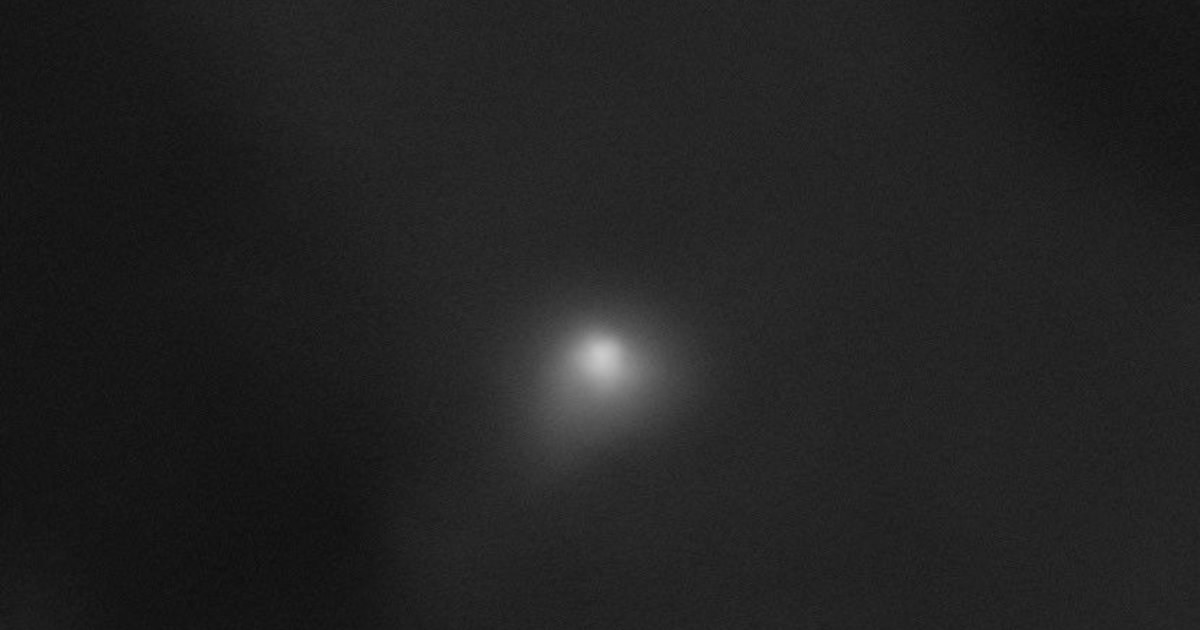
The High Resolution Imaging Science Experiment (HiRISE) camera aboard NASA’s Mars Reconnaissance Orbiter captured this image of interstellar comet 3I/ATLAS on Oct. 2, 2025. At the time it was imaged, the comet was about 0.2 astronomical units (19 million miles, or 30 million kilometers) from the spacecraft. (Image Credit: NASA/JPL-Caltech/University of Arizona)
The High Resolution Imaging Science Experiment (HiRISE) camera aboard NASA’s Mars Reconnaissance Orbiter captured this image of interstellar comet 3I/ATLAS on Oct. 2, 2025. (Image Credit: NASA/JPL-Caltech/University of Arizona)

Size 

Based on the observations made by the Hubble Space Telescope on August 20, 2025, its size is estimated to be anywhere from 1,400 feet (440 meters) to 3.5 miles (5.6 kilometers) wide. 

Distance on December 19

At its closest approach on December 19, 3I/ATLAS will be within 170 million miles (270 million kilometers) away from Earth. That is about 1.8 astronomical units, nearly twice the distance between Earth and the Sun. 
Stock image of a comet flying through space close to the Earth (Representative Cover Image Source: Getty | buradaki)
Stock image of a comet flying through space close to the Earth (Representative Image Source: Getty | buradaki)

One-way trip 

The comet happens to be on what has been defined as a hyperbolic trajectory. Since its speed is too high for it to be captured in a permanent orbit by the Sun's gravity, it will just slingshot around our star and head back into interstellar space, never to be seen again.

Galactic direction

Scientists think that the comet came from the general direction of the constellation Sagittarius, which is situated roughly in the direction of the Milky Way's center. When it was discovered, it was about 410 million miles (670 million kilometers) from the Sun, in the orbit of Jupiter.
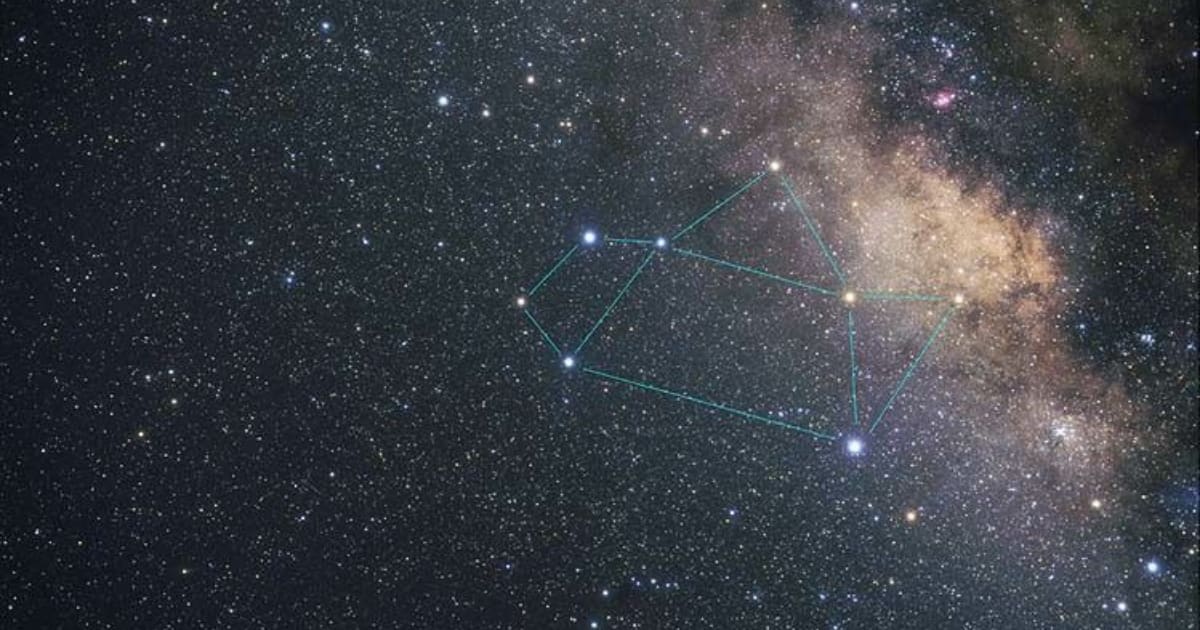
Sagittarius Constellation (Image Source: NASA | Akira Fujii)

Although the comet is indeed making its "closest approach" to our planet, NASA stresses that it will not be a "naked-eye" spectacle for casual viewers, despite being a significant scientific event. A dark sky and a telescope with an aperture of at least 30 centimeters (12 inches) are required to see it. The comet will be visible in the east-northeast sky, directly beneath Regulus, the brightest star in the center of the constellation Leo. 

More on Starlust

Comet 3I/ATLAS makes its closest approach to Earth: Skywatching tips, livestream, and more

NASA missions observing 3I/ATLAS as it makes its closest approach to Earth

MORE STORIES

Residents of the US, Europe, Canada, and northwestern Africa will see a partial eclipse, meaning only a portion of the Sun will be blocked by the Moon.
52 minutes ago
August brings in many events for skywatchers, and here are a few lesser-known meteor showers worth a look.
4 hours ago
This year's peak arrives hours after a rare total solar eclipse. Here's where to catch it.
10 hours ago
Afraid of missing the total solar eclipse of August 12? Worry not, there are many livestreams available.
17 hours ago
Besides auroral activity, the U.S. will also get to experience a solar eclipse and the Perseid meteor shower on August 12.
22 hours ago
Here’s what to look for before, during and after totality on August 12, 2026.
1 day ago
Here's what will happen in the sky during the total solar eclipse, from partial eclipse to totality.
1 day ago
The spectacular planetary parade will be visible with the naked eye.
1 day ago
Under perfect conditions, the Perseids can produce more than 100 meteors per hour.
2 days ago
The eclipse will be witnessed by millions across different continents on August 12 and it will offer scientists a rare chance to study the Sun.
2 days ago