ESA-China’s Smile mission launch April 9: Vega-C timeline, live stream and how to watch
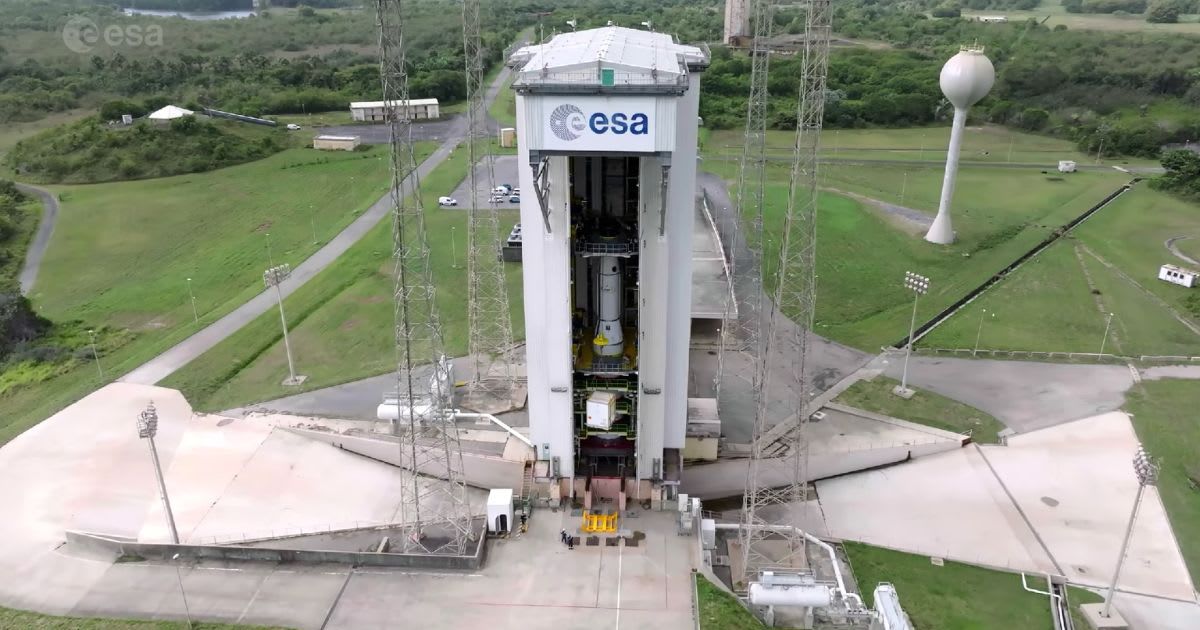
On Thursday, April 9, the European-Chinese Smile mission is all set to launch aboard a Vega-C rocket from Europe’s Spaceport in French Guiana. The spacecraft is scheduled to lift off at 07:29 BST / 08:29 CEST (03:29 local time). Short for Solar wind Magnetosphere Ionosphere Link Explorer, the Smile mission is a collaborative effort from the European Space Agency (ESA) and the Chinese Academy of Sciences (CAS). ESA confirms that final preparations are underway for this launch, as both the satellite and rocket components are already at the spaceport.
Join us for the Smile launch!
— ESA Science (@esascience) April 2, 2026
🤳 Tune into ESA Web TV at https://t.co/aiFFYYFVH5 from 08:10 CEST on 9 April.
Key milestones expected:
🚀 08:29 Vega-C lift off
👋 09:25 Separation of Smile
📈 09:26 Acquisition of Smile’s first signal from space
🛰️ 09:32 Deployment of… pic.twitter.com/aXEp5YMNVq
ESA confirmed that it will broadcast the Smile mission’s launch live at 08:10 CEST (07:10 BST) via ESA Web TV and its YouTube livestream. The Vega-C rocket is expected to carry Smile through a step-by-step launch sequence lasting nearly an hour. Following liftoff at 08:29 CEST, the rocket’s three solid-propellant stages (for ascent) will separate rapidly in the first seven minutes or so. During this phase, the payload fairing opens, exposing the Smile spacecraft loaded inside it.
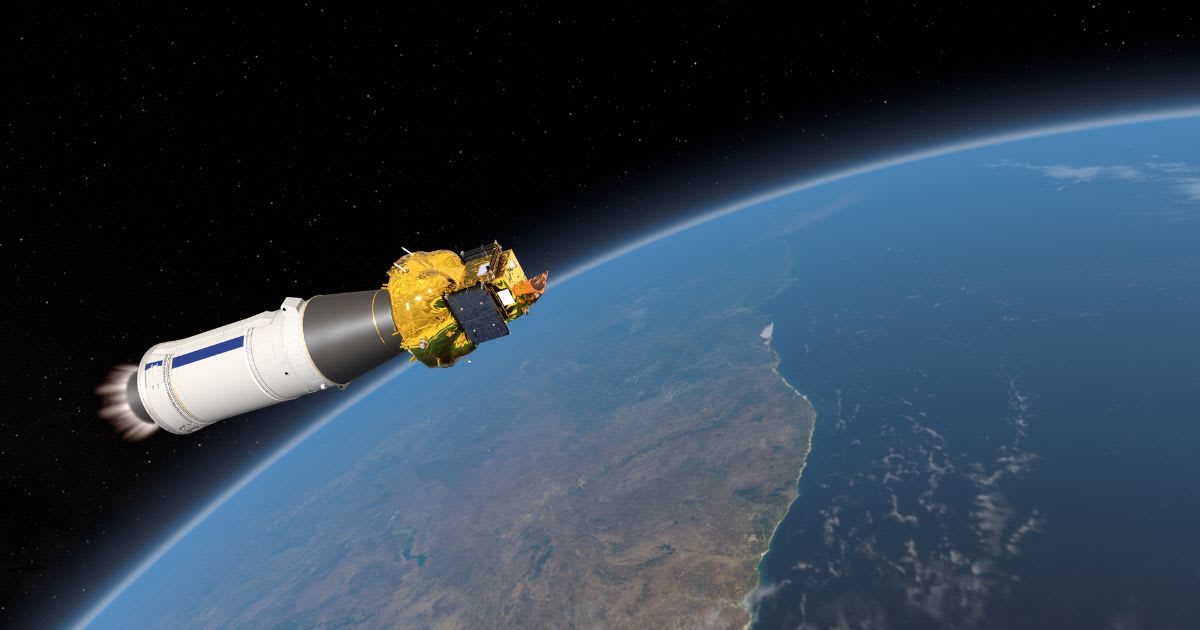
Following upper stage operations, Smile will separate from the rocket at T+56 minutes, after which it will send its first signal to ESA and deploy its solar arrays. At first, the spacecraft starts off in a circular orbit 700 km above Earth’s surface. Then, it will gradually raise its orbit — with 11 engine burns over 25 days — to begin its science mission. Smile will collect and return data on an elongated, polar orbit, roughly 121,000 km above the North Pole and 5,000 km above the South Pole.
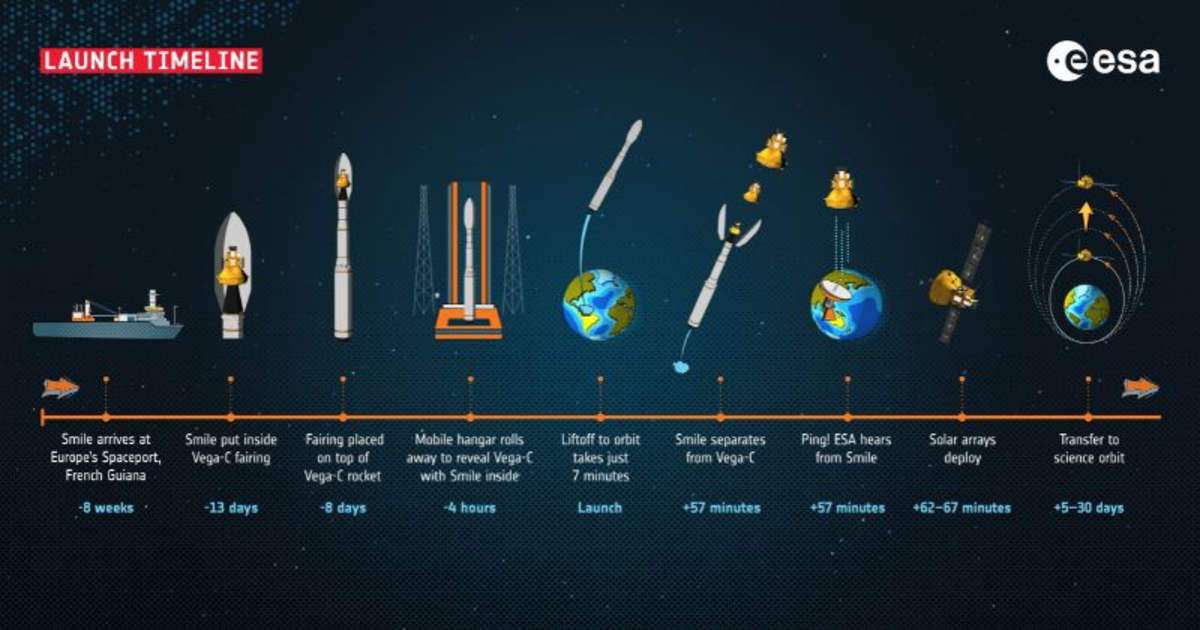
The ESA-CAS Smile spacecraft will send home its first science images about three months after launch, and the mission itself is expected to be operational for three years. Its four instruments are the magnetometer (MAG) boom, the soft X-ray imager (SXI), the light ion analyzer (LIA) and the ultraviolet imager (UVI). Using them, it aims to study how the Earth’s magnetosphere reacts to solar wind. By observing solar and geomagnetic storms, Smile will offer insights into space weather and help improve satellites, communications systems and power grids.
T-6️⃣ days until launch!
— ESA Science (@esascience) April 3, 2026
DYK? Smile will observe the northern lights non-stop for 45 hours at a time for the first time ever.
This will give us a better idea of how geomagnetic storms lead to auroras, but also of other consequences on our infrastructure 👉… pic.twitter.com/YCMUd2yJ33
Upon launch, Smile is all set to be the first mission to observe Earth’s magnetic environment in X-ray light. It will also complement it by continuously imaging auroras in ultraviolet light for 45 hours at a time. Smile marks the first time that ESA and CAS are jointly launching a mission. It gets its name not just from its abbreviation, but from a literal smiley-like face, seen from a simulation of X-ray emissions from Earth's magnetic field.
More on Starlust
ESA–China's Smile mission launches April 9 to study how Earth reacts to solar wind
ESA to launch dedicated SpaceX Crew Dragon mission to ISS in early 2028