Cosmic mystery solved? Dark matter may not be entirely 'dark' after all, new research suggests
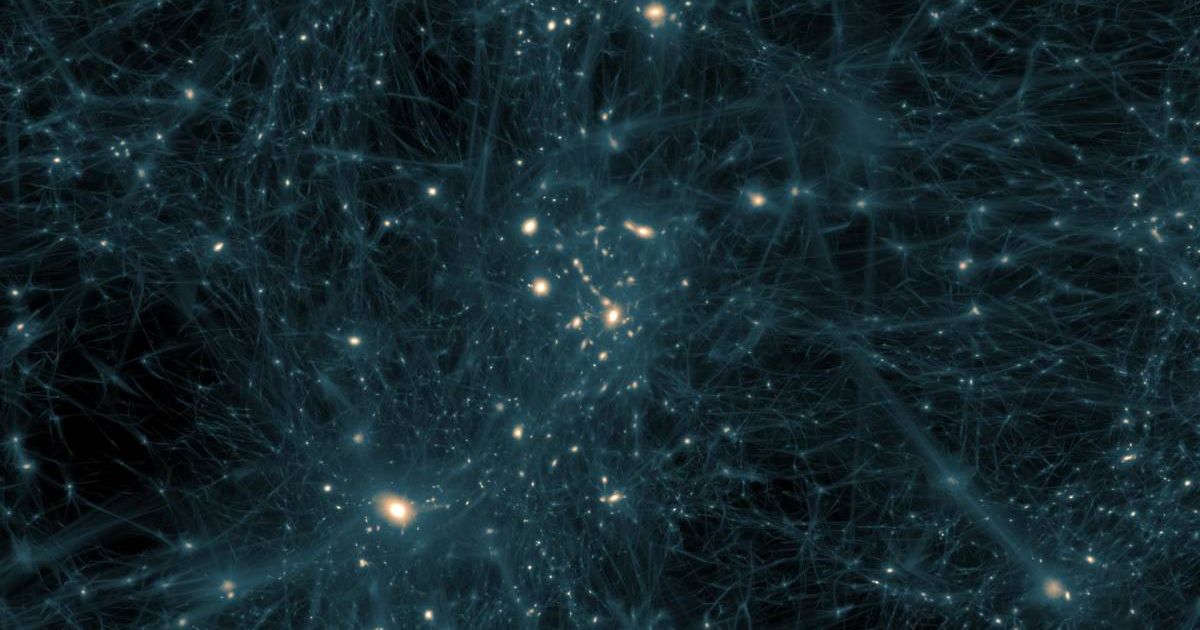
A groundbreaking theoretical study suggests that Dark Matter, the universe’s most mysterious component, may not be entirely "dark" after all. New research from the University of York proposes that this elusive substance could leave a subtle, detectable red or blue "fingerprint" on light, offering an unexpected new path in its long-running cosmic search, according to the University of York.
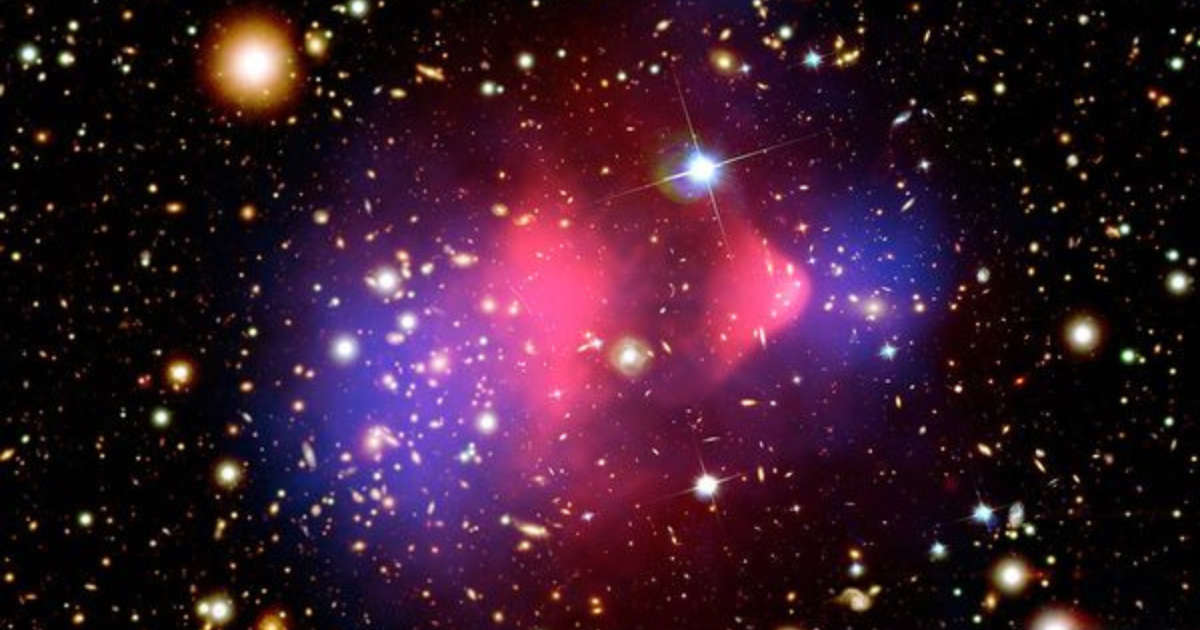
Dark Matter's existence has, until now, been inferred solely through its powerful gravitational pull, the unseen force that binds and shapes galaxies. The prevailing scientific consensus holds that Dark Matter does not interact with light, making it truly invisible. However, the York team's findings challenge this fundamental assumption. They suggest that as light traverses areas rich in Dark Matter, it may acquire a slight tint, shifting to the red or blue end of the spectrum depending on the type of matter encountered. Detecting this minute chromatic effect could revolutionize the hunt for the mass that dominates the cosmos.

The theoretical framework draws on an analogy to the "six handshake rule," proposing a similar chain of indirect connections among particles. Even if Dark Matter doesn't directly touch light, the researchers argue, it could influence it through intermediary particles. For instance, certain Dark Matter candidates, like Weakly Interacting Massive Particles (WIMPs), might connect to light via a sequence of interactions involving standard model particles, such as the Higgs boson and the top quark.
Dr. Mikhail Bashkanov, from the University of York's School of Physics, Engineering and Technology, acknowledged the unorthodox nature of the inquiry. "Most researchers would agree that Dark Matter is dark," Dr. Bashkanov stated, "but we have shown that even Dark Matter that is the darkest kind imaginable — it could still have a kind of color signature." The research has been published in the journal Physics Letters B.
Crucially, the study suggests this indirect "color" may be detectable under specific conditions using advanced observational equipment. "With the right kind of next-generation telescopes, we could measure it." Dr. Bashkanov explained. "That means astronomy could tell us something completely new about the nature of Dark Matter, making the search for it much simpler."

The research outlines how these indirect particle effects could be tested in future experiments, providing scientists with a new criterion to rule out or focus on specific Dark Matter theories. This approach could streamline multi-billion-dollar efforts currently dedicated to finding various Dark Matter forms, like WIMPs, axions, and dark photons. Dr. Bashkanov concluded that the results can "narrow down where and how we should look in the sky, potentially saving time and helping to focus those efforts.”
Understanding Dark Matter remains one of the greatest challenges in modern physics. Despite its sheer cosmic abundance, believed to make up around 80% of all matter in the universe, it has so far only revealed itself through its gravitational effects on visible objects, per Space.com. For decades, scientists have been spending significant resources searching the skies and building massive underground experiments designed to capture or indirectly observe this elusive substance.
More on Starlust
Physicists predict dark matter will doom the Universe to a catastrophic 'Big Crunch' soon