Cosmic collaboration: Hubble and Euclid show Cat’s Eye Nebula in intricate detail
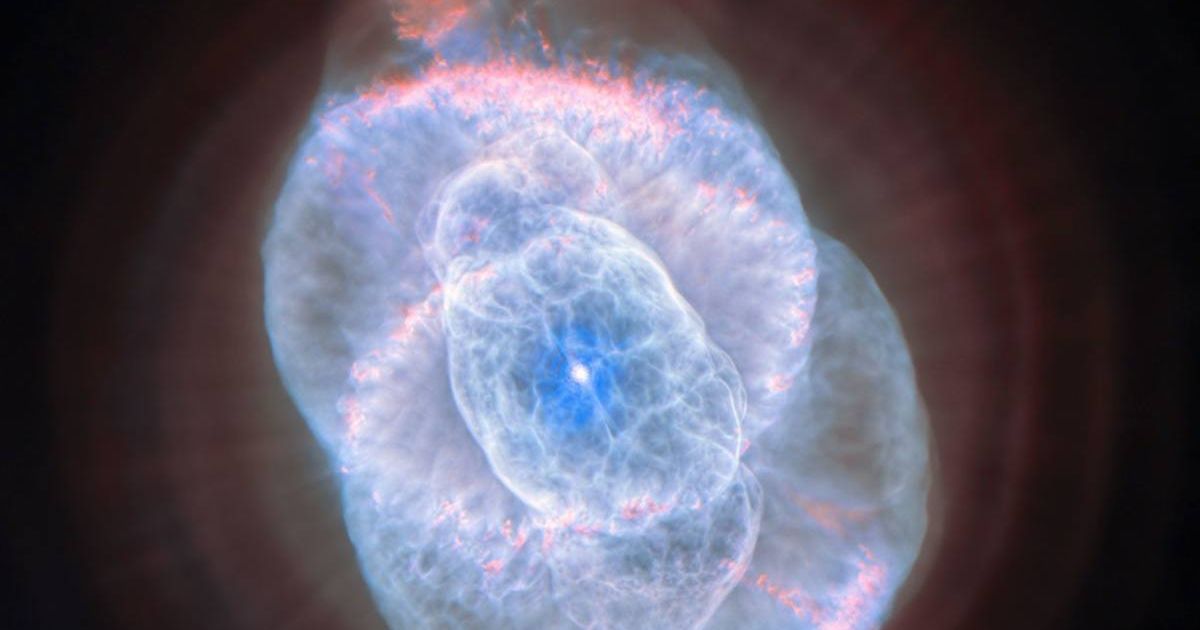
The Cat's Eye Nebula is located 4,400 light-years away in the constellation Draco.
In this new image, Hubble captures the very core of billowing gas of the Cat's Eye Nebula with the High Resolution Channel sub-instrument on its Advanced Camera for Surveys. (Cover Image Source: ESA/Hubble & NASA, Z. Tsvetanov)

NASA has released the latest images of the Cat's Eye Nebula (NGC 6543) captured by the NASA/ESA Hubble Space Telescope and the ESA’s Euclid Space Telescope. The images reveal the complexities of the planetary nebula, which the ESA's Gaia mission places 4,400 light-years away in the constellation Draco, in exquisite detail.
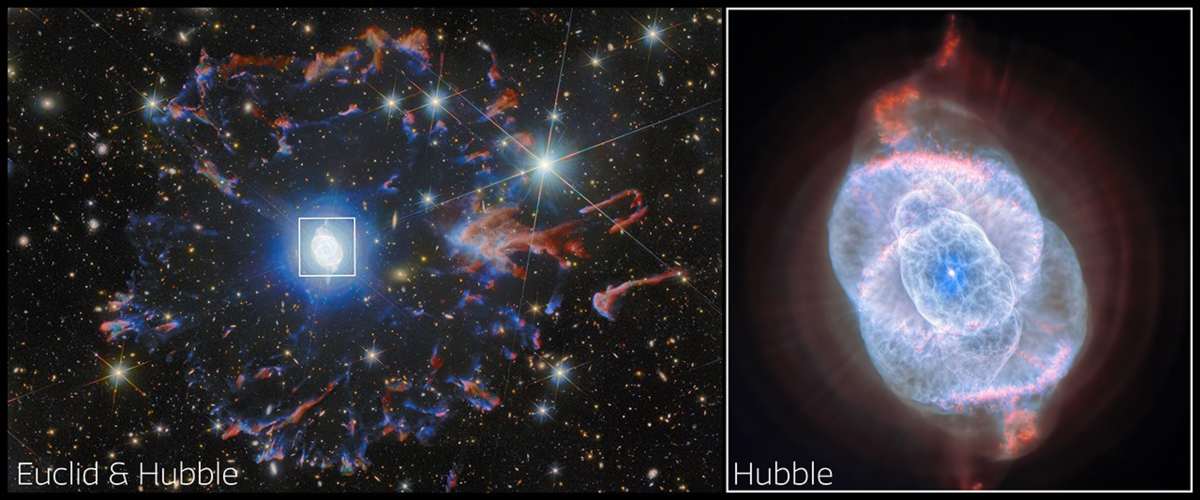
ESA/Hubble & NASA, ESA Euclid/Euclid Consortium/NASA/Q1-2025, J.-C. Cuillandre & E. Bertin (CEA Paris-Saclay), Z. Tsvetanov (Image Source: NASA)
The Cat's Eye Nebula as seen by Hubble and Euclid. [Image Source: ESA/Hubble & NASA, ESA Euclid/Euclid Consortium/NASA/Q1-2025, J.-C. Cuillandre & E. Bertin (CEA Paris-Saclay), Z. Tsvetanov]

Despite their name, planetary nebulae have nothing to do with planets. They are called so because they appeared spherical when they were viewed through early telescopes. In fact, they represent one of the dying stages of Sun-like stars. It is to the expanding cloud of gas given off by these stars that the structures owe their planet-like shape. This was revealed when the Cat's Eye Nebula, discovered in 1864, had its spectrum analyzed. The examination showed emissions from individual molecules typical of gas, hence distinguishing planetary nebulae from stars and galaxies. 
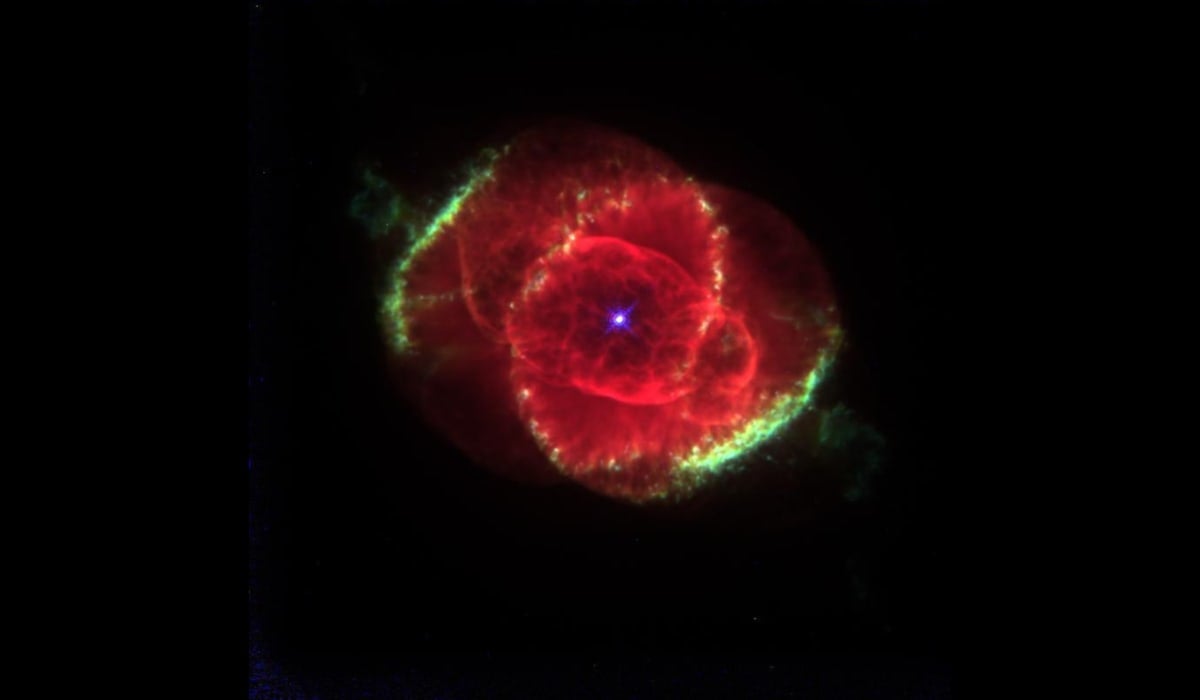
The planetary nebula NGC 6543, also known as the
The planetary nebula NGC 6543, also known as the "Cat's Eye Nebula," as seen from the Hubble Space Telescope Wide Field and Planetary Camera 2 on September 18, 1994. (Image Source: Corbis via Getty Images; Image Edited by Starlust Staff)

The Hubble Space Telescope, hailed as one of NASA’s most transformative observatories uncovering mysteries about the universe since 1990, has also revolutionized our conception of planetary nebulae, revealing the hidden complexities of their composition. This isn't the first time Hubble has imaged the Cat's Eye Nebula either. The Hubble images of the nebula released in 1995, in fact, brought never-before-seen intricacies of the structure into light, giving scientists a deeper understanding of how planetary nebulae are born.

The Hubble Space Telescope drifts through space in a picture taken from the Space Shuttle Discovery during Hubble's second servicing mission in 1997. (Representative Photo by NASA via Getty Images)
The Hubble Space Telescope drifts through space in a picture taken from the Space Shuttle Discovery during Hubble's second servicing mission in 1997. (Image Source: NASA via Getty Images)

The latest image taken by Hubble is no less impressive. In the new high-resolution visible-light image, Hubble has captured the core of the billowing gas. The data shows a pattern of concentric shells coupled with spurts of fast-moving gas and dense knots that have been shaped by shock waves. These structures are believed to record episodic mass loss from the dying star at the center, thus carrying with them remnants of the star's final days like a cosmic "fossil record." 

The Euclid Telescope, which is primarily designed to map the distant universe, managed to capture even the surroundings of the nebula. The nebula shines like a small, colorful dot in the center, while the backdrop glimmers with the light of faraway galaxies. Part of its deep imaging surveys, Euclid’s wide and near-infrared light and visible light view shows the arcs and filaments constituting the central region, situated within a radiating ring of colorful gas blowing away from the star, which was ejected at an earlier stage in the star’s evolution preceding the formation of the nebula's core. 
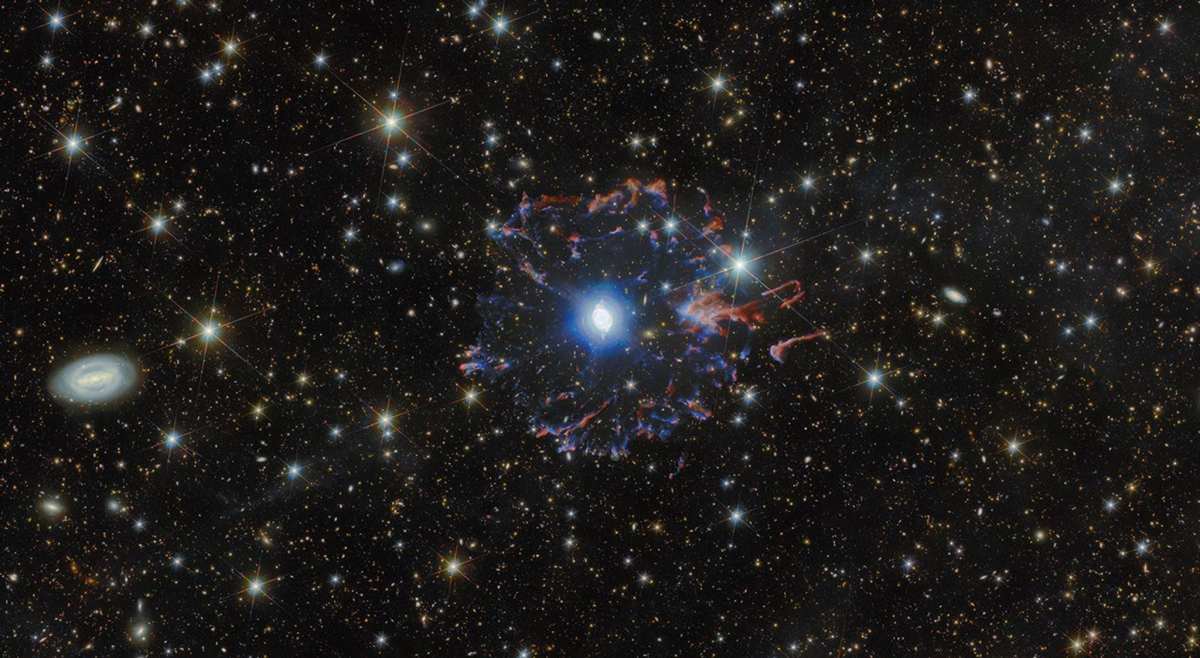
In Euclid’s wide, near-infrared, and visible light view, the arcs and filaments of the nebula’s bright central region are situated within a halo of colorful fragments of gas zooming away from the star.  
ESA/Hubble & NASA, ESA Euclid/Euclid Consortium/NASA/Q1-2025, J.-C. Cuillandre & E. Bertin (CEA Paris-Saclay), Z. Tsvetanov (Image Source: NASA)
In Euclid’s wide, near-infrared, and visible light view, the arcs and filaments of the nebula’s bright central region are situated within a halo of colorful fragments of gas zooming away from the star. [Image Source: ESA/Hubble & NASA, ESA Euclid/Euclid Consortium/NASA/Q1-2025, J.-C. Cuillandre & E. Bertin (CEA Paris-Saclay), Z. Tsvetanov]

These latest pictures of this cosmic eye enlighten us with a deeper understanding of the nebula’s structure and its formation process. It gives us a clear glimpse of the final stages of a dying star and the sheer beauty this phenomenon holds. The combined power of Hubble and Euclid’s deep field vision has enabled us to place these astronomical entities in the broader context of the universe. And it goes without saying that more such images will be taken by the two observatories and others that represent the endless curiosity of our civilization.

More on Starlust

NASA's Hubble Space Telescope detects a faint galaxy that is almost entirely dark matter

Researchers discover the most compact 3+1-type quadruple star system till date
MORE STORIES

Back in 2006, the International Astronomical Union (IAU) shocked the world by denying Pluto its planetary status.
2 hours ago
It will detect violent phenomena in our galaxy by directly capturing cosmic rays and gamma rays.
10 hours ago
The orbital period of an asteroid provides clues to the shortest path to the Red Planet.
1 day ago
NASA has invited people from all over the world to help support their Artemis program and future human space exploration through several citizen science projects.
1 day ago
'Binary stars were once seen as hostile environments for planet formation. What we're finding is that they can actually be extremely productive.'
1 day ago
The metal deposits date back to a time when Mars' climate was changing from wet to dry
5 days ago
Scientists have found that liquid-water habitable zones can overlap with ultraviolet habitable zones around low-mass stars.
5 days ago
Although Uranus possesses rings, they are not as structured and bright as the rings of Saturn. They are rather dark, narrow, and tough to study.
6 days ago
ISS Expedition 74 aims to boost space health and future medical breakthroughs on Earth.
6 days ago
Citizen scientists will look for warped spacetime using data from the European Space Agency's Euclid telescope.
7 days ago