Researchers discover the most compact 3+1-type quadruple star system till date
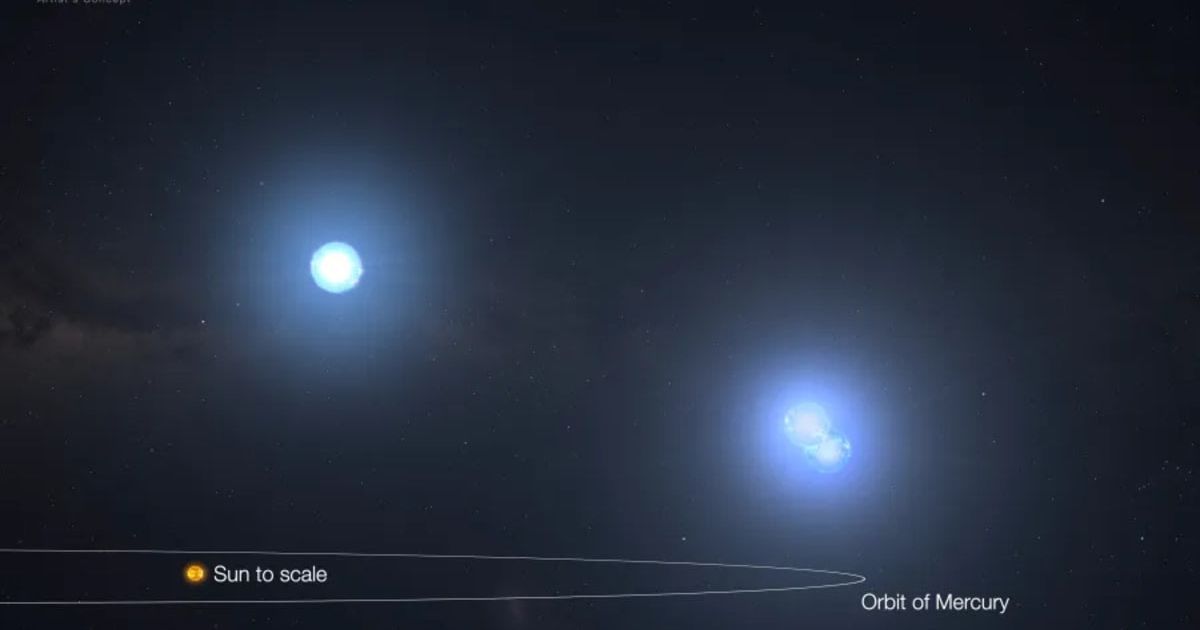
NASA’s Transiting Exoplanet Survey Satellite (TESS) has helped astronomers discover a strange and spectacular quadruple star system in the constellation Cygnus. This is the most compact 3+1-type star system detected so far. The astronomers who made the discovery also predict that this system of four stars will end its life as a binary system of two white dwarfs. The star system, named TIC 120362137, comprises three inner massive stars that are orbited by a fourth distant sun-like star. The inner stars could fit within an area of Mercury’s orbit around the Sun, whereas the distance of the outermost star to the triplet is around the same as that between Jupiter and the Sun. All the findings have been reported in a paper published in Nature Communications.

"By a simple inspection of the early TESS data, we realized that TIC 120362137 is a compact, tight, triply eclipsing triple star system," team leader Tamás Borkovits, a researcher at the University of Szeged, Hungary, told Space.com. TESS began tracking the star system in 2019 and continued till 2024. Initially, the researchers thought that TIC 120362137 is a pair of stars eclipsing each other every 3.3 days, dropping brightness for one to two hours. However, upon further inspection, the researchers detected 1-2 day-long extra fadings every 25 to 26 days, leading them to suspect that there is a third star that circles the binary. They found that the third star has an orbital period of around 51 days.
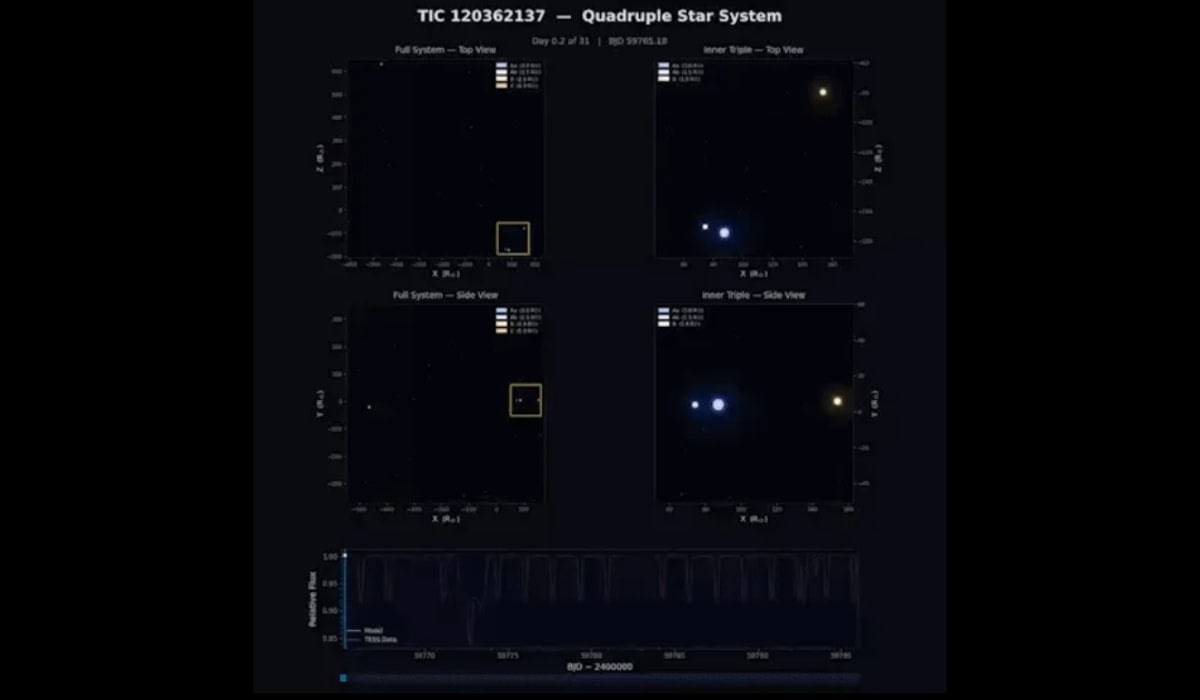
Having nailed down the presence of the third star, they still didn’t know what more was in store for them. Then they found further eclipses that couldn’t be possible without the presence of a fourth star. Their hunch was right. The Tillinghast Reflector Echelle Spectrograph (TRES) device on the Tillinghast telescope perched on Mt. Hopkins in Arizona captured signals from the fourth star. "TIC 120362137 is a record-holder in the sense that we found that the outermost star has an orbital period of only around 1,046 days, which is the shortest amongst all the currently known 3+1 quadruple stars by far," Borkovits said. As for some of the other characteristics of the system, the team found that the innermost stars are hotter and bigger than the Sun, while the outermost star is similar to the Sun in mass and temperature.

The team also speculated how the stars would evolve with time. "First, the most massive star, which is the primary component of the innermost binary, will reach the red giant state. In that state, it will merge with its mate, the secondary star of the innermost binary. We call this daughter stellar body A," Borkovits said. "Then, in around 276 million years, in a second step, this new, merged star A will merge with the third stellar component, star B, when both stars have reached the red giant stage. We call this massive new star AB." Thereafter, star AB will lose a huge portion of its mass, becoming the first white dwarf, while the outermost star will become the second white dwarf in the system after undergoing a similar process. With the help of models, the researchers further predict that two white dwarfs will have an orbital period of 44 days.
More on Starlust
A brown dwarf may have dimmed a star in what was one of the longest eclipses ever
An invisible explosion rivaling a billion suns vanished in space—until its trace reached Earth