Comet C/2025 R2 (SWAN) to make its closest approach to Earth on October 20—here's how to spot it before the big day

Comet C/2025 R2 (SWAN) is currently headed toward a close approach with Earth on October 20, 2025, marking its nearest pass this century. On that day, it will soar within within approximately 39 million kilometers (0.26 Astronomical Units) of our planet, as per Sky Live.
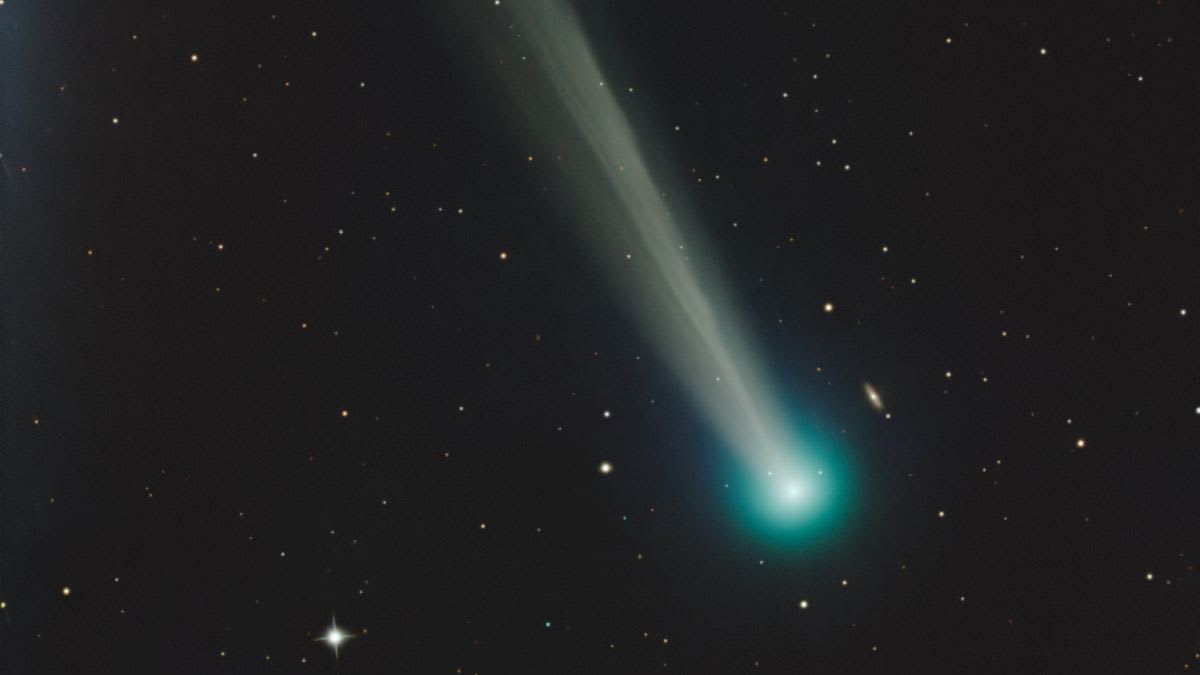
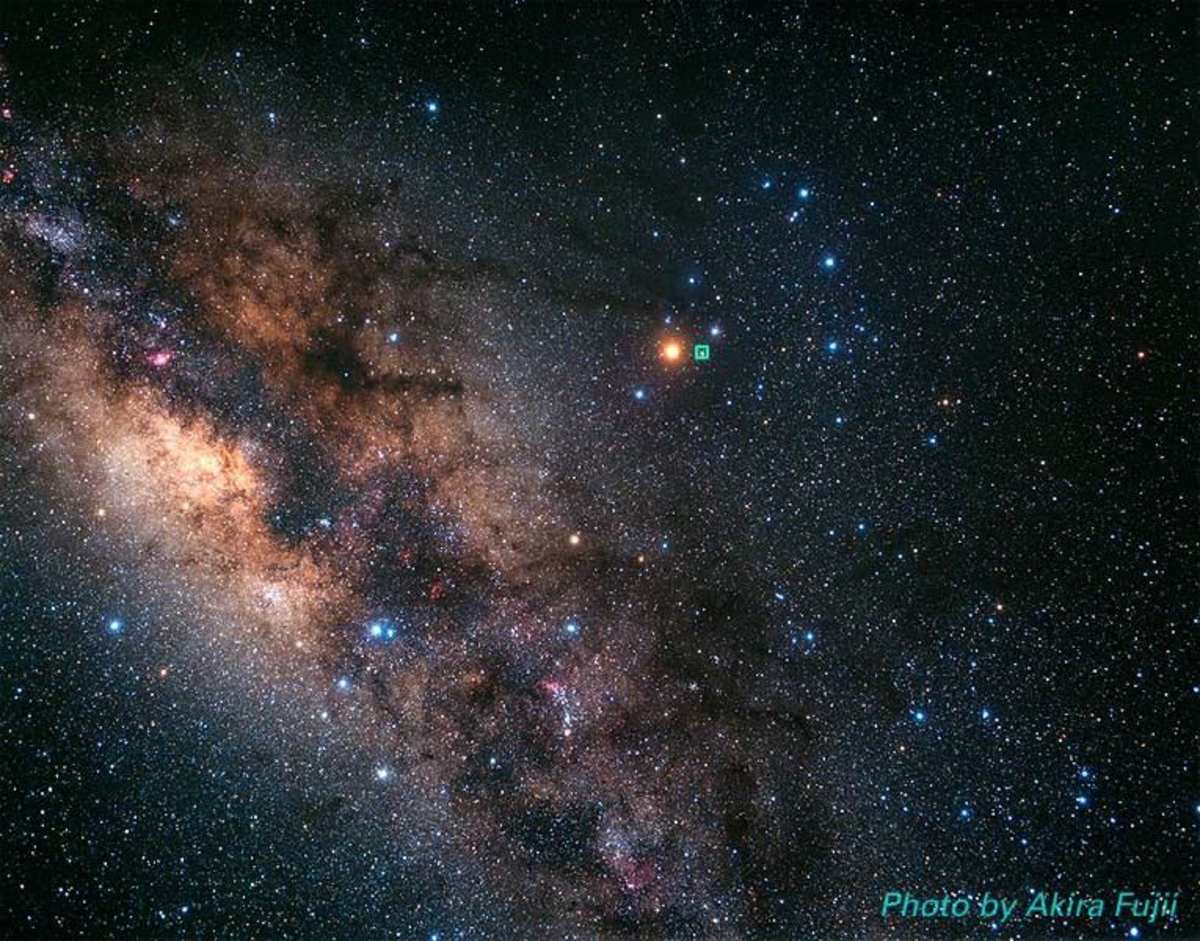
The comet is currently positioned in the constellation Scorpius. As of today, C/2025 R2 (SWAN) is approximately 49.5 million kilometers away from Earth. According to COBS, its an absolute magnitude of 8.8. The comet is considered a relatively faint object, meaning it is highly unlikely to be observable with the naked eye and will require the aid of small telescopes or binoculars for viewing. Astronomers can use its current coordinates (at the time of writing the article), a Right Ascension of 16h 13m 44s and Declination of −16∘41’04” to track its position, according to Sky Live.
The comet's trajectory is highly distinctive. Its orbit is extremely elongated, with an eccentricity (e) of 0.993, making its path appear nearly linear rather than circular, per COBS. At its closest point to the Sun, the comet swings within approximately 0.5 AU, a distance closer than the average orbital distance of Venus. Its vast orbit has a semi-major axis (a) of 76.5 AU, resulting in an immense orbital period of roughly 670 years to complete a single journey around the Sun.
To assist observers tracking the comet leading up to its peak on October 20, 2025, COBS has provided precise coordinates. The comet, which was discovered in September, is already nearing the threshold of human vision. On October 10, the comet reaches a temporary close distance to Earth of 0.802 AU, hovering on the edge of naked-eye visibility at an estimated magnitude of 6.0. Its coordinates on this day are approximately 16h 05m Right Ascension and −16.5∘ Declination. Over the next two days (October 11–12), its brightness improves slightly to Magnitude 5.9, placing it in clear naked-eye territory for those with dark skies. This increase in brightness occurs despite its slightly increasing distance from Earth, as it rapidly drops to less than 0.32 AU from the Sun.
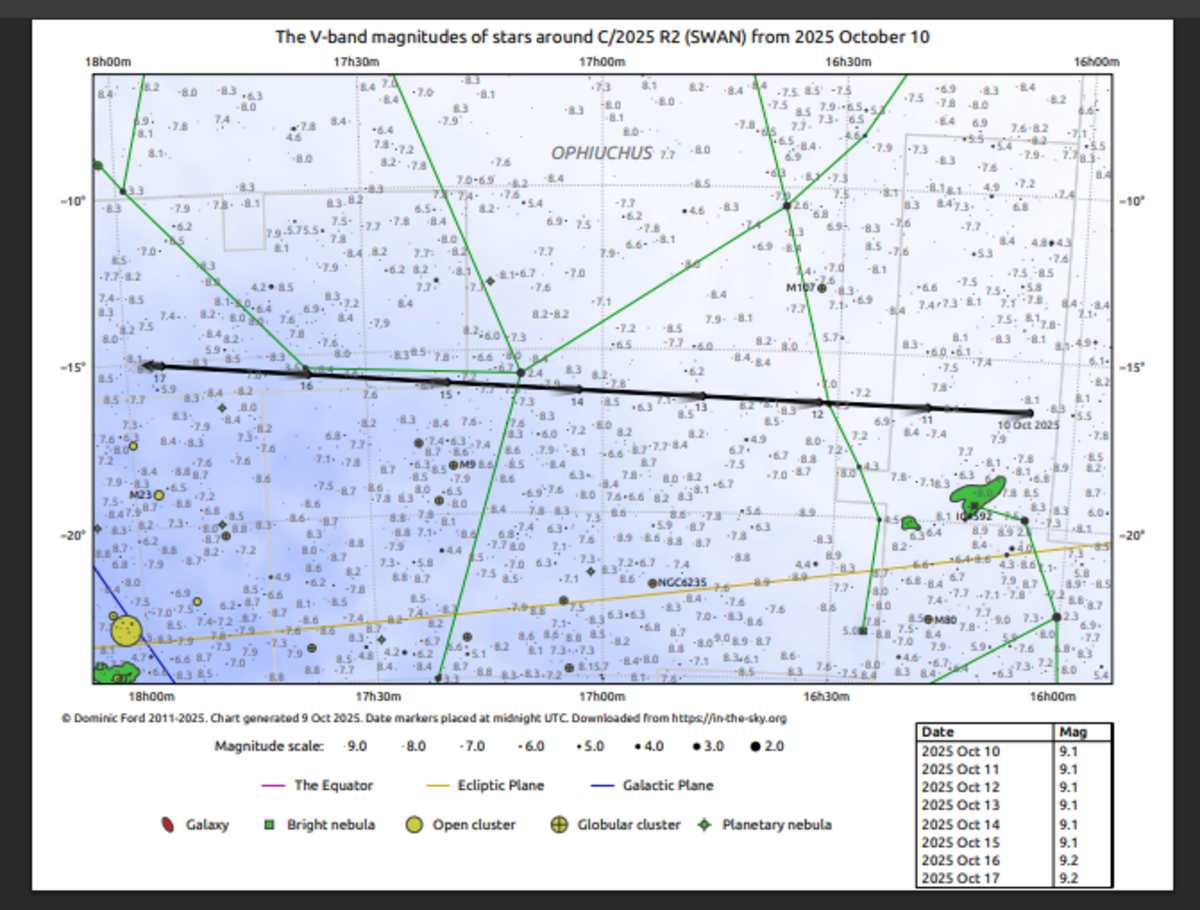
The final week leading up to the main flyby is characterized by stable brightness and increasing speed. By October 13, the comet's brightness stabilizes at Magnitude 5.8, where it remains for the rest of the viewing window. Its motion across the sky becomes noticeably swift, exceeding 9 arcseconds per minute.

Between October 14 and 16, the comet continues its rapid descent toward the Sun, passing the quarter-AU distance mark. Its angular velocity continues to accelerate, peaking at 12.013 arcseconds per minute around October 20. This peak speed is significant, translating to the comet covering a distance equivalent to the Moon's diameter in the sky every 2.5 hours, a motion that will be readily apparent when viewed through a tracking telescope. During this time, the comet's position shifts significantly northward, passing through constellations like Sagittarius and moving from a Declination of −15∘ to −12.9∘.
More on Starlust
Comets C/2025 K1 ATLAS and C/2025 R2 SWAN appear to 'race' each other in extraordinary sky moment