Artemis II to return to Earth soon: When and how to watch re-entry and splashdown on April 10

The Artemis II mission is nearing its completion with splashdown in the Pacific Ocean slated for 8:07 pm EDT today (April 10). Having already completed lunar reconnaissance and obtained a great deal of scientific data, the success of the mission now comes down to the safe return of the flight crew. The crew members are currently asleep, but when they wake up, their primary focus will be to complete preparing the spacecraft for a lofted re-entry procedure, where it will skip over the atmosphere to some degree before heading for splashdown. This stage, too, like the rest of the mission, will be streamed live by NASA.
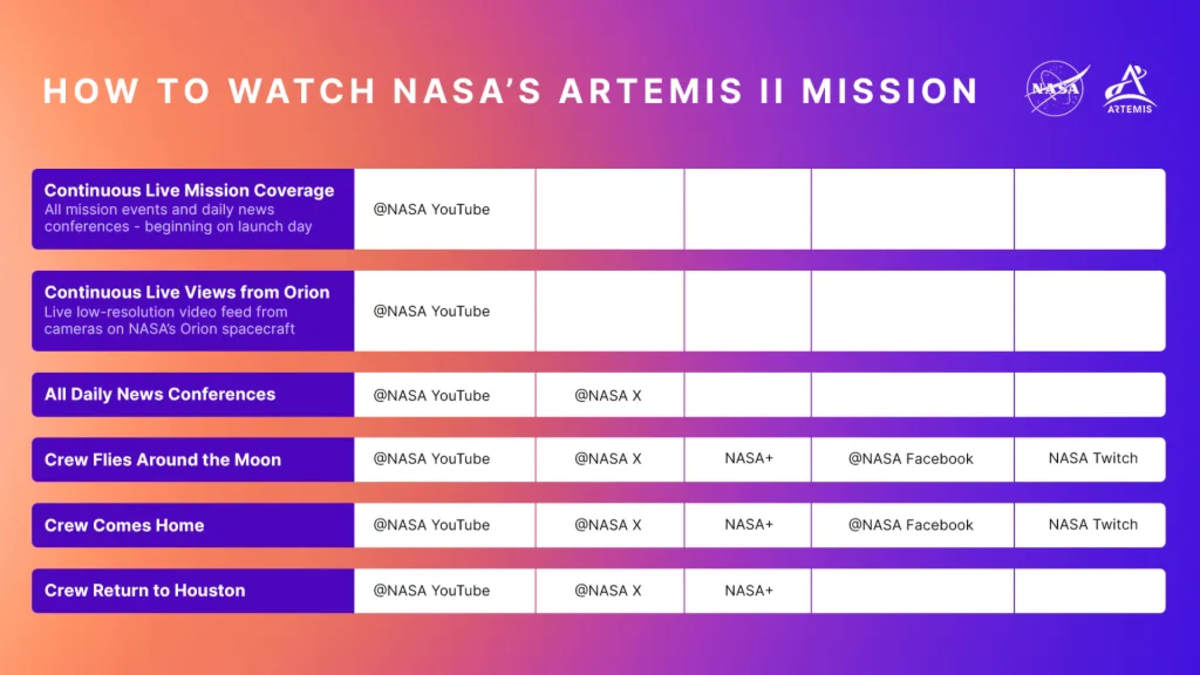
The live stream of the event will begin at 6:30 pm EDT and will run until NASA and the U.S. Department of War have safely transported all four crew members to the USS John P. Murtha. Besides NASA’s YouTube channel, coverage will also be available on NASA+, Amazon Prime, Apple TV, Netflix, HBO Max, Roku, Peacock, and Discovery+. The stream of the astronauts’ return to Earth will also be available across the social media handles of NASA.
“This is a relay race.”
— NASA Artemis (@NASAArtemis) April 9, 2026
Mission specialist Christina Koch describes how the Artemis II astronauts have not only been focused on their mission — but on all future Artemis missions, which will build on their lessons learned and successes. pic.twitter.com/lXTOCk9Onv
NASA will have a keen eye on the weather near the coast of San Diego in California. Wind, precipitation, and wave height and frequency are the things to watch out for. On day 8 of the mission, Rick Henfling, Artemis II entry flight director, had notified the media about an encouraging weather forecast, though. A news conference in the aftermath of the recovery of the astronauts will also be held at 10:35 pm at Johnson Space Center in Houston. Mission managers can be expected to address media questions about the health of the Moon-voyaging astronauts and the performance of the spacecraft during its fiery re-entry. A detailed catalog of Artemis II mission updates exists to provide added context for those interested. Photographs taken by the astronauts as well as by the solar array-mounted cameras on Orion are available to be viewed as well.
Our Artemis II astronauts are headed back to Earth after their test flight around the Moon.
— NASA (@NASA) April 9, 2026
Listen to the latest episode of our Curious Universe podcast to learn how we'll bring the crew home: https://t.co/5c0wToicQW pic.twitter.com/OKlTEeLAS1
To have an even better understanding of the status of the mission, the public has also had the provision to learn the exact location of the spacecraft relative to theirs, its velocity, and its distance from the Moon as well as from Earth with the help of the Artemis Real-time Orbit Website (AROW). It is available both as a website and as a mobile app. It also shows the path taken by the Orion spacecraft thus far as it set a new record for carrying humans farther than anyone has ever been away from our planet. The software, however, will stop tracking the mission after Orion enters our atmosphere.
More on Starlust
Will the helium leak in Orion affect Artemis II's re-entry? Here's what NASA says
Artemis II crew names Moon craters “Integrity” and “Carroll” in tribute during lunar flyby